
How to Use VHF Radio Effectively in Crowded Ports
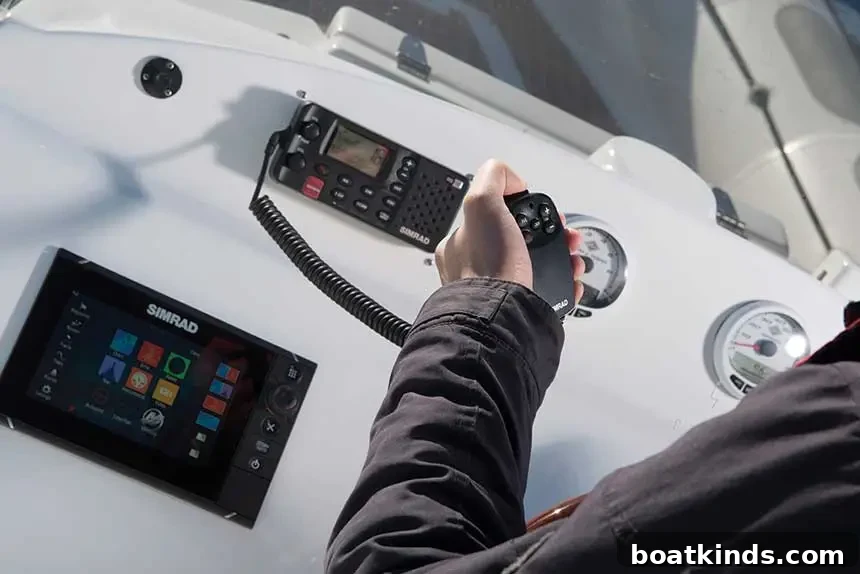
Boating on wide open water is straightforward: you can often rely on sight and simple signals. But when you enter a congested harbor or navigate near commercial shipping lanes, situational awareness and competent VHF radio use become essential. Understanding how to listen, interpret, and communicate on the VHF will make you a safer skipper when sharing the water with larger commercial traffic.
Capt. Michael Carr, with more than 40 years of experience running commercial and government vessels, emphasizes a few practical principles every recreational boater should follow when VHF traffic is heavy. First and foremost: know your exact position at all times. Be able to identify the buoy you’re nearest to, the channel you are in or crossing, and the closest point of land. This positional awareness forms the basis for clear radio communications and safe decision-making.
Once you know your location, use it to orient yourself relative to commercial traffic. Carr suggests visualizing where you are in space and time compared to the larger vessels that call their movements on VHF. When a commercial ship announces, for example, “Outbound making 23 knots approaching Chesapeake Bay Bridge-Tunnel North Island,” that call conveys speed, direction, and a limited window for maneuvering. Translate those words into a mental picture of where that ship will be in the next few minutes and whether your course intersects its path.
Always correlate radio calls with what you see visually. Look around and identify the vessel that matches the call. Confirm that the running lights, aspect and bearing correspond to the radio report. If you’re uncertain which ship is speaking or whether your assessment is correct, communicate with nearby recreational vessels or make a concise radio call to clarify the situation. Don’t guess—ask.
If you determine your position is relevant to a commercial vessel’s passage, prepare a clear, succinct transmission that states your identity, exact position, intent and the channel you’re monitoring. For example: “M/V Vittone, this is S/V Carr, 2.5 miles off your port bow in the vicinity of green buoy 7. I am sailing southwest, will slow, remain outside the channel and allow you to pass before I cross Thimble Shoal Channel. S/V Carr standing by on channel 13.” That level of detail helps the ship’s bridge team make safe decisions and reduces ambiguity.
Capt. Carr also recommends using the OODA loop—observe, orient, decide, act—to maintain a continuous mental picture. Constantly scan the horizon, monitor VHF traffic, cross-reference charted information, and be ready to adapt as new information becomes available. If entering a busy harbor, consult published pilotage resources such as the United States Coast Pilot, and monitor both channel 13 (pilot/working channel in many areas) and any posted pilot board or Vessel Traffic Service (VTS) frequencies.
Capt. John Konrad, Master Unlimited Oceans and founder of gCaptain.com, stresses that professional mariners keep their radios on continuously; recreational boaters should adopt that habit while underway. Channel 16 is the international hailing and distress channel and should be monitored. Important safety broadcasts—pan-pan, Mayday, and sécurité—are often missed by skippers who only tune in intermittently. For practical onboard setup, Konrad suggests running at least one radio on channel 16 and another on the local working frequency so you don’t miss urgent calls while communicating on the working channel.
Konrad also advises familiarizing yourself with the low-power (1-watt) transmit function on handheld and fixed VHF radios. Using full transmitting power for a short-range call, such as signaling a nearby launch or another small vessel, can broadcast your message over many miles and clutter the channel, potentially confusing other users. Use handheld units or the low-power switch when communicating with nearby traffic, and reserve higher power for when greater range is necessary.
Good VHF practice includes concise language, correct vessel names, precise positions, and a calm tone. Avoid broadcasting unnecessary commentary that creates channel congestion. When in doubt about obligations or right-of-way, refer to COLREGS (the International Regulations for Preventing Collisions at Sea) and make a clear statement of your intentions that other mariners can understand and respond to.
In busy waterways, combining strong situational awareness, professional radio habits, and respectful communication will keep you safer and help larger commercial vessels manage their constrained maneuvering room. Monitor the correct channels, correlate calls with what you see, use low-power transmissions near other small craft, and make concise, informative calls when your vessel’s position is relevant.
This article originally appeared in the June 2019 issue.