
Let’s take a 45-foot DWL yacht.
The commonly used rule of thumb for estimating the theoretical maximum hull speed of a displacement hull is 1.34 times the square root of the waterline length (DWL or LWL) in feet. This formula gives a practical upper limit for a displacement hull before it begins to climb its own bow wave and requires disproportionate power to gain additional speed.
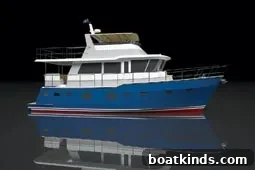
Using that rule, the square root of a 45-foot waterline is about 6.7. Multiply 6.7 by 1.34 and you get roughly 8.9 knots as the theoretical maximum hull speed for a 45-foot displacement waterline. In practice, a well-designed, efficiently powered 45-foot displacement yacht will cruise comfortably and economically a little below that number—typically in the 7.5 to 8.0 knot range—where engines run at efficient RPMs and fuel consumption is minimized. For that efficient cruising speed the example boat would commonly be powered by about 450 horsepower at a cruise setting that balances speed and economy.
A few important caveats follow. First, hull type makes a big difference. A lighter, semi-displacement or planning hull can exceed the classical displacement-hull limit, but it generally requires much more horsepower to climb onto the plane. Designers sometimes use a simplified multiplier to contrast these regimes: whereas displacement hull speed follows the 1.34 × sqrt(LWL) rule, higher-speed hulls will achieve significantly higher speeds for the same waterline by using more power and different hull shapes. The trade-off is obvious—more speed means more installed horsepower and higher fuel burn at speed.
The physics behind displacement hull speed is tied to the wave system the hull creates. A displacement hull moves through the water creating a bow wave and a stern wave; the effective limit occurs when the distance between the crest of the bow wave and the crest of the stern wave approaches the waterline length. The larger that distance relative to the hull, the higher the speed the hull can sustain before resistance rises sharply.
Real-world examples help illustrate these points. A modern 52-foot long-range fast explorer hull looks similar in profile to a traditional trawler but incorporates propulsion and hull features that allow it to achieve higher speeds. With larger engines and hull refinements it can partially plane or operate in a semi-displacement mode, whereas a traditional ocean trawler is optimized for steady, fuel-efficient displacement cruising at modest speeds.
Consider a 60-foot heavy-displacement boat weighing around 200,000 pounds. In practice such a vessel is often most economical around 8 to 9 knots when driven by twin engines in the 260-horsepower range. The theoretical maximum for that waterline, by the 1.34 × sqrt(LWL) rule, would be roughly 10 knots. However, thoughtful naval architecture changes—such as a specialized bulbous bow form, tapered or modified aft lines leading to the transom, and twin screw installations with skegs spaced outward—can yield measurable gains. In one configuration, those refinements increased hull speed by roughly 18 percent, raising the effective top end to about 11.8 knots without resorting to extreme increases in installed horsepower.
For owners and designers, the practical takeaway is straightforward: heavy-displacement vessels are most efficient when operated at speeds below their theoretical maximum—commonly around 20 percent under that top estimate. Running in this sweet spot reduces fuel consumption, limits engine stress and vibration, and provides a more comfortable ride at sea. If higher transit speeds are critical, selecting a lighter, semi-displacement or planning hull and accepting the higher horsepower and fuel requirements will deliver the speed, but with a different set of operational compromises.
Hull design decisions—waterline length, hull form, bow shape, stern profile, propulsion arrangement—should therefore be made with the intended mission in mind. Long-range cruising favors efficient displacement characteristics and modest, steady speeds; fast passages or quick coastal hops favor semi-displacement or planning forms and larger powerplants.
See related stories:
– Cracking the trawler code
– Stabilized or not?
This article originally appeared in the June 2010 issue.