MV Golden Ray Salvage: How the Capsized Car Carrier Is Being Recovered
In September 2019 the MV Golden Ray, a 660-foot car carrier loaded with more than 4,000 vehicles, capsized in St. Simons Sound off Brunswick, Georgia. The immediate priority was life and environmental safety: a Donjon-Smith salvage team quickly rescued four engineers who had been trapped in the engine room and removed roughly 320,000 pounds of fuel oil from the vessel to reduce pollution risk. Since that initial response, the long and technically complex salvage effort has focused on removing the ship’s hull from the sound in a series of controlled operations.
Phased Salvage Approach
Salvage teams have proceeded methodically, dividing the recovery into distinct phases to manage risk and protect the local environment and waterways. After securing the site and stabilizing what remained of the vessel, crews evaluated options for removing the wreckage. Because of the ship’s size and the volume of cargo trapped inside the hull, cutting the ship into manageable sections became the chosen method. Breaking the hull into sections reduces the hazards of lifting a single massive structure and allows for incremental removal and inspection.
Chain-Cutting Technique and Heavy-Lift Equipment
T&T Salvage, a Texas-based company working on the operation, has used a large, purpose-built lift vessel — the Versabar VB-10000 — to perform the cuts. The VB-10000 is a dual-barge crane platform with a rated capacity of 7,500 tons, giving salvage engineers the lifting capability needed to handle extremely heavy sections of the ship as they are severed.
The cutting method involves feeding a heavy steel chain along the underside of the sunken hull via a pulley system attached to the lift vessel. The chain is drawn back and forth while abrasive action and grinding cut through the ship’s structure. Reported cutting rates are on the order of seven feet per minute, a deliberate pace that balances efficiency with the precision necessary to avoid uncontrolled collapse or additional environmental risk.
Sectioning the Hull
The full salvage plan calls for the hull to be cut into eight sections. Each resulting block will be extremely heavy, with estimated weights ranging from approximately 2,700 to 4,100 tons per section. Cutting such large pieces from a capsized and partially submerged hull requires careful structural analysis, detailed lifting plans, and close coordination between divers, riggers, and crane operators to ensure that each piece can be safely raised, stabilized, and transferred to barges or other transport platforms.
Revealing the Cargo and Ongoing Work
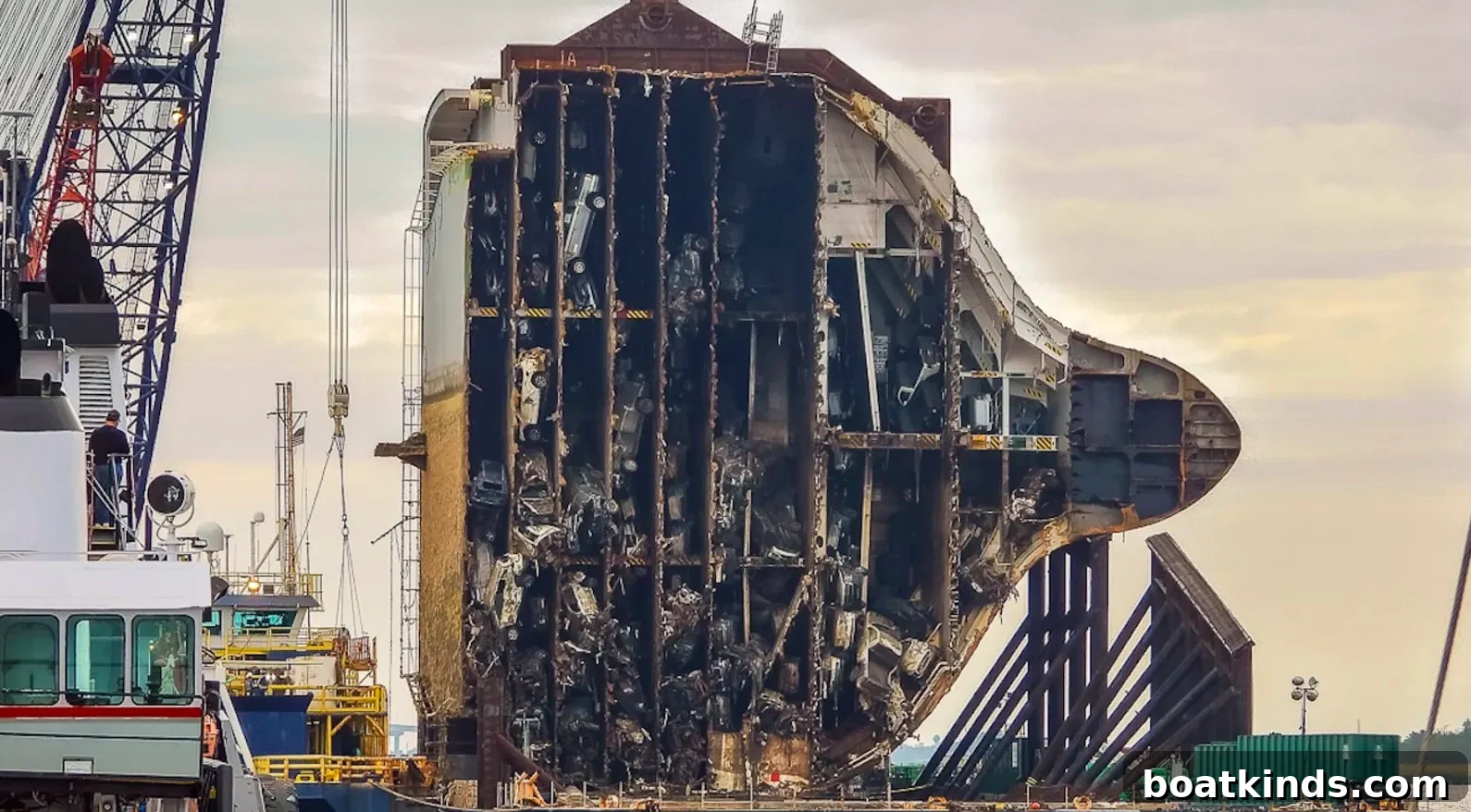
When a substantial portion of the ship was cut away in November, salvage crews revealed the interior of the capsized hull and the thousands of vehicles that had been trapped inside. That discovery underscored the scale of the logistical challenge: not only must heavy steel sections be severed and removed, but crews must also account for the large volume of cargo and ensure it is handled in a manner that limits further environmental risk and navigational hazard.
The operation remains ongoing. Salvage specialists continue to sequence the cuts, lift each section with heavy-lift plant, and manage the complex safety and environmental controls that accompany such a high-profile marine recovery. The work draws on specialized skills in underwater cutting, marine engineering, heavy lifting, and environmental protection.
Context and Coverage
The initial phases of the response, including the engine room rescue and fuel removal, drew attention from maritime publications and the wider boating community. Subsequent coverage has followed the step-by-step dismantling and removal of the hull as teams continue their careful, staged work in St. Simons Sound.
Removing a capsized car carrier is among the most challenging salvage operations undertaken in coastal waters. The combination of heavy equipment like the Versabar VB-10000, the chain-cutting technique, and a phased plan to cut the hull into multiple sections exemplifies how modern salvage operations address both safety and environmental concerns while working to clear a major navigational obstruction.