
Black Maritime Heritage of the Chesapeake Bay
The Chesapeake Bay, the largest estuary in the United States, has long been the economic and cultural heart of the Mid-Atlantic’s maritime life. Too often, the central role that Black people played in building and sustaining that maritime economy is minimized or overlooked. From skills brought from West Africa to innovations developed on the bay itself, Black labor, knowledge and ingenuity were foundational to the region’s fisheries, boatbuilding trades and waterborne commerce.
Enslaved maritime skills and early recognition
Enslaved Africans arrived in the Americas with generations of maritime expertise: boatbuilding techniques, net-making, oystering, crabbing, seamanship and knowledge of tidal waters. Those skills were eagerly exploited by white merchants and shipowners. By the late 18th century, the federal government recognized sailors’ needs in a way that sometimes worked to the advantage of Black mariners: in 1796, Seamen’s Protection Certificates began to be issued. These documents provided Black seamen with legal protection similar to that offered to white sailors and, in many cases, functioned as de facto free papers long before Emancipation.
The Chesapeake and the Underground Railroad
The waterways of the Chesapeake Bay also became important routes in the struggle for freedom. The bay and adjacent rivers formed part of the complex network known as the Underground Railroad. Abolitionists, free Black communities and sympathetic mariners used houses, docks and vessels as safe passage for people escaping bondage. Many enslaved people fled by boarding coastal ships or small craft that crossed rivers such as the Potomac, blending into the workaday presence of watermen and fishermen. In at least one recorded instance, Frederick Douglass successfully escaped slavery with papers that included a Seamen’s Protection Certificate, demonstrating how maritime credentials could be used to obtain freedom.
Work on the water after Emancipation
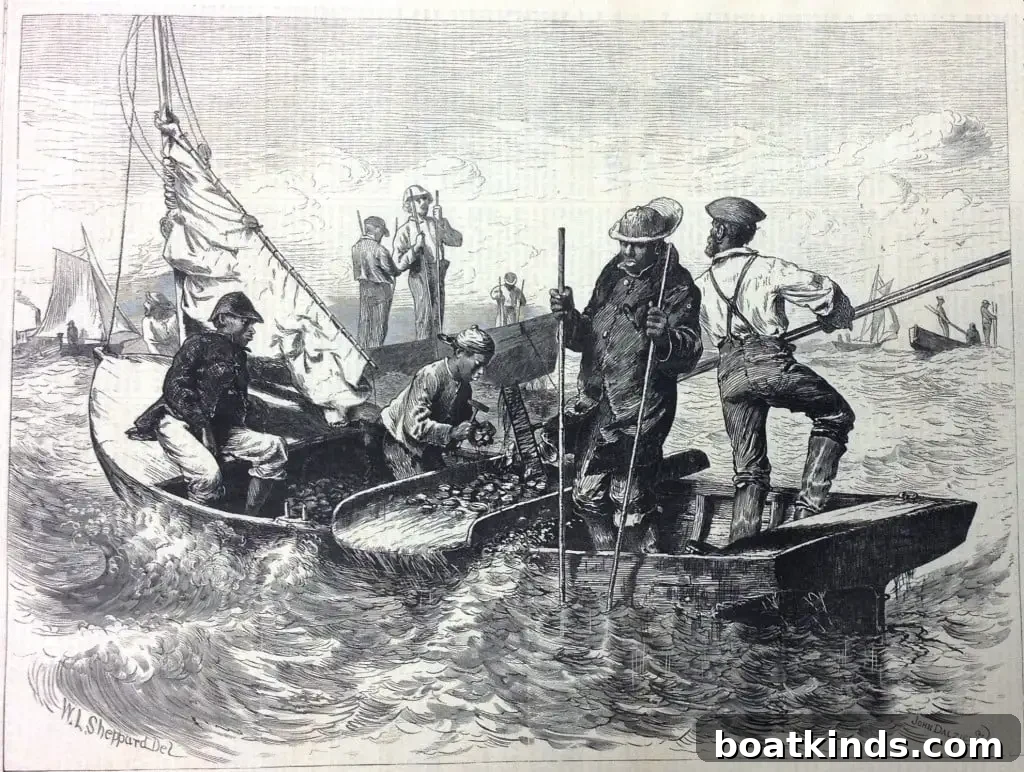
After Emancipation, newly freed Black men and women gravitated to maritime trades that matched their inherited and practiced skills. They worked as sailors, captains, crew, boatbuilders, oystermen, crabbers, seafood processors and longshore laborers. These occupations offered steady work and often allowed Black families to build independent communities centered on the water. Many of those communities still exist along the Chesapeake shoreline and rivers.
Innovation and legacy
Black maritime workers were not only laborers but also inventors and innovators. The multiple-log canoe, a recognizable symbol on the bay today, traces its construction back to an enslaved boatbuilder known as Aaron of Your County, Virginia. Techniques and boat forms developed by Black craftsmen helped shape the utilities and efficiency of regional watercraft. Frederick S. Jewett, a Black innovator, developed the crab grading system—backfin, claw, lump—that continues to structure how crabmeat is processed and marketed in the Chesapeake region.
By the mid- to late 19th century, the Chesapeake Bay emerged as the nation’s main oyster supplier. Black oystermen often outnumbered their white counterparts, and oystering became a comparatively lucrative avenue for economic advancement. The thriving oyster trade supported associated industries—boatbuilding, shucking houses, packing plants and coastal trade—that further anchored Black communities along the waterways.
Community, continuity, and cultural importance
The concentration of maritime jobs allowed Black families to form strong, interdependent neighborhoods with distinctive cultural and economic patterns tied to the water. Those communities produced generations of skilled watermen, captains and craftspeople who passed their knowledge down through families and apprenticeships. That continuity helped preserve maritime traditions born in African and African American experience and adapted to the unique environment of the Chesapeake.
Today, acknowledging this history matters for more than correction of the record. It illuminates how the Chesapeake’s thriving marine economy depended on Black expertise, labor and innovation. From boatbuilding and net-making to oystering, crabbing and navigation, the contributions of Black people fueled the region’s trade and culture. Understanding that legacy strengthens appreciation for the Chesapeake Bay’s maritime heritage and the communities that continue to sustain it.