
Donald Baxter MacMillan and the Arctic Schooner Bowdoin
They don’t make foul-weather gear like this anymore. Pictured here is Arctic explorer Donald Baxter MacMillan aboard his schooner Bowdoin, wearing the confident, ready expression of a man accustomed to cold seas and difficult voyages.
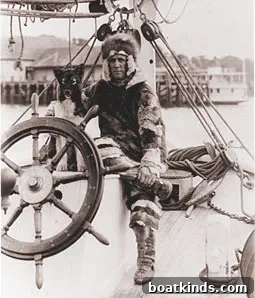
Donald Baxter MacMillan was born in 1874 in Provincetown, Massachusetts, into a Cape Cod seafaring family. Although his father was lost at sea while MacMillan was still a boy, the sea remained central to his life. After graduating from Bowdoin College in Maine in 1898, he established a school for seamanship and navigation, training young mariners and sharpening his own skills as a navigator and leader.
MacMillan’s aptitude for northern travel brought him to the attention of famed Arctic explorer Robert Peary, who invited him to join an expedition in 1908. That voyage set the tone for MacMillan’s career: he would spend the remainder of his life voyaging north, leading and participating in numerous Arctic expeditions and developing an intimate understanding of the demands of polar work.
It was during one of those expeditions, after being caught in ice, that MacMillan conceived the idea for a purpose-built vessel able to withstand the unique hazards of Arctic seas. He wanted a small, sturdy, and highly maneuverable ship—one that could take the physical punishment of ice and still give a captain the control needed in narrow channels, pack ice, and unpredictable weather.
The result was the schooner Bowdoin, designed by William H. Hand of New Bedford, Massachusetts, and built by the Hodgdon Brothers shipyard of East Boothbay, Maine. Launched in 1921, the 88-foot, two-masted auxiliary schooner was described in its day as “small but strong,” a succinct summary of a vessel engineered for rugged service rather than speed or luxury.
Bowdoin’s construction reflected a focus on toughness and survivability. The hull was double-planked and double-oak-framed for exceptional strength. A massive ice fender made of Australian greenheart encircled the hull at the waterline, providing added protection where the ship met the ice. A steel-plate nosepiece weighing 1,800 pounds was bolted to the bow to reinforce the forward structure. The schooner’s rudder was deliberately oversized to enhance maneuverability in ice-packed waters, and the hull was shaped to be rounded so that, if the ship were beset by ice, it would tend to rise out of the pack rather than be crushed inward.
Over the course of more than three decades, Bowdoin proved the soundness of that design. The schooner made 26 voyages north of the Arctic Circle, covering more than 300,000 miles in cold, demanding conditions. Those voyages established Bowdoin’s reputation as one of the sturdier and more reliable small vessels built specifically for polar exploration and scientific work.
Today, after a careful restoration that preserved her character and seaworthiness, Bowdoin serves a new generation of mariners and students. The fully restored schooner is based at the Maine Maritime Academy in Castine, where she is used as a training vessel. There, the Bowdoin continues to teach seamanship, navigation, and the practical lessons of life afloat—linking modern maritime education with the legacy of early 20th-century Arctic exploration.
William H. Hand’s design, the Hodgdon Brothers’ workmanship, and MacMillan’s practical vision combined to produce a craft that met the harsh realities of polar travel without excess. The Bowdoin remains an enduring example of how thoughtful naval architecture and robust construction can extend the capabilities of a small vessel, enabling it to operate safely where lesser ships could not.
January 2013 issue