
Investigating Boat Fires: Insights from a Marine Fire Investigator
Daniel K. Rutherford has spent three decades as a certified marine investigator, examining boat fires, explosions, sinkings and disappearances at sea. His role is to determine the causes of marine casualties, and he typically investigates roughly 150 claims each year. Rutherford is president of Ocean Marine Specialties in West Cape May, New Jersey, and a founding member of the International Association of Marine Investigators, which represents about 1,200 professionals worldwide.
“Most losses are accidental, and many originate from electrical faults,” Rutherford explains. However, he notes that economic pressures have coincided with an increase in suspicious fires. Marine investigations often involve a range of participants — local law enforcement, public and private fire investigators, marine surveyors and insurance examiners — so the association works to promote consistent methods for examining incidents and documenting findings.
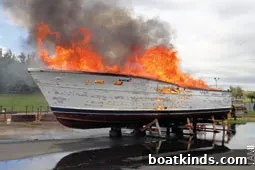
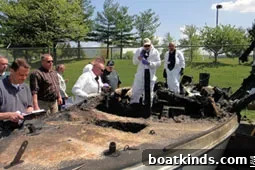
Earlier this year, Rutherford and colleagues organized a hands-on fire investigation course in Sayreville, New Jersey, offering a rare controlled opportunity to observe how boat fires start and spread. Organizers burned 10 donated vessels, including boats that had suffered storm damage and derelict hulls. Scenarios included radiant heat exposure, wiring-harness fires, exhaust fires and a simulated propane explosion staged aboard a Dufour 27 sailboat. Each burn was recorded with infrared and high-definition video for later analysis.
“The propane explosion scenario was the most dramatic,” Rutherford says. About 80 members of the association attended to study the staged incidents — far more than would normally be present at a single real-world investigation. BoatUS provided six of the boats, many damaged during Tropical Storm Irene, ranging from a 20-foot center-console to a 42-foot sailboat. Lockwood Boat Works donated four derelicts that were occupying space in its South Amboy yard.
Certified marine investigators classify vessel fires into four categories: natural, incendiary, accidental and undetermined. Having a variety of fire types in a controlled setting allowed attendees to observe critical details that are rarely available in live cases: how a fire starts, the color and movement of smoke, venting patterns, and how flames move through a boat’s enclosed compartments.
“One thing that surprised everyone was how fast a small fire turned into an uncontrollable blaze — in just a few minutes,” Rutherford says. Unlike a fire in a house or public building where occupants often have time to exit and follow established evacuation routes, people on boats face a much narrower range of options: either extinguish the fire immediately or abandon ship. That urgency makes both prevention and immediate response essential.
In one simulated engine-room fire, instructors observed smoldering inside the enclosed space for several minutes. When the hatch was opened and an extinguisher was applied, the fire intensified almost instantly. “Opening that compartment introduced oxygen and the fire rapidly grew out of control,” Rutherford explains. “If you don’t suppress a fire while it’s still very small, it can escalate extremely quickly.”
Private investigator Todd Schwede, who helped organize the exercise, installed infrared and conventional cameras around each vessel. The infrared footage revealed how heat and flames propagated within cabins, while other cameras tracked the fire’s origin and how it spread depending on fuel load, ventilation and wind direction. Schwede’s office manages hundreds of claims annually, and he says the visual record from the exercise provided important teaching material for investigators and insurers alike.
Rutherford emphasizes that although the seminar targeted professionals, the lessons apply directly to recreational boaters. Sinkings can be gradual, often allowing time to prepare and abandon a vessel safely. Fires are immediate and demand prompt, decisive action. He warns that many boats are under-equipped to manage onboard fires, even when they meet Coast Guard standards. Modern vessels increasingly place electrical equipment in compact, poorly ventilated spaces, and saltwater environments accelerate corrosion — all factors that raise fire risk.
Recommended steps for boat owners include regular maintenance of electrical systems, careful routing and protection of wiring harnesses, routine inspection of fuel and exhaust systems, and ensuring that fire extinguishers and detection equipment are appropriate for the vessel and in working order. Training — including hands-on practice in the correct use of extinguishers and clear understanding of escape procedures — can make the difference between a contained incident and a catastrophic loss.
Rutherford would like to see marinas, yacht clubs, auxiliary organizations and power-squadron groups offer more workshops and practical seminars focused on boat fires. Practical training and communal preparedness can reduce the risk of rapid, devastating onboard blazes and improve outcomes when incidents do occur.
See related articles:
- Understanding boat fires
- Use the right extinguisher
October 2012 issue.