Jay Fleming: Chesapeake Bay Photographer Capturing Watermen, Boats and Wild Places
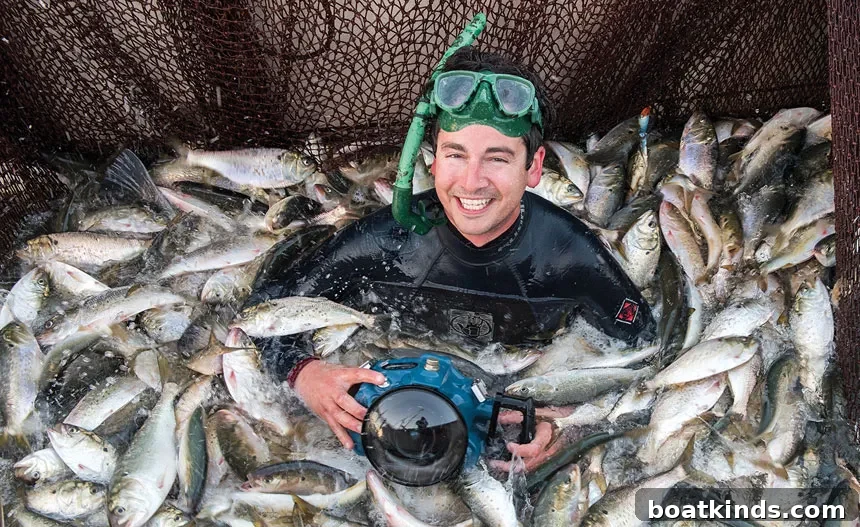
On any given day, Chesapeake Bay photographer Jay Fleming can be found slogging through mosquito-rich marshes, paddling among workboats or plunging into a net full of fish to get the images he needs. Always willing to go the extra mile, Fleming’s photography opens a window onto corners of the Bay most people never see, documenting the livelihoods, landscapes and wildlife that define this vital estuary.
Photography is in Fleming’s blood. His father was a National Geographic photographer, and Fleming’s own career took shape when he was 14 and inherited his father’s Nikon film cameras. While his father taught him the basics and instilled a strong work ethic, Fleming quickly forged his own visual voice and approach to storytelling through the lens.
Based in Annapolis, Maryland, Fleming specializes in distinctive perspectives of Chesapeake wildlife, shoreline landscapes, traditional boatbuilding, and the people who work the water. His book Working the Water follows a year in the Bay’s seafood cycle, portraying the hardworking watermen and women who harvest crabs, clams, oysters and other seafood that end up on dinner tables across the country. The project blends intimate portraiture with broader environmental and cultural context to celebrate the region’s maritime heritage.
On Boats, Memory and the Craft of Photography
First memory of being on a boat: My earliest recollection is being in a small skiff on the Severn River out of Annapolis. My parents took me out chicken-necking for crabs when I was five, and that day planted the seed for a lifetime on the water.
First boat you owned: My first command was a kayak. The first powerboat I owned was a 15-foot Gheenoe with a 5-horsepower tiller—simple, capable and perfect for learning how to handle a small craft in local waters.
Last or current boats: I currently run a 22-foot Privateer Roamer, a 1983 hull that I rebuilt in the winter of 2018, plus a 17-foot, 6-inch Privateer bay boat, a 1986 hull rebuilt in the winter of 2016. I also own six kayaks, which I use for quiet access and shallow-water exploration.
Favorite boat you’ve owned: Both the Roamer and the bay boat have their strengths. They serve different purposes on the Chesapeake, and the bay boat is my go-to for fishing and exploring the shallow flats where much of the Bay’s life is found.
Your dream boat: I’ve never wanted to limit myself to a single vessel. My next step will be a larger boat capable of overnight trips—ideally a 36- to 40-foot fiberglass Chesapeake deadrise-style boat—while still keeping small rigs for exploring shoal water and tight channels.
Notable Experiences and Adventures
Most rewarding (sailing) experience: Spending time with Art Daniel of Deal Island, Maryland, stands out above many shoots. Art skippered a skipjack until he retired at 93, and I boarded his boat, City of Crisfield, seven times while working on Working the Water. Those sessions were invaluable: Art’s knowledge of Chesapeake history and his decades as a waterman added deep context to the images and to my understanding of the Bay.
Scariest adventure aboard: I once crossed nine miles of open water in Tangier Sound alone in my Privateer bay boat while facing 5- to 6-foot waves. That tiller-handle skiff wasn’t meant for heavy seas, and waves were washing over the bow. I opened the plugs to let the water drain, kept a steady hand on the tiller and proceeded slowly. Reaching shore felt like a minor miracle.
Most memorable experience aboard: Shooting in the shallow, clear waters of the Exuma Cays in the Bahamas was unforgettable. I paddled more than 30 miles in a rented kayak, camping on small islands and fishing for bonefish. Near an inlet full of juvenile lemon sharks, I witnessed a bonefish being taken by a 3- to 4-foot lemon shark right at my feet and captured a series of images as the event unfolded.
Longest time at sea without setting foot on land: While most of my outings are day trips, I spent a week sailing the Aegean Sea and the Greek islands with my aunt and uncle in 2009. I also have an assignment planned that will keep me at sea for six consecutive days on the Gulf of Mexico.
Favorite destination so far: Cuba made a strong impression. Restricted access to the water because of government limits made me appreciate how fortunate we are in the United States to have broad access to shorelines and waterways.
Books, Causes and a Favorite Quote
Favorite nautical book: Watermen by Randall Peffer ranks high on my list—alongside my own book, Working the Water.
Favorite nautical cause you support and why: I support initiatives that get people out on the water and promote education about the environment. Encouraging firsthand experience with waterways helps build stewardship for fragile ecosystems like the Chesapeake Bay.
Favorite quote about the sea: “If it’s blowin’, we’re going.” — Scott Wivell, Cape Charles, Virginia, waterman.
This article originally appeared in the May 2018 issue.