
Waiting for the tide
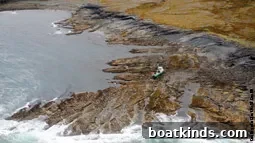
The 48-foot fishing vessel Sisiutl ran hard aground in Portage Bay, Alaska, during a severe wind and sea event. At the time of the grounding, winds were reported at about 35 mph with seas of 4 to 8 feet. When the tide rose, salvage crews were able to tow Sisiutl to Kodiak, where the boat was hauled out for necessary repairs.
Right place, right time when violent storm hits
In roughly 45 minutes on Aug. 15, 2010, David Esposito and two crewmembers rescued eight people, including a 2-year-old girl, from the turbulent Susquehanna River during a sudden hailstorm with winds up to 65 mph. The dramatic, unpublicized rescue unfolded near Port Deposit, Maryland, when Esposito, then 48 and operating his 2006 Sea Ray Amberjack 270, encountered multiple boats in distress.
Esposito, his wife Darlene and a friend, Gary Sikorski, were returning to the Port Deposit boat ramp when the weather collapsed. Hail and driving wind obscured visibility and sent a 15-foot bass boat under a wave and swamping it. The overwhelmed vessel lost power and was drifting toward a concrete I-95 bridge pylon. Esposito threw a tow line, pulled the boat clear of the bridge and brought the three occupants aboard.
Minutes later they heard more voices. A separate group of boaters had been separated from their 1959 14-foot Whirlwind when it swamped and sank. Shane Youlton, 23, and two women in their early 20s were clinging in the water with a small child. The women and child wore PFDs, but Youlton had been unable to put his on before the boat sank.
“They were hysterical,” Esposito recalls. Darlene, a former EMT and in-water rescue instructor, helped calm the survivors. A fourth passenger, a young woman who could not swim, clung to the visible bow of the sunken Whirlwind and resisted letting go. She wore a life preserver around her neck that was not secured. The crew repeatedly threw a life ring; once she grabbed it they hauled her aboard.
Youlton, an ironworker from North East, Maryland, remained level-headed throughout the ordeal and focused on keeping others safe. He had been in the water about 20 minutes and suffered a recent shoulder injury that left him with use of only one arm. Sikorski spotted him after Youlton rode a 6-foot wave high enough to be seen and began waving and yelling for help.
After pulling everyone from the water and towing the swamped bass boat, Esposito returned to the ramp where police and paramedics checked the survivors and found no injuries. Youlton later said that without the Espositos’ intervention he likely would not have survived. The experience left him shaken: he had nightmares for weeks and avoided boating for months.
Both Espositos emphasize the role of preparedness and quick action. Darlene credits providence for their being in the right place at the right time, while Youlton says the incident taught him to ensure every passenger knows how to don a PFD properly. “Since then, before I get underway I ask, ‘Do you know how to put on a life jacket?’ If they don’t, I show them until they get it right,” he said.
John M. Jones of the Maryland Natural Resources Police praised the rescuers: “They rose to the occasion. They acted swiftly and appropriately, without question.” Meanwhile, Youlton’s friends managed to refloat his family’s wooden runabout after the storm.

– Chris Landry
Lucky Teens

These young sailors were fortunate after their 12-foot catamaran capsized about 200 yards off Ponte Vedra Beach, Florida. All of the teens were wearing PFDs and were rescued while sitting atop the overturned hull.
Three N.H. lobstermen saved
Rye, N.H. — A Coast Guard crew rescued three men from Strafford, New Hampshire, after their 18-foot lobstering boat capsized about a mile off Rye on June 24. The Rye Fire Department notified Station Portsmouth Harbor around 10:30 a.m. after the men called 911 when a wave swept over the stern and overturned the vessel.
“These men are really lucky,” said Petty Officer 3rd Class John Matthews of Station Portsmouth Harbor. “The water was only 57 degrees and they weren’t wearing life jackets. In water that cold, hypothermia can set in very quickly.” The three men, ages 20, 21 and 22, were recovered uninjured.
Seven lost as charter boat sinks
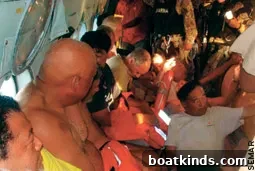
Sea of Cortez — A C-130 Hercules crew from Coast Guard Air Station Sacramento completed searching an 803-square-mile area July 12 near Isla San Luis as part of a wider effort to find seven Americans missing after a charter fishing boat sank on July 3. Mexican authorities and other fishing vessels rescued 35 people from the over-40-person boat; however, seven remained missing. U.S. aircrews flew multiple missions alongside Mexican search teams, covering more than 7,303 square miles during the operation.
Rear Adm. Joseph Castillo, commander of the Coast Guard’s 11th District, expressed condolences to the families and emphasized the strong collaboration between U.S. and Mexican search-and-rescue agencies. After the thorough search, no signs of the missing men were found, and Mexican authorities officially suspended further search operations.
Mackinac race’s first fatalities
Lake Michigan — The sailing community mourned two competitors who died in July when their boat capsized in a violent storm during the Chicago Yacht Club’s annual Race to Mackinac, a long-running offshore event from Chicago’s Monroe Harbor to Mackinac Island. The incident marked the first fatalities in the race’s 103-year history.
The Kiwi 35 WingNuts capsized after midnight on July 17 in 4- to 6-foot seas with winds near 50 mph about 13 nautical miles northwest of Charlevoix, Michigan. WingNuts skipper Mark Morley, 51, and crewmember Suzanne Bickel, 41, both of Saginaw, Michigan, were later found deceased. The competing Beneteau 40.7 Sociable recovered six survivors: Christopher Cummings, 16; John Dent, 50; Stan Dent, 51; Peter Morley, 47; Stewart Morley, 15; and Lee Purcell, 46. The Sociable reported the capsize to the Coast Guard at 12:40 a.m. July 18. Rescue divers located Morley and Bickel approximately eight hours later.
Racing crews reported extreme conditions: one participating boat recorded winds up to 100 knots, and sailors described unprecedented gusts in decades of racing experience on the Great Lakes and beyond.
– Chris Landry
This article originally appeared in the September 2011 issue.