Offshore Survival: How Three Fishermen Escaped a Sinking Boat 100 Miles from Shore
Kyle Haskins remembers climbing into his berth around 11 p.m. thinking everything on board was normal. The 29-year-old commercial fisherman was the youngest member of a three-man crew that included 58-year-old Capt. Terry Britton and 43-year-old mate Patrick Leoni. They were five days into a two-week grouper trip about 100 miles offshore from Madeira Beach, Florida, aboard a 32-foot Thompson the owner had recently bought used. Although the boat’s first trip for the new owner had ended with a blown transmission, the second outing initially felt routine.
None of the men realized the Thompson lacked a functioning high-water alarm and a bilge pump. Haskins says he had just lain down when he heard the sound of water breaking on the stern. “Our captain starts yelling, ‘Get up! Get up! Get the hell up!’” he recalls.
Capt. Britton says he was unusually restless that night and happened to get up, giving him the chance to act while there was still time. The mate was asleep on the fishbox on deck and hadn’t noticed the water pouring in. When Haskins reached the deck, the stern was swamped with two to four feet of water and the bow was rising toward a dark sky. The captain opened the engine hatch and found the engine compartment dry, but the steering wouldn’t respond. They discovered they had lost the rudder.
“If you can get surfing, you can get the water out, but we couldn’t turn at all,” Haskins says. The laptop and other instruments tumbled off the dash into the bilge, confirming they were taking on too much water. With the boat filling fast, the crew decided to abandon ship.
According to U.S. Coast Guard Lt. Tyler Dewechter, the crew’s actions after that point were exemplary. They performed the basic emergency tasks that give rescuers the best chance to locate and recover survivors in open water: making mayday calls, deploying signaling equipment and entering the life raft in an orderly way.
Haskins says he grabbed the lifejackets and made the first mayday call while Capt. Britton continued to search for the source of flooding. Britton then repeated several calls, giving their coordinates over VHF radio. “The last one I said we are abandoning ship,” the captain remembers. “We are going in the water.” They heard nothing in reply; heavy static on their VHF prevented clear reception, likely caused by the boat’s lighting rig.
Unknown to the men at the time, those distress calls had reached other vessels and Coast Guard Sector St. Petersburg. Cruise ships and a freighter heard some of the traffic, and at 1:52 a.m. the Coast Guard had received notification.
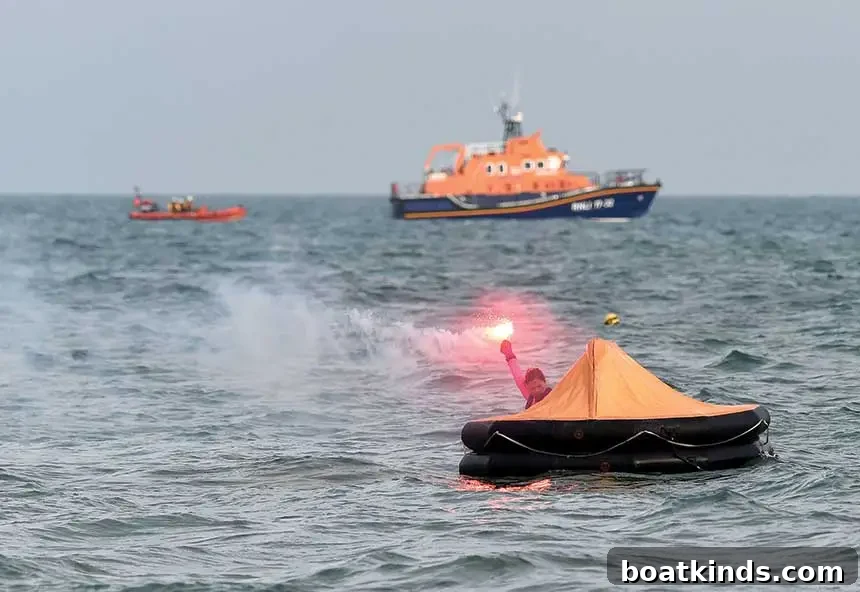
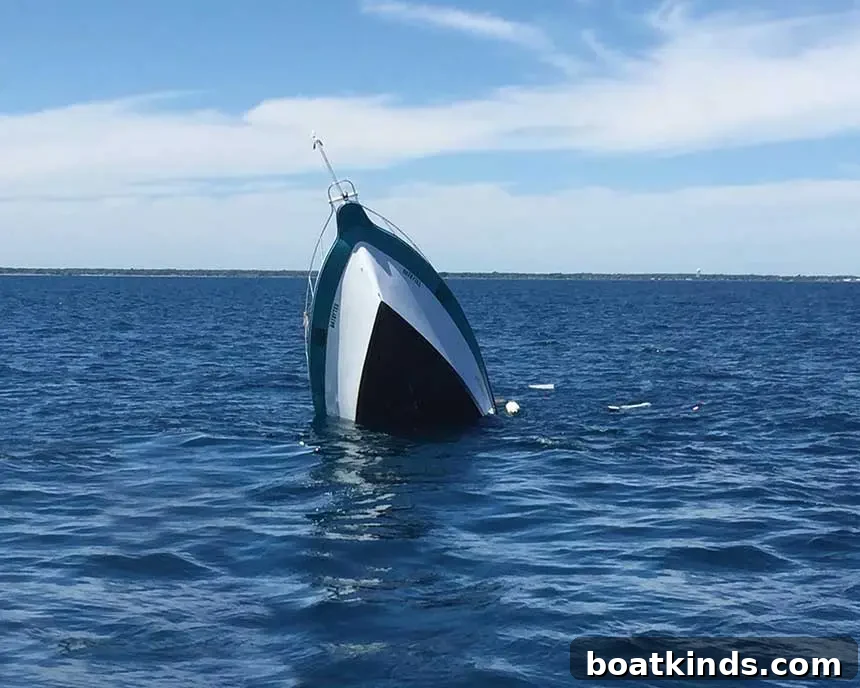
Haskins unlatched a six-person Viking life raft stowed on the canopy and struggled to deploy it. He had never practiced the full inflation sequence. “I pulled the cord, and it’s like one of those clown cars—you just keep pulling cord,” he says. Eventually the raft inflated on the canopy and Haskins shoved it into the sea. The captain tied the painter to the boat long enough for all three men to board, then cut it so the raft could drift freely. Within 20 to 30 minutes the Thompson rolled and sank; Britton says the stern came straight up and the lights remained on as the boat went under.
Once aboard the raft, the crew checked their emergency gear: an emergency position-indicating radio beacon (EPIRB), flares and a pre-packed survival bag with water, ready-to-eat rations, aspirin and basic tackle. Their first attempt to activate the EPIRB failed because a toggle switch would not operate, so Britton secured the unit to the raft and submerged it; once wet, the beacon began transmitting immediately.
Water temperature was roughly 75°F with air temperatures near 80°F. Haskins had only on basketball shorts and deck boots, so once his adrenaline faded he began to feel cold. The men drifted in about 240 feet of water where sharks were present, a reminder of the hazards after abandoning ship.
The Coast Guard diverted the cruise ship Norwegian Pearl and launched an MH-60 Jayhawk helicopter and an HC-144 Ocean Sentry aircraft from Air Station Miami to the scene. By 2:28 a.m. rescuers had the EPIRB signal, and at 4:04 a.m. the Ocean Sentry crew sighted the life raft’s strobe lights. The plane circled overhead, and the men in the raft deployed hand flares.
“My captain tried to launch the first flare, but it wouldn’t go off,” Haskins says. He fired another, and the aircraft acknowledged by tipping its wings. Soon a Coast Guard diver was knocking on the side of the raft and helped bring the men aboard the rescue helicopter and other boats on scene.
Captain Britton later learned a critical signaling lesson from the Coast Guard about flare use: while flares help attract attention, they can blind rescuers using night-vision equipment. Once rescuers confirm a sighting, switch to low-intensity methods such as flashlights to guide the approaching aircraft or ship.
Lt. Dewechter praised the crew for knowing their safety equipment and how to use it, which sped up the response and helped ensure a safe rescue. Haskins urges fellow boaters to remain calm, assign specific tasks during an emergency so no one panics, and consider enhancing the standard raft survival kit with items that help pass long waits—books or a hand-crank radio, for example.
By late April the two fishermen were preparing for another commercial trip, this time on a different older vessel being converted for commercial use. One of the first upgrades they made was installing a 2,200-gph pump and a new high-water alarm. Britton emphasizes that anyone venturing offshore should keep emergency equipment current and practice raft deployment and boarding. “It’s one thing if you have a problem on the boat, but when the boat’s gone, that’s a different story,” he says. “Don’t think that a 50-footer can’t be underwater and gone inside of 20 minutes.”
This article originally appeared in the July 2019 issue.