
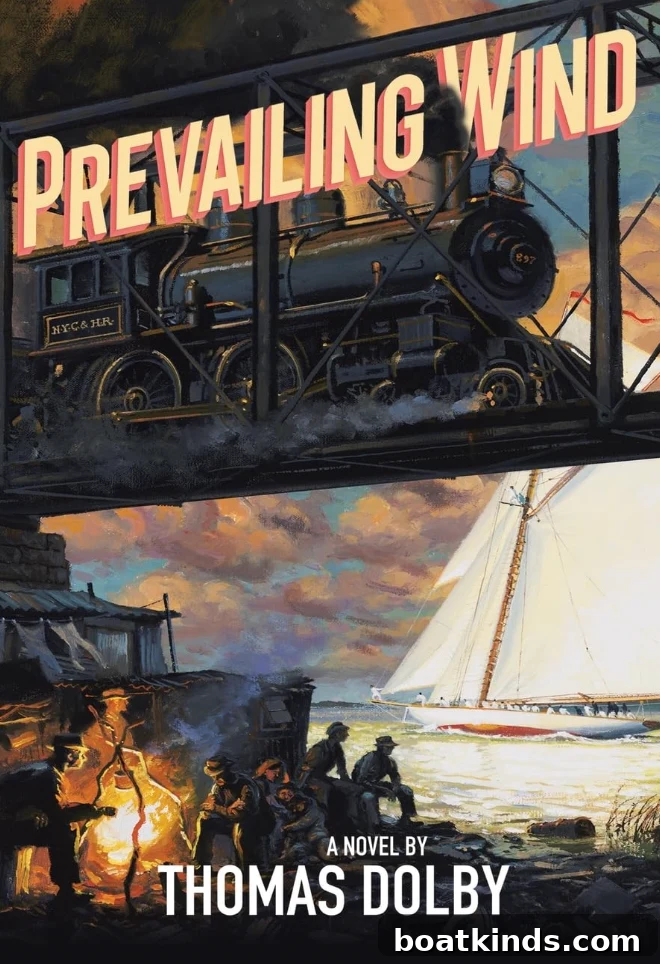
As a boy, Thomas Dolby discovered a large, black-and-white book by Beken of Cowes that captured his imagination: photographic plates of the grand America’s Cup yachts from the turn of the 20th century. The scale of those vessels fascinated him, and what struck him most were the tiny figures clustered along the rails—“those tiny little dots along the rail were actually men,” he has recalled. The sight raised questions: who were they, and what lives did they lead? That curiosity eventually suggested to Dolby that these characters could populate a novel.
Many readers will recognize Dolby as an influential figure in electronic music—an innovative synthesist of the 1980s who earned industry acclaim and mainstream success with hits like “She Blinded Me With Science.” He has continued to perform and has shared his knowledge in academic settings, including teaching music at Johns Hopkins University in Baltimore. Less widely known is his lifelong devotion to sailing, especially classic wooden yachts, and his scholarly interest in the Progressive Era in the United States, when stark economic disparities and social movements transformed everyday life.
Those twin passions—sailing and historical curiosity—converge in Dolby’s first novel, Prevailing Wind. The novel centers on an America’s Cup challenge and layers a mystery within the exclusive world of the New York Yacht Club. At its heart are two brothers from Maine, Davey and Jacob Haskell, who come from a poor fishing community on Penobscot Bay and are drawn, in very different ways, into the high-stakes, gilded realm of Cup racing.
Davey and Jacob, nineteen and twenty-one, earn a chance at something greater when a New York Yacht Club millionaire visits their coastal town to recruit crew for his syndicate’s challenger. Dolby grounds this plot point in historical reality: around the era he portrays, Cup contenders required crews of upwards of forty men, and wealthy syndicates often recruited tough, sea-hardened fishermen and lobstermen from Maine to fill those ranks. Their hands were already calloused; they endured cold and hardship for a living, and a successful gig on a racing schooner could mean vital pay during a lean season.
Complicating the brothers’ fates is their father, once a crewman on a contender himself and now bedridden after what appears to have been a stroke. His past connects them to a legacy they scarcely expected and triggers the novel’s central mystery. Dolby tells much of the story through Davey’s eyes. Davey is introspective and romantic, a foil to Jacob’s swagger and confidence. Their dynamic carries the emotional core of the book—sibling rivalry, loyalty, and the choices that define the course of their lives.
Dolby’s descriptive gifts are on display throughout. He delivers vivid, tactile scenes—whether it’s the grime and intensity of The Bowery or the technical and physical drama of handling a heavily canvassed racing yacht. At Davey’s first trial aboard such a vessel, Dolby captures both the scale and the physics of the moment: “Davey sighted up his now-rigid backstay all the way to the tip of the topmast, a hundred and sixty feet above the water,” he writes. “The windward shrouds and runners creaked, taking up the strain on the masts. As the schooner heeled and accelerated, the sails took on the smooth aerodynamic curves designed into them. Westward was a beautiful cloud of white Egyptian cotton. The power and sheer scale was like nothing Davey had ever seen: it was physics in motion. He had to remind himself to keep breathing.”
Dialogue is frequently a stumbling block for debut novelists, but Dolby’s ear for speech is impressive. The conversations in Prevailing Wind feel alive and appropriate to setting—whether among Maine fishermen or among New York’s privileged yacht owners—without descending into pastiche. The novel’s pacing sustains momentum: the plot introduces compelling mysteries and delivers twists that keep readers engaged. Dolby also convincingly stages an unlikely, yet plausible, relationship between Davey and a young Harold S. Vanderbilt, rendering its development believable within the social context he evokes. If the novel falters at all, it’s in the final stretch, where a few elements of authenticity wobble—but doing so would risk spoiling a key plot turn.
Beyond its central mystery and nautical thrills, Prevailing Wind presents a textured portrait of a turbulent era. Dolby uses yacht racing as a lens to illuminate broader social and economic rifts during the Progressive Era—the gap between wealth and poverty, the power of industrial fortunes, and the tensions that stirred calls for reform. Underneath the competition and spectacle, the novel is about opportunity and sacrifice, resilience and wonder: what it means to be tested by sea and by life.
In the end, Prevailing Wind is an engaging debut that merges meticulous historical detail with a genuine affection for sailing. It celebrates the art and science of yacht racing while probing the human stories that made that age both glorious and fraught. Through the perspective of young Davey Haskell, Dolby delivers a narrative of grit, longing, and the timeless lure of the open water.
—Wendy Mitman Clarke