
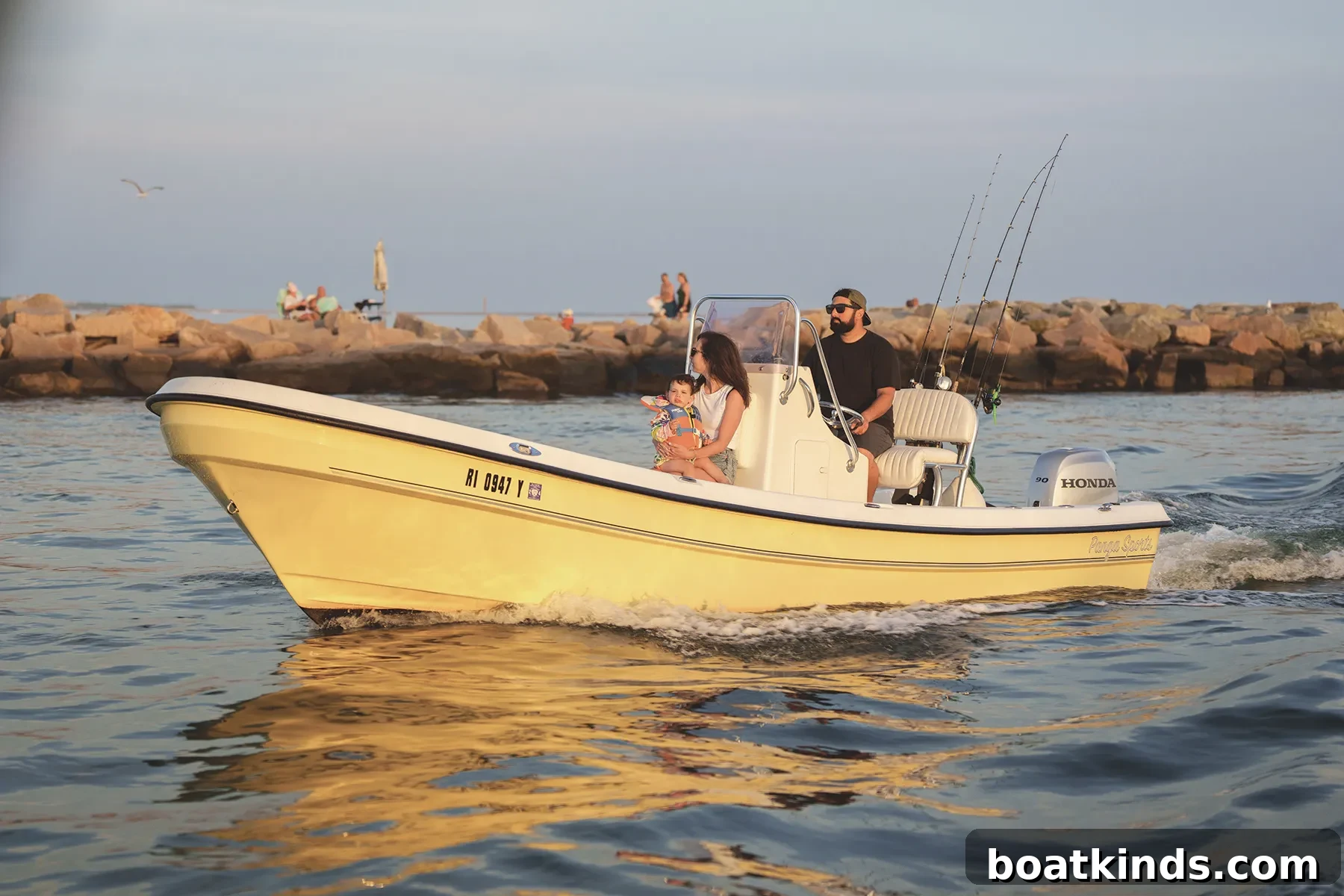
Two years after installing a two‑speaker sound system on his new 22‑foot Panga, John Salafia ran into repeated problems with one speaker and decided it was time for a full replacement and upgrade. He switched brands and opted for a four‑speaker setup, adding two additional speakers in the bow. To drive the new array he chose Clarion’s NMEA 2000‑certified CMM‑30 marine source unit paired with four Clarion CMSP‑771RGB‑SWG speakers.
The Clarion CMM‑30 is a weatherproof marine source unit rated IP66 with a 3‑inch full‑color LCD display. It supports SiriusXM, includes a digital AM/FM tuner with built‑in NOAA weather radio, Bluetooth audio streaming, and a USB 2.0 port for playback from storage devices. It also offers an analog auxiliary input, an onboard amplifier capable of powering two main speaker zones, eight channels of preamp outputs and subwoofer capability. NMEA 2000 certification enables multi‑function display control and compatibility with popular MFDs from Garmin, Lowrance and Simrad. The CMSP‑771RGB‑SWG speakers are 7.7‑inch coaxial marine speakers with built‑in RGB illumination. John had considered adding a subwoofer but the Panga offered no suitable mounting location.
Because work and family commitments limited his time, John turned the installation over to his neighbor Mike Garretson, owner of Sea and Land Yacht Works in Wakefield, Rhode Island. Sea and Land specializes in design, installation and troubleshooting for marine electronics—everything from multifunction displays and radar to engine monitors and thermal cameras—and its technicians maintain ABYC and NMEA certifications to ensure code‑compliant installations. Mike and his technician Drew Tedeschi handled the job and shared several practical tips.
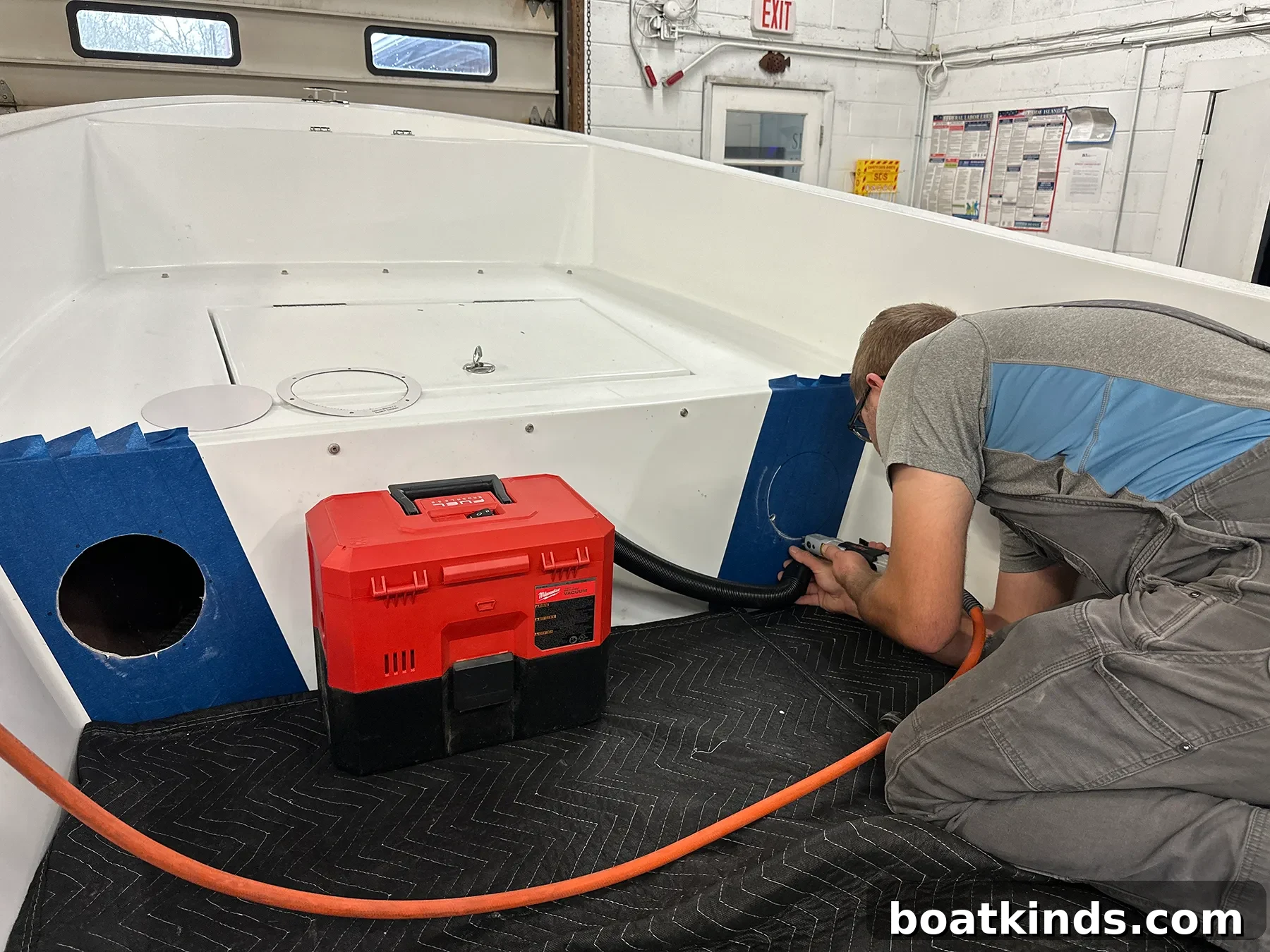
The first step was locating speaker positions and verifying clearance behind the mounting panels. To protect the gelcoat, Drew applied painter’s tape across each location, placed the speaker template on the tape, marked the cut lines and used an air saw to cut the holes. Mike noted a jigsaw can also work, but advised using a metal‑cutting blade or diamond‑grit blade instead of a standard wood blade, which will burn out quickly when cutting fiberglass.
Drew pre‑marked the mounting holes on the tape as well. Mike stressed the importance of sizing those drill holes correctly: if a stainless screw is threaded into a hole that’s too small, the screw head can snap off. Their rule was to drill a hole somewhere between the shank diameter and the outer thread diameter so the shank passes freely while the threads still bite into the fiberglass. They also used a countersink bit to start each hole and reduce the chance of chipping the gelcoat.
John had planned to run speaker wiring down the gunwales, but Mike rejected that approach because the wires couldn’t be secured every 18 inches as recommended by ABYC standards; loose wiring can chafe. Instead, they routed the cable below deck through the console hatch boxes in a length of PVC conduit. The conduit was fastened with Weld Mount adhesive bases and an MMA two‑part adhesive that bonds to many substrates; the pipe was zip‑tied to the mounts so it remains removable for future service.
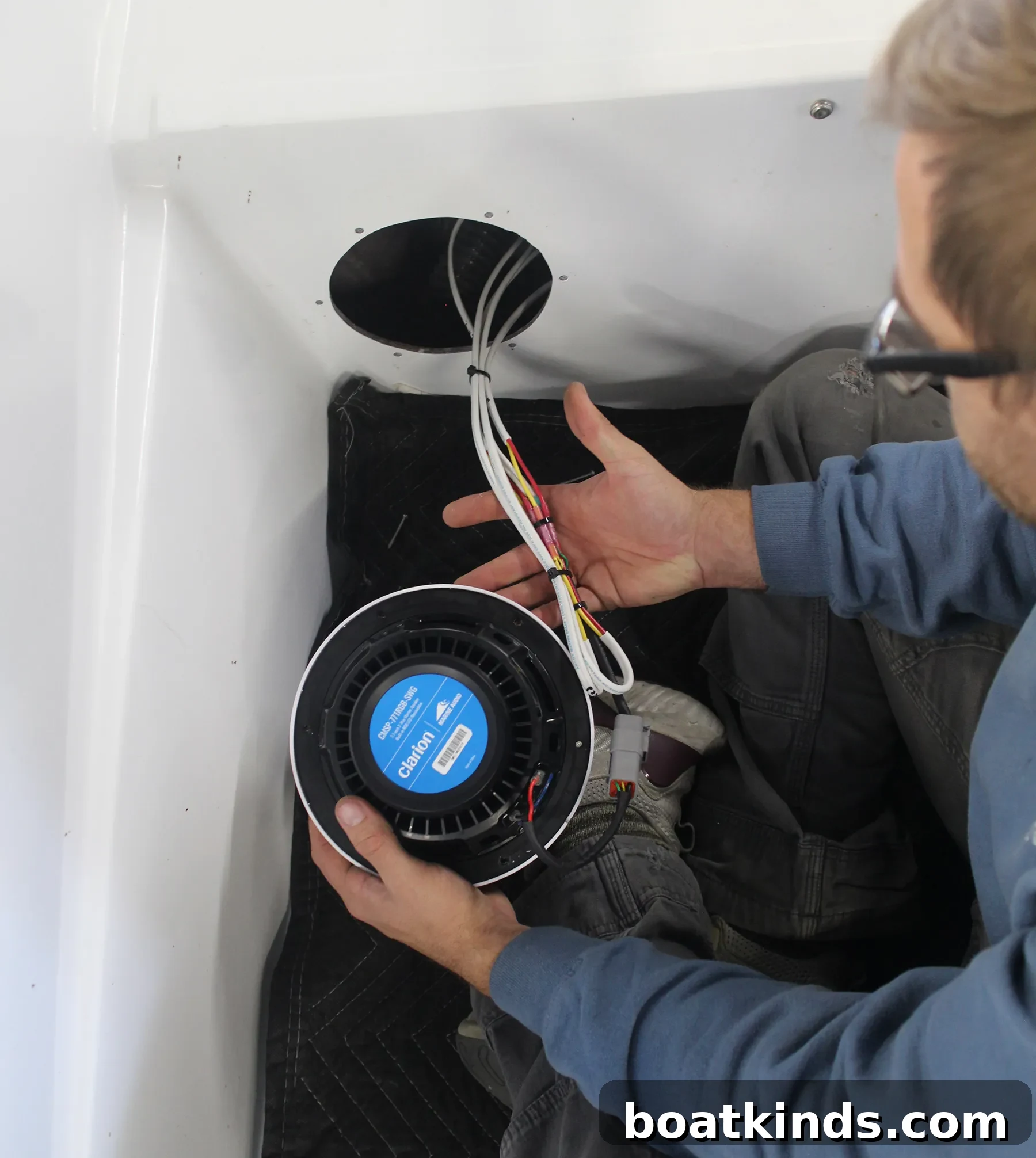
With the conduit in place they ran all wiring from the head unit and amplifier in the console to the bow speakers. Mike appreciated that the Clarion speakers use Deutsch connectors—robust, water‑resistant connectors that simplify removal and reduce vulnerability to corrosion. The Deutsch tails were butt‑connected to the boat’s wiring and heat‑shrunk for corrosion protection.
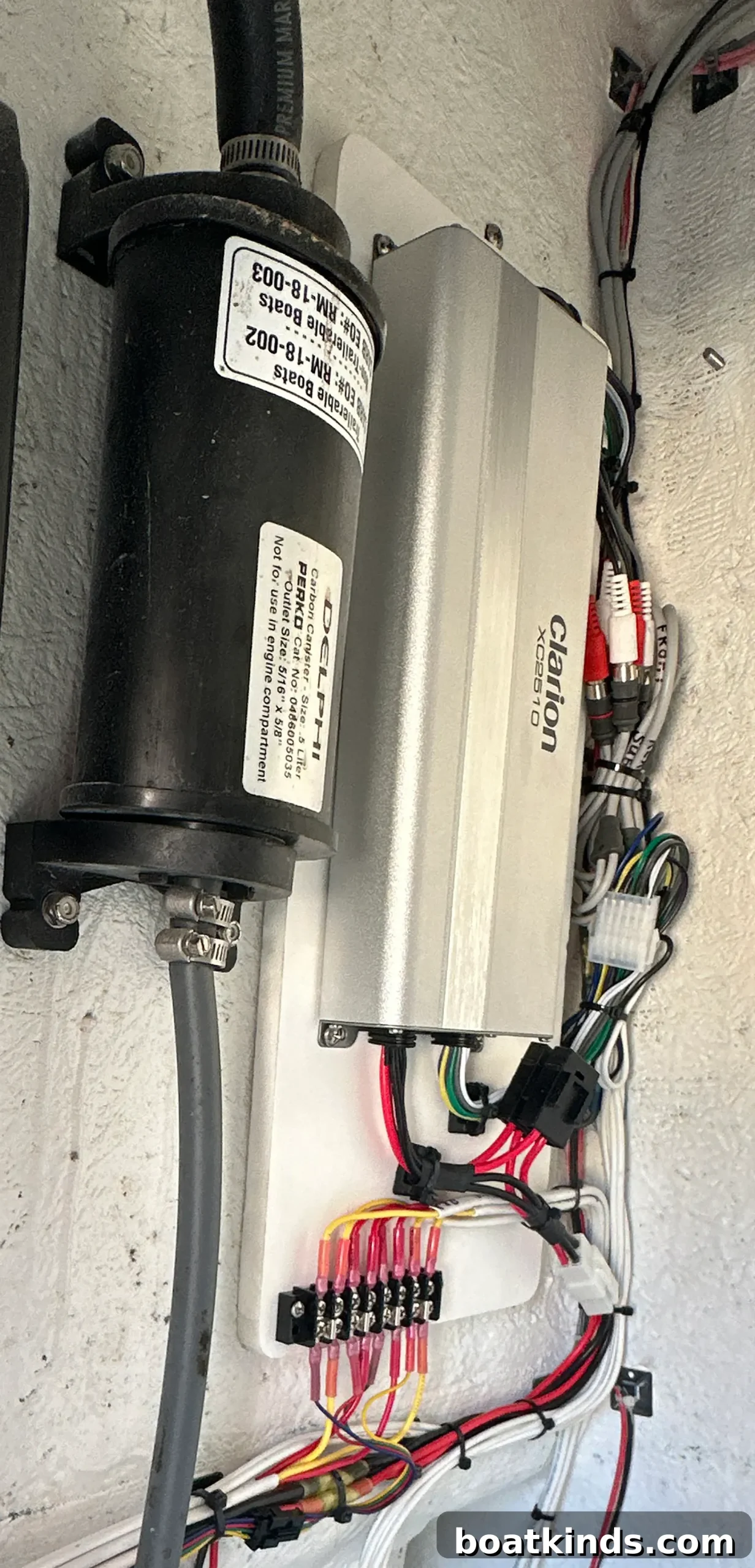
The amplifier was mounted on a PVC board so wire runs could be organized neatly; the board itself was bonded to the inside of the console with MMA adhesive to avoid drilling and screwing into the structure. PVC is easier to work than Starboard in this context, Mike said, because Starboard often requires pre‑drilling. Because the speaker LEDs require a four‑wire connection—and Mike prefers to avoid numerous butt splices—the team installed an eight‑gang terminal block on the PVC board to secure parallel wiring runs, then tinned the connections for reliability.
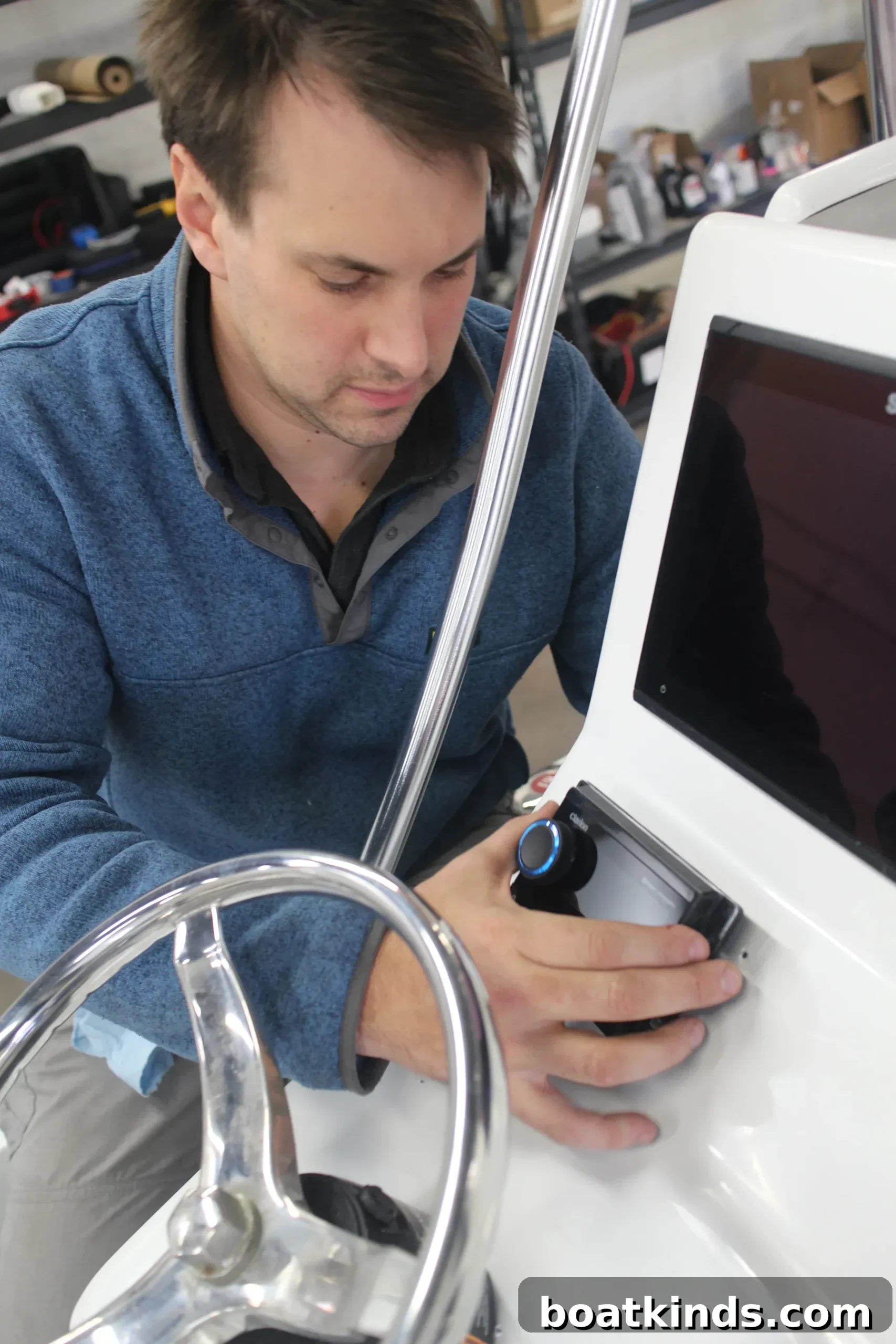
The new Clarion head unit and console speakers fit into the openings left by the old equipment. Drew finished the speaker openings with a flapper wheel on a grinder to ensure clean edges for the new Clarion units.
Power connections required attention. No single breaker in the console could serve the Clarion equipment alone, so the system was tied into the electronics switch that already powers the Panga’s Simrad MFD. They also connected the CMM‑30 to the boat’s NMEA 2000 network so the stereo can be controlled from the MFD.
Electrical safety was a priority. Proper fusing protects wiring from shorts, overheating and fire—risks created by pinches or screw punctures in looms. The team installed a fused connection at the battery switch, used the inline fuse on the Clarion head unit wiring harness, and relied on the LED harness’s integrated fuse for the lighting circuit.
With wiring and fuses in place, Drew tuned the amplifier. The CMM‑30 leaves gain control to the amp, so he set the head‑unit volume to about 75 percent of max, started the amp gains at zero and played music while slowly increasing each gain until slight distortion was audible, then backed off. He emphasized that gain is not a volume control but a way to match the head unit’s output voltage to the amplifier. On this Clarion amp there were separate gains for the subwoofer, front and rear speakers; with no sub installed they adjusted only the front and rear gains. Drew also explained filters: high‑pass filters protect speakers by blocking very low frequencies, while low‑pass filters are used for subwoofers. For speaker longevity he recommends avoiding head‑unit volumes above roughly 80 percent.
Although John couldn’t fit a subwoofer, he’s very pleased with the result. “The bass is pretty darn good without the subwoofer,” he said, and he’s impressed with the professional installation. “It looks and sounds really good, and it has better clarity than the old system.”
This article was originally published in the March 2024 issue.