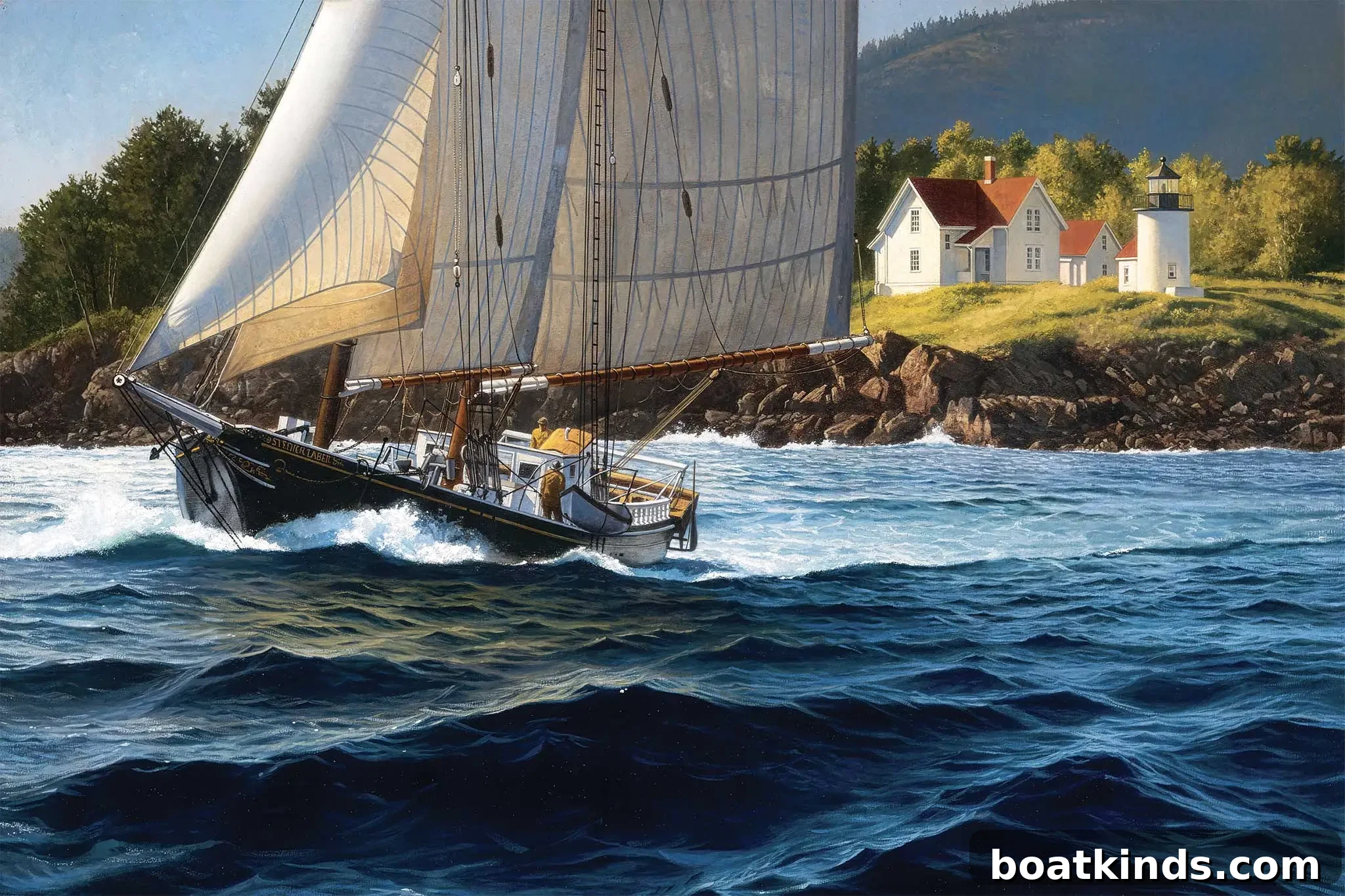
Neal Hughes’ Painting of the Schooner Stephen Taber, Captured Near Curtis Island Light
Maritime artist Neal Hughes photographed the two-masted schooner Stephen Taber while attending a windjammer event in Camden, Maine. He remembers the vessel gliding past Curtis Island Light at the harbor entrance and immediately recognizing an ideal composition. That memory became the basis for an 18-by-24-inch oil painting that translates the fleeting coastal light and maritime atmosphere into a carefully observed work of maritime art.
The subject of Hughes’s painting, the 115-foot Stephen Taber, is a National Historic Landmark and one of the few surviving schooners originally built for the Atlantic coasting trade. Launched in October 1871 at Bedel Shipyard in Glenwood Landing, New York, the vessel worked primarily near New York Harbor for decades before entering the windjammer tourist trade in 1946. For more than 150 years the schooner has remained in near-continuous service, and today it sails from Rockland, Maine—a living piece of maritime history and an evocative subject for artists who focus on coastal and nautical themes.
Hughes divides his time between New Jersey and frequent trips to Maine, where the rocky coastline provides a richer variety of shapes, textures, and atmospheric conditions than the relatively flat inland scenes closer to home. He explains that the Maine coast’s working boats and sailboats offer endless variations of subject matter: rigging and spars against an ever-changing sky, the interaction of light on varnished wood and hulls, and the contrast of human activity against a rugged seascape. These are the elements that inspire much of his maritime painting.
Boating has been part of Hughes’s life since childhood. He sailed with his father from a young age and served on his father’s crew for many years, participating in regattas up and down the East Coast and later cruising Chesapeake Bay and the waters around Newport, Rhode Island. Those formative experiences on the water inform Hughes’s confident handling of nautical details and his understanding of how vessels sit in the water—knowledge that enhances the realism and authenticity of his oil paintings.
Hughes’s interest in art began early; he took art lessons as a child and later graduated from the former Philadelphia College of Art. He started his career as an illustrator, which taught him strong compositional and narrative skills, then transitioned to fine art between 2002 and 2004. Today he blends the discipline of illustration with the observational freedom of plein air painting, focusing primarily on maritime and coastal subjects rendered in oil.
Over the years Hughes’s process has shifted toward working directly from life. While his earlier painting years relied heavily on photographic references—an approach rooted in his illustration background—he now prefers to paint on location to capture subtle shifts in light, color, and atmosphere. Painting en plein air allows him to respond to immediate visual cues: the way sunlight glances off a sail, the particular haze over a harbor, or the rhythm of waves along a rocky shore. Since 2012, Hughes has taken part in plein air competitions across the country, experiences he credits with accelerating his development as an artist and sharpening his ability to paint quickly and decisively outdoors.
Hughes’s professional recognition reflects his dedication to the maritime genre. He is a Fellow of the American Society of Marine Artists, a Master Signature member of Oil Painters of America, and a Master Artist of the National Oil and Acrylic Society. He also holds Signature Memberships with the American Impressionist Society and the Plein Air Painters of America. These affiliations underscore his expertise in oil painting and his standing within communities that value both technical skill and the evocative power of coastal subject matter.
Artwork courtesy the J. Russell Jinishian Gallery
This article was originally published in the October 2026 issue.