
Propane-Powered Outboards: A Cleaner, Affordable Option for Small Boats
What began as a concept aboard a research vessel in the North Sea has evolved into a practical alternative for small-boat propulsion: the propane-powered outboard. Developed by Lehr Inc. of Los Angeles, these outboards aim to bring more affordable, lower-emission propulsion to the mass market, based on the expectation that gaseous fuels will play a larger role in the future of transportation.
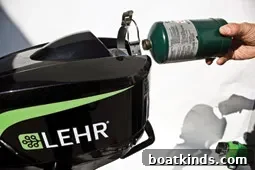
Propane already powers buses, taxis, forklifts, gardening equipment, go-karts and small scooters, so extending its use to portable marine engines is a logical step. “There are many upsides to propane-powered propulsion,” says Bernardo Herzer, a licensed captain and CEO of Lehr, which has introduced 2.5- and 5-hp outboards (www.golehr.com). Propane is a relatively low-cost, widely available fuel that burns cleanly and is not predominantly sourced from politically unstable regions.
Herzer’s interest in propane grew from his experience as a research-ship captain, where he became increasingly dissatisfied with the noise and fumes produced by onboard combustion engines. He investigated whether the same clean-burning, odor-free fuel used in galley stoves could be adapted for propulsion. “If it works in the galley, why not for propulsion?” he says, noting both environmental and domestic benefits.
While propane offers notable emissions advantages compared with gasoline and diesel, it is not a zero-emission or renewable fuel. Propane is typically produced as a byproduct of oil and gas extraction and must be separated in large processing facilities. It is used in heating, refrigeration and various propulsion applications. With rising heating-oil prices and growing interest in alternatives, propane has attracted political and economic attention.
According to Lehr, propane combustion produces about 25 percent less carbon dioxide and up to 60 percent less carbon monoxide than gasoline, and it reduces ultra-fine particulate emissions by roughly 97 percent. Lehr also states that propane generates 96 percent fewer carcinogenic emissions than gasoline and has no ozone-depleting potential.
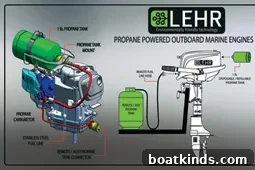
Lehr emphasizes that its outboards are purpose-built for propane rather than converted gasoline engines. “This is not a conversion of an engine that was designed to burn gasoline,” Herzer says. “It was designed and optimized to burn propane, which is rated at 110 octane, and the more octane, the higher the efficiency.” Lehr asserts higher efficiency compared with comparable gasoline outboards.
When comparing fuel costs, Lehr estimates annual savings that vary widely by engine size — from about $26 per year for a 2.5-hp engine to as much as $1,841 per year for a 175-hp engine. Their example assumes an annual average engine run time of 57 hours, a gasoline price of $3.72 per gallon and a propane cost of $2.42 per gallon.
Propane’s physical properties also offer practical advantages. It liquefies at a pressure between 80 and 120 psi, which is far lower than the high pressures required to compress natural gas for vehicle fuel. Lower storage pressure means tanks can be lighter and less bulky, making them a good fit for small craft. Lehr reports that one gallon of propane can power a 5-hp outboard for up to two hours and a 2.5-hp model for up to four hours.
Another practical benefit is that propane avoids the problems associated with ethanol-blended gasoline, which can harm marine engines when fuel sits for extended periods. Lehr summarizes the advantage succinctly: no ethanol, no water contamination, no stabilizers—fewer storage-related issues for seasonal boaters.
Lehr holds multiple patents and has received industry recognition, including the EPA Clean Air Excellence Award and the Popular Mechanics Breakthrough Product Award. The company has also been honored by the National Marine Manufacturers Association in the environmental category. Since incorporating in 2007, Lehr has pursued several funding rounds and licensed technology to other manufacturers for non-marine applications.
The company has established co-branding and retail partnerships in the consumer goods and hardware sectors. Lehr’s outboards are distributed through marine retailers such as Donovan Marine and Discount Marine Mart, with availability at participating store chains. Suggested retail pricing ranges from around $1,200 for the 2.5-hp short-shaft model to approximately $1,956 for the 5-hp long-shaft version. Lehr sources components globally and assembles its engines in China. The company reports that larger models, including 10-hp and 25-hp units, are under design.

Herzer imagines propane outboards resonating with users who already depend on propane for other activities: backyard barbecues, camping stoves, lawn care tools and portable lanterns. Those devices commonly use disposable 16.4-ounce propane canisters sold through outdoor retailers. Lehr offers a similar “twist-and-go” canister option for quick, portable use, and the outboards can also be plumbed to refillable propane cylinders or Lehr’s proprietary see-through composite tanks using a fuel-line hose.
“Picture a fishing trip where the outboard, a lantern and a grill are all fueled from the same source,” Herzer says. “That kind of interoperability isn’t possible with traditional liquid fuels.”
This article originally appeared in the June 2102 issue.