
Thomas Townsend and the Restoration of the Alice W.: A Beals Island Lobsterboat Story
When boatbuilder Thomas Townsend first laid eyes on the Alice W., a Beals Island–style lobsterboat, he was immediately captivated, even though the vessel required significant repair. Growing up in Northport, New York, on Long Island, he had often seen Beals Island lobsterboats tied up near his family’s 1928 Wheeler. To him they were “the sexiest, coolest and most seakindly boats around.”
Townsend’s family was steeped in boating; his parents, grandparents, aunt and uncle all owned boats. He learned to be comfortable on deck as a child, spending his earliest years afloat. After his parents’ divorce, he moved aboard a 42-foot Matthews motorboat he shared with his father during high school. That period cemented his conviction that he was happiest living and working near the water.
When it was time to choose his next step, Townsend realized a traditional classroom career held little appeal. He enrolled at The Landing School of Boatbuilding & Design in Arundel, Maine, from 1989 to 1990. There he met Jamie Houtz, who became both instructor and friend, and he first encountered the 35-foot, 10-foot-beam vessel that would become the Alice W.. The boat sat at the school awaiting restoration, and Townsend told Houtz that if it ever came up for sale he would buy it.
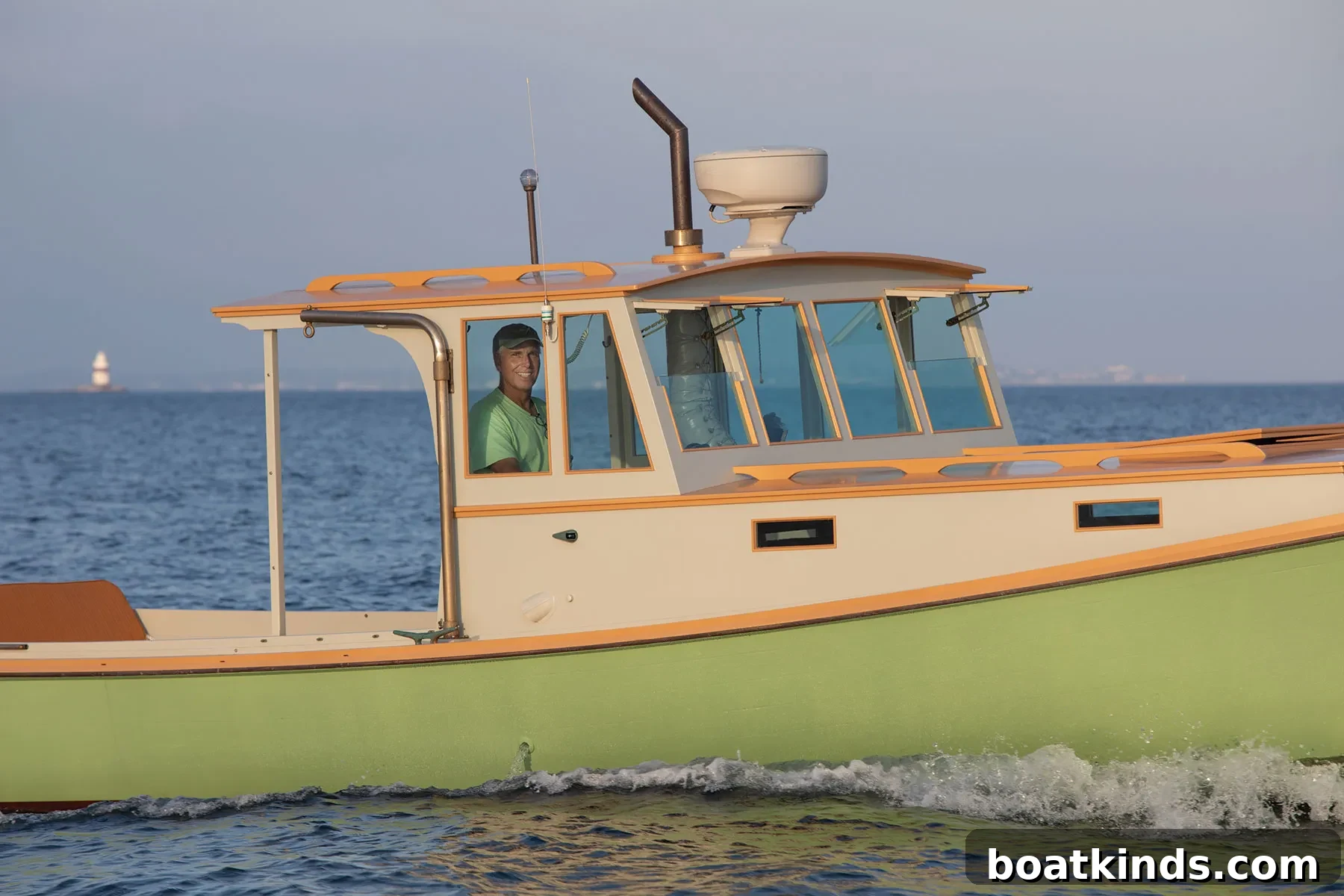
Built in 1969 by Vinal Beal on Beals Island, Maine, the boat was originally commissioned by a New Hampshire lobsterman. Vinal Beal and his brothers were part of a family of boatbuilders born in the early 1900s, and the craft tradition continued through later generations. The Beals Island style—also referred to as Jonesport-style—traces its design influences to Nova Scotia shipwright William Frost, who introduced skeg-built hulls and “cut-off” sterns to fishing boats. Those features produced faster, lighter, and more stable hulls that could carry heavier loads in rough conditions compared with the older “built-down” designs. As Nancy Beal notes in The History of Downeast Boats, Frost’s influence shaped the lobsterboat tradition for builders that followed.
Houtz purchased the boat directly from the original New Hampshire owner in 2002. Although she had solid construction, the vessel needed restoration. Houtz began the work in his spare time, reframing and replanking as required, adding a new transom and new floor timbers aft of the bulkhead, installing a cockpit and deck structure, and refurbishing the engine. Townsend kept watching the progress, and when Houtz ultimately sold the boat in 2012 Townsend purchased her and brought her to his shop. Houtz had intended to name the boat for his mother, Alice Walker, so Townsend retained that name as a nod to Houtz’s plan.
Townsend’s path after school brought him to Mystic, Connecticut, where he moved after driving home on Route 1 from Maine. He worked with furniture maker Joshua Friedman and boatbuilder Jeff Hall, eventually joining Hall full time. After five years he launched his own business, Thomas Townsend Custom Marine Woodworking, in 1996. He specializes in repairing, restoring, and maintaining classic wooden boats—both power and sail—having built dinghies and worked on everything from bass boats and lobsterboats to catboats and yachts up to 65 feet.
Even with Houtz’s prior work, the Alice W. required more attention. Townsend built a new wheelhouse, cabin structure and windows; refastened the hull above the waterline; replaced floor timbers from the main bulkhead forward; fiberglassed the plywood decks; and updated the original 350 Chevy V‑8 with a newer version of the same engine. Light and nimble at roughly 12,000 pounds, the boat returned to public view at the 2014 WoodenBoat Show held at Mystic Seaport.
While on display, a short film by Off Center Harbor featured the boat, drawing the attention of collector Ralph Dafoe. Dafoe purchased the Alice W. and hired Townsend to install an interior and a lobster pot hauler to raise the anchor without detracting from the boat’s clean bow profile. Dafoe kept the boat on a mooring near his East Blue Hill, Maine, home and used her mostly for day trips and occasional overnight stays. After Dafoe’s health declined, three years later he offered to sell the boat back to Townsend, who accepted the offer.
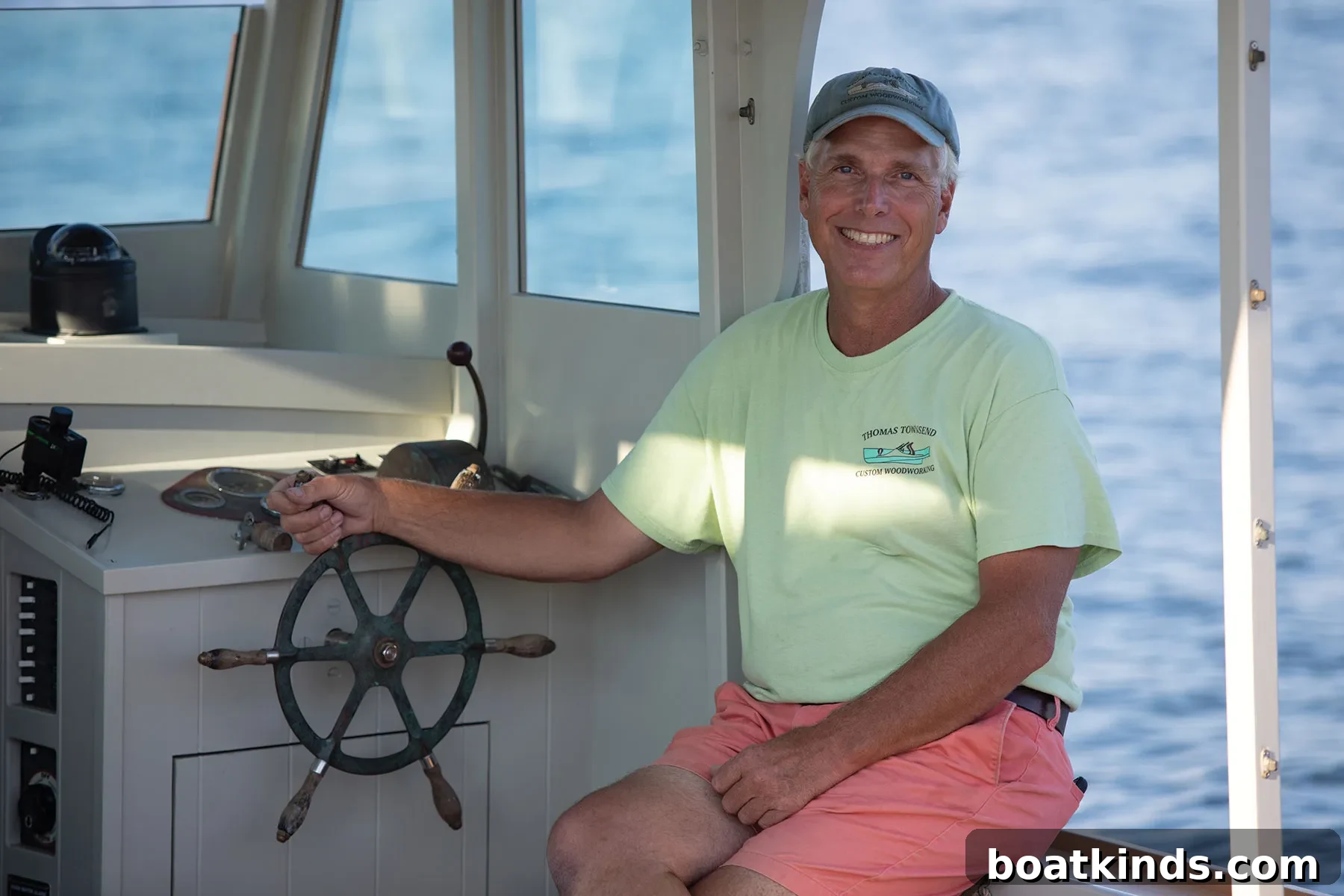
Townsend continues to refine and enjoy the classic lobsterboat. He has added modest comforts—two bunks, an 18-gallon freshwater tank and a compact galley—accepting the limited headroom belowdecks in favor of maintaining the boat’s original lines. At 53, he cruises the region with his girlfriend, Mary, visiting destinations such as Block Island, Shelter Island and Cuttyhunk. At a comfortable cruise speed of about 12 knots, these trips are roughly two hours from his homeport in Mystic; the boat will reach about 19 knots at top speed. Townsend praises the boat’s seakindly behavior—she doesn’t pound and is easily driven thanks to her narrow beam and fine entry at the bow, the very traits lobstermen describe as “long and lean.”
Whether Townsend will sell the Alice W. again is uncertain. He frequently buys, restores and sells boats, and he keeps an eye out for new projects. For now, though, the Alice W. remains a testament to traditional Downeast design and to Townsend’s commitment to preserving and enjoying classic wooden boats.
This article was originally published in the November 2020 issue.