
Olivia Wyatt: From Solo Pacific Voyages to the 2026 Golden Globe Race
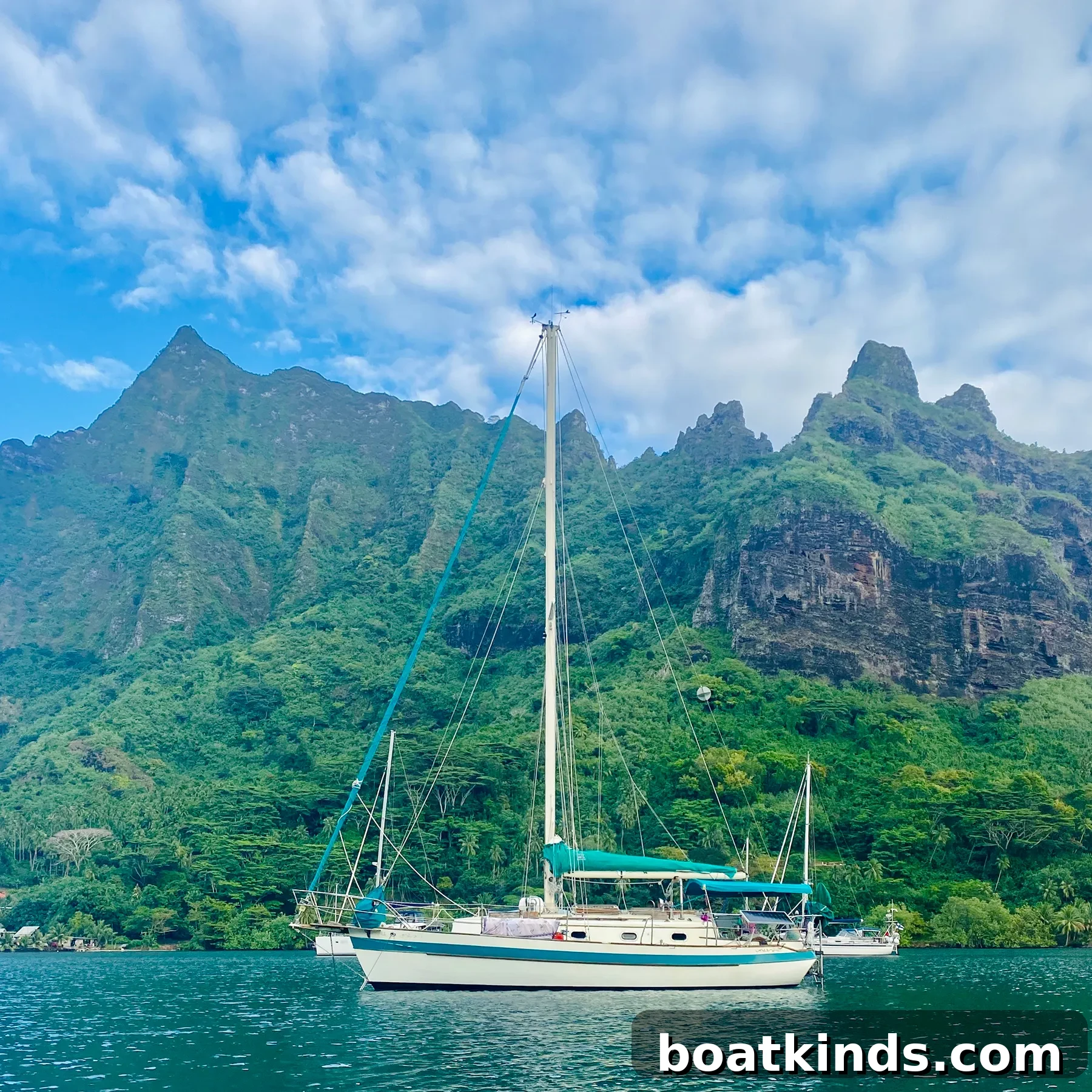
In the summer of 2019, Olivia Wyatt cast off from shore, a decision that had been forming for years—part obsession, part dare, and part promise to herself. She prepared her 34-foot Ta Shing Panda, Juniper, for a solo Pacific crossing from San Diego to Honolulu.
At the time, Wyatt was a relatively new boat owner. The 30-year-old full-keel cutter was her first true cruising yacht (aside from a Sunfish she’d whimsically named Queequeg) and remains her only boat. She had studied sailing and had some short solo experience—36 nautical miles and six hours—but admitted she’d been afraid to sail alone, which is largely why finally leaving the shore mattered so much.
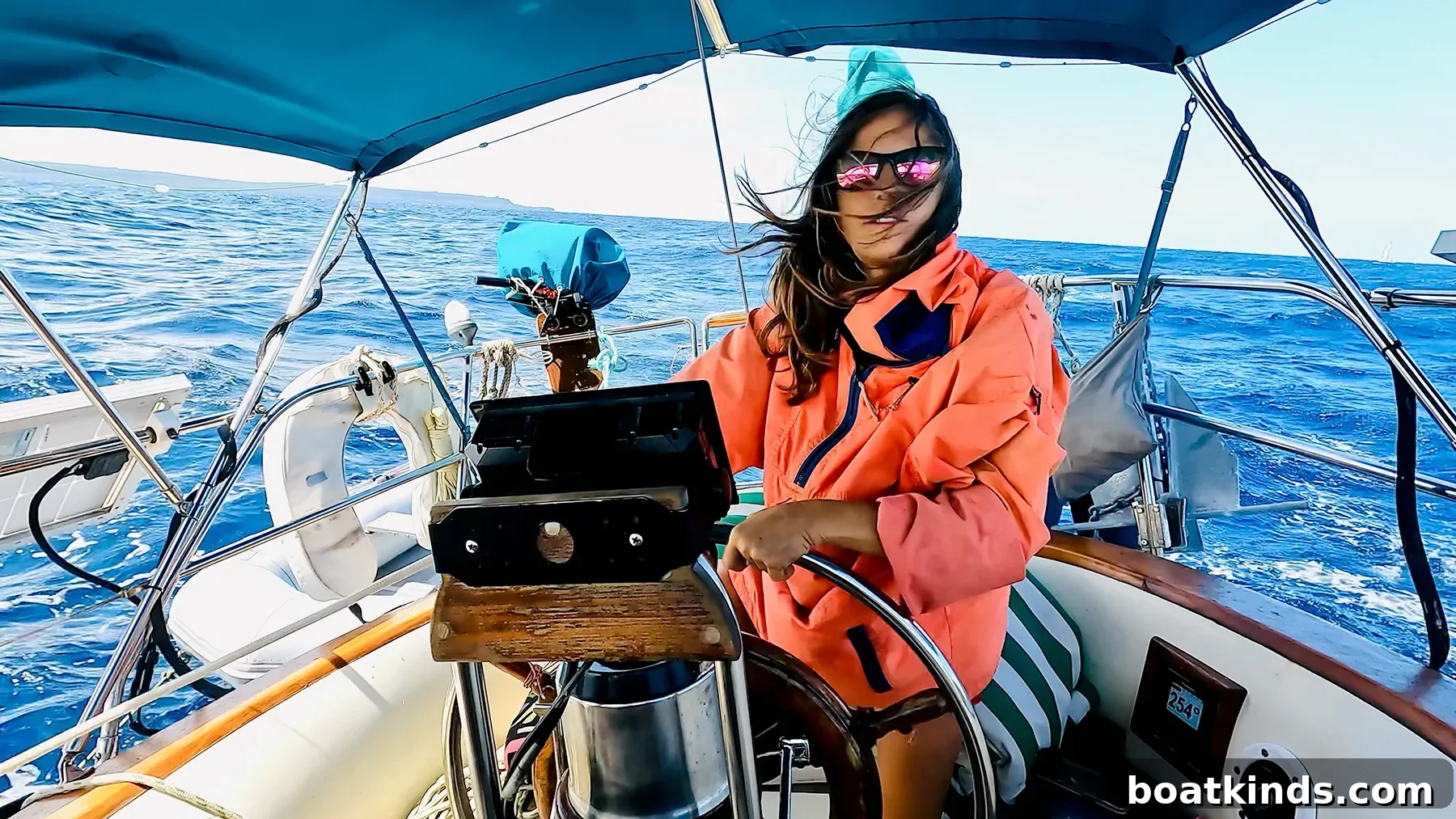
Four years later, Wyatt is a provisional entrant in the 2026 Golden Globe Race (GGR), one of four Americans and the only woman in the field so far. The retro solo, nonstop race starts and finishes in Les Sables-d’Olonne, France, and takes competitors around the globe via the great capes of Good Hope, Leeuwin, and Horn with prescribed rendezvous gates. Wyatt has now sailed about 16,000 nautical miles, 9,000 of them solo, mostly across temperate Pacific waters. Her longest single time at sea to date is 23 days; the Golden Globe will demand eight to ten months alone at sea.
“I needed a bigger purpose than cruising from place to place,” she says. “I want there to be a bigger purpose for everything I do in life. I am the type of person that wants big things to sink my entire self into. I need to be consistently challenged and learning and exploring. And I love to be consumed by a goal, otherwise I get super bored.”
Wyatt, now 41, is a filmmaker, photographer, and writer. Over recent years she’s drifted across the Pacific aboard Juniper, visiting the Hawaiian Islands, crossing the equator to French Polynesia, then sailing to Fiji, Vanuatu, and the Solomon Islands, where she arrived in September 2023.
She has nearly met the Golden Globe Race entry requirements—8,000 miles in any boat, 2,000 solo miles, and 2,000 solo nonstop in the boat she intends to use. Because she didn’t use celestial navigation the first time, she must repeat the nonstop qualifier, documenting at least six celestial observations and computed position lines using a sextant. This year she plans a refit in Malaysia before heading toward the Mediterranean in 2025, either by rounding the Cape of Good Hope or by shipping Juniper from Thailand to Europe. A final refit in Portugal is planned before the Les Sables-d’Olonne start.
The idea of entering the Golden Globe Race first struck last summer while Wyatt was anchored off Espiritu Santo in Vanuatu. She knew of the original 1968 Golden Globe but only learned about the modern reboot after following the 2022–23 edition, won by Kirsten Neuschäfer in April 2023—the first woman to win a solo round-the-world race. The GGR is unique: it allows only production boats 32–36 feet long, designed before 1988, with full-length keels and rudders attached to the trailing edge; it also requires traditional navigation with sextant and paper charts, with no electronic instruments or autopilot allowed.
“I was on full fire inside,” Wyatt says. “I woke up the next day unable to shake the idea of the race out of my head, but I didn’t know if I had what it takes to do it.”
She researched the race and discovered the Baba 35—sister to her own design—was on the list of pre-approved boats. In many ways she had been practicing for the GGR during her years at sea. She contacted Neuschäfer and Elliott Smith, a 2022–23 competitor who retired in Australia after a rig failure, and spent hours asking questions and absorbing their advice. She also spoke with race founder and chairman Don McIntyre, who told her, “You’re already doing it. You’re already sailing around the world by yourself.”
McIntyre emphasizes the “head space” needed for the GGR: obsession and an unshakable commitment are as important as seamanship. “Olivia came across as a creative dreamer with an obsession with the GGR,” he says. “Being obsessed is critical even if you do not completely understand why. Fear and uncertainty are important because without that there is nothing to gain and to drive you forward. Olivia is the classic GGR entrant.”
Wyatt sailed with two crew members on legs to Hawaii and French Polynesia, but most of her miles on Juniper have been solo. She told McIntyre she didn’t care about winning—she was in it for the adventure. He advised her that the only realistic goal is to finish, since very few competitors complete the race. In 2018 and 2022, only five finishers completed each edition, with some making stops and being placed in the Chichester class.
Wyatt describes herself as a spiritual, reflective sailor. The solitude of long passages provides a sense of communion with nature and personal transformation. “I’m super spiritual,” she says. “For me, my dreams are direct messages from God. They are like the little lighthouses illuminating my life, guiding me, warning me, teaching me, healing me. The fact that my dreams about the GGR left me with such a sublime feeling indicated to me that I was being guided to do this race.”
She cites another moment she took as a sign: while completing her GGR application with no funds for the entry deposit, the exact amount she needed appeared in her account on the day she finished the paperwork—inheritance money from her grandmother she was unaware of until a bank merger revealed it.
As a filmmaker, Wyatt plans to document the GGR. She’s enlisted filmmaker Philip Andrews to help rig Juniper with microphones and cameras so she can record with ease. This will be her fourth feature-length documentary and her first since the 2015 film “Sailing a Sinking Sea,” about the Moken sea people of Myanmar and Thailand—work that helped launch her life as a sailor.
“I pour myself so deep into my films that I get postpartum depression after I give birth to one,” she says. “For a while I dealt with that by just turning around and making another film. It was not healthy. Making that film made me want to turn the ocean into my home, so I did.”
People who have followed her progress note how much her seamanship has evolved. Tom Celentano, a Honolulu boatbuilder who helped Wyatt upgrade Juniper for a Tahiti passage and later sailed with her off Oahu, remembers a sailor who lacked confidence early on. “Her passagemaking skills still needed some work,” he says. Three years later, he praises her improved understanding of routing, weather, and navigation and a new groundedness in decision-making that will serve her well in the Golden Globe Race.
Wyatt’s gender will likely be discussed as a distinguishing aspect of her campaign. Women have been few but notable in recent editions: Susie Goodall was the only woman in the 2018–19 race and retired after losing her mast; Neuschäfer was the only woman in 2022–23 and won while also aiding a fellow competitor rescued at sea. Wyatt may be the only woman in the 2026 field.
Fellow solo cruiser Holly Martin met Wyatt in 2020 and they sailed together in Fiji. Martin, who grew up sailing, stresses the need to celebrate women in the sport while also recognizing individual accomplishments. “Olivia and I stick together because we’re a vast minority,” Martin says. “It’s important to celebrate the fact that women have broken into this world, but it’s just as important to remember we’re much more than our gender.”
One of Wyatt’s first major hurdles has been fundraising for her GGR campaign. She estimated a budget of about $300,000 to refit Juniper, purchase equipment, and cover training. Friends hosted fundraising events in her hometown of Little Rock, Arkansas, while she also completed required entrant courses, including medical training and survival at sea.
Wyatt did not grow up sailing. Her interest began in her late 20s when a friend gave her sailing lessons for a birthday. Living in the Rockaways, Queens, she practiced in Jamaica Bay and sometimes sailed to her summer job as a bartender. She delivered boats, joined race crews, and slowly moved from task-based skills to a broader understanding of passagemaking after buying Juniper for about $45,000.
With film work slowing, she took a minimum-wage job at a West Marine, studied for a 50-ton USCG license, and lived aboard Juniper in Marina del Rey and later San Diego to sharpen her skills. Her first major solo ocean passage—to Hawaii—felt audacious. She told few people because she didn’t want the pressure of potential failure; her mother, however, reacted with fear and anger, refusing to speak to her for months.
“I am still mortified every time she takes off,” her mother says. “I’ve earned every grey hair that one child can give you. Sailing by herself really has unnerved me. I’m trying to let go of my fear. I have to realize whatever happens to her out there, good or bad, she’s doing exactly what she wants to do, something she loves. She loves that boat, she loves being on that water.”
This article was originally published in the April 2024 issue of SAIL Magazine and appeared in Soundings May 2024 issue.