
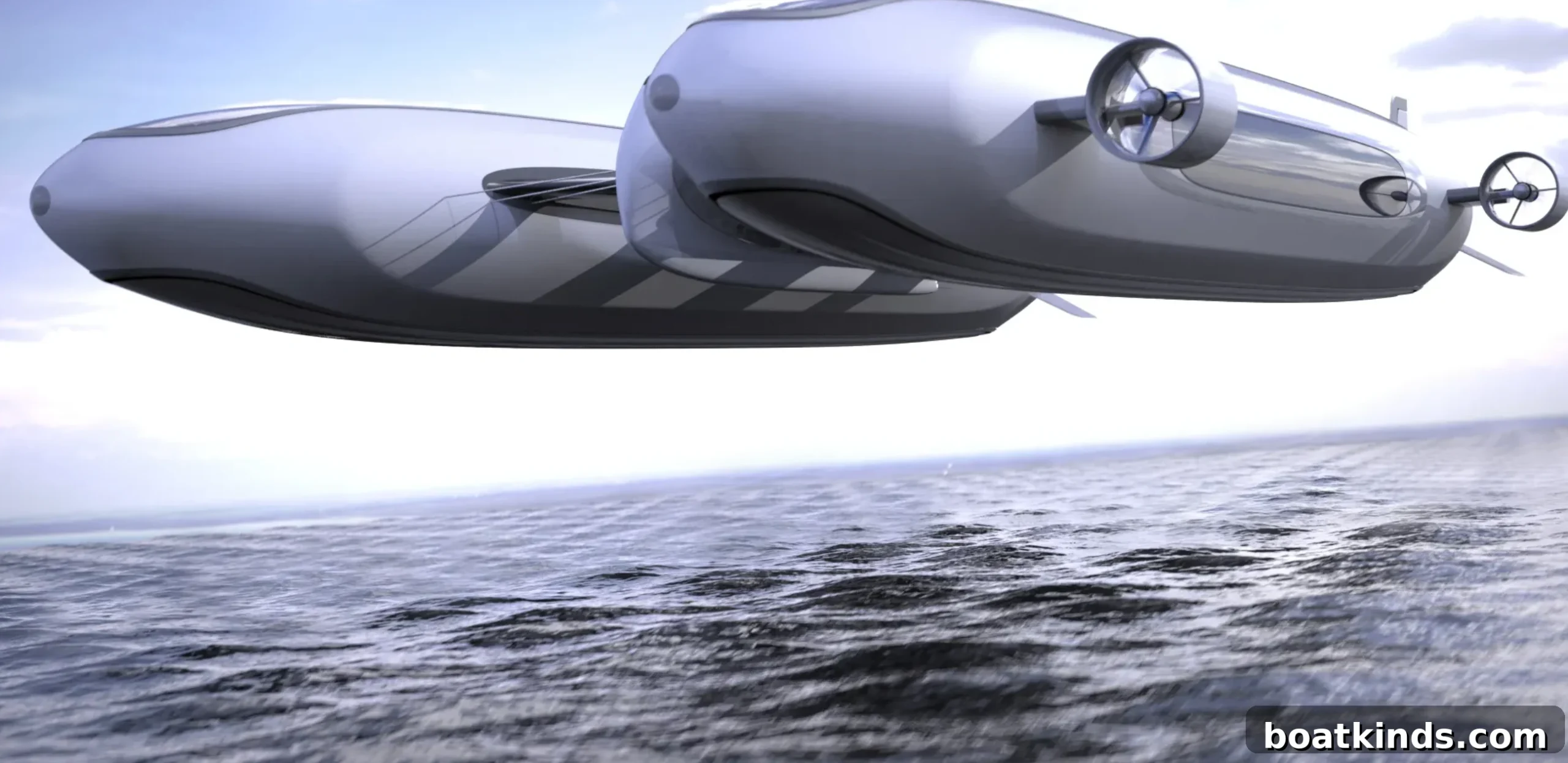
Futuristic Sky Yacht Concept Promises Air and Sea Travel in One Carbon-Fiber Vessel
A dramatic new travel concept could blur the lines between yacht and aircraft: a 500-foot “sky yacht” designed through a collaboration between Italian designer Pierpaolo Lazzarini and a private German investor. The project envisions a hybrid vessel capable of operating both above the water and across the sky, combining advanced lightweight materials, buoyant helium structures and electric propulsion to create a radically different mode of luxury transport.
Design and Structure
The sky yacht’s structure is organized into three principal modules. A central carbon-fiber compartment houses the main living and dining areas, while two large helium-filled blimps flank the central section and contain ten individual suites. The three modules are linked by a series of carbon-fiber bridges—four on each side—that provide structural continuity and access between the central living space and the suite-bearing blimps.
Construction emphasizes carbon fiber for its high strength-to-weight ratio and resistance to corrosion, a logical choice for a craft intended to operate in both marine and airborne environments. Two additional balloon-like compartments located on either side of the vessel provide buoyancy for waterborne operation, allowing the sky yacht to float and function as a seafaring platform when not airborne.
Lift and Buoyancy
Buoyancy in the sky is supplied primarily by the pair of helium blimps. The design documentation cites a combined helium volume reported as 14,125,867 square feet, used to provide the lift required to float the hybrid yacht in the air. On the water, the balloon-like side compartments enable flotation and stability, making the craft versatile for long-distance coastal cruising as well as aerial transit.
Propulsion and Performance
Propulsion is handled by eight counter-rotating electric engines. These motors draw energy from an onboard battery system supplemented by solar panels integrated into the vessel’s surfaces. Designers expect the propulsion arrangement to deliver continuous transit at a cruising speed of 60 knots for periods exceeding two days without recharging, according to published project details. The counter-rotating configuration aims to increase thrust efficiency and reduce torque effects on the overall structure.
Reliance on electric propulsion and solar generation highlights an effort to minimize direct fossil fuel use during operation, though the overall environmental impact will depend on factors such as battery production, charging infrastructure and operational profile.
Accommodations and Use Cases
The two blimp modules accommodate ten suites intended for guests, while the central compartment contains communal living and dining areas. This layout positions the sky yacht as a platform for private travel, luxury cruising, or exclusive experiential journeys that combine aerial views with the amenities of a high-end yacht. The modular arrangement also offers opportunities for different interior configurations, potentially allowing custom layouts for owners or charter clients.
Prototype, Cost and Development Status
Pierpaolo Lazzarini has indicated that the first prototype of this concept—estimated to cost approximately $627,511,500—could take flight later this year. A range of variant designs with differing lengths and layouts are reportedly in early prototyping stages, suggesting the concept may evolve into multiple models tailored to different markets or performance requirements. As with any pioneering concept, development will need to address regulatory, safety and certification hurdles before widespread operation can occur.
Implications and Challenges
The sky yacht concept highlights several notable trends in design and transportation: the use of advanced composite materials, a move toward electric propulsion augmented by renewables, and creative thinking about how to combine floating and flying capabilities. At the same time, practical challenges remain. Integrating large helium volumes with rigid carbon structures, ensuring structural integrity across air and water operations, satisfying safety and aviation regulations, and creating reliable, long-duration electric power systems are all substantial engineering and regulatory tasks that will shape the timeline and feasibility of any operational model.
Conclusion
While the sky yacht remains a visionary project at the intersection of yacht design and aerospace thinking, the proposal demonstrates how designers are reimagining transportation for affluent travelers and niche markets. If the prototype milestones are met and further development proves technologically and economically viable, this hybrid craft could represent a new category of mobility—one that offers the spectacle of flight combined with the comforts of a luxury yacht. For now, the project stands as an ambitious concept to watch as it moves through prototyping and testing phases.