
Pegasus: Saving a 108-Year-Old Tugboat and Its Mission on the Hudson
The tug Pegasus has been part of the New York waterfront for most of its 108 years and has been the passion of Capt. Pamela Hepburn for 28 of them. This summer, financial strain forced the historic vessel off its berth at Pier 25 in Hudson River Park and into a free slip at a drilling company’s shipyard on the industrial Morris Canal in New Jersey.
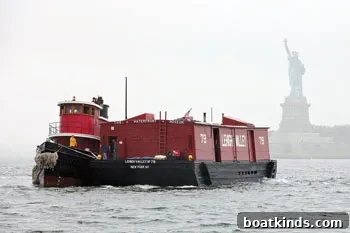
The Pegasus Preservation Project, the nonprofit that owns the vessel, was unable to afford insurance and other operating costs required to keep the 100-foot tug as a public attraction within the park’s historic fleet. Pegasus is currently tied up at the Warren George yard while the board searches for an energetic partner to develop a sustainable plan that keeps the tug out of the scrapyard and honors its heritage. “The boat needs operating capital [of about $100,000 a year],” says Jan Andrusky, board chairman and manager of a 14-tug fleet at Weeks Marine. “That’s too much for us to sustain.”
The board has received two proposals — with a possible third on the way — that align with their aim to preserve Pegasus and use it as a platform for education about the harbor’s ecological value, its role in New York’s history, and its continuing importance as a commercial port, Andrusky says.
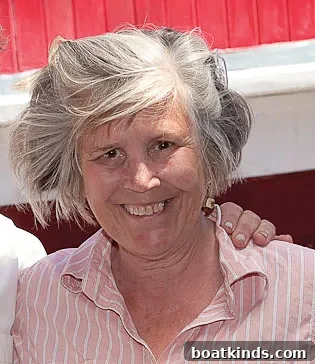
That prospect is welcome news to Hepburn. “Pegasus could use an infusion of youthful energy,” she says. After decades of keeping the tug afloat and active as an educational resource, she is ready for new stewardship but remains committed to the vessel’s mission. “A lot of New Yorkers don’t understand the waters around them — their harbor,” she adds.
Not everyone agrees on the best future for the ship; some have proposed converting Pegasus into an entertainment venue such as a beer hall — an idea Hepburn finds unattractive.
Hepburn’s connection to Pegasus dates back to 1987, when she bought the 100-foot, steel-hulled tug for $25,000, becoming one of the early female tugboat owner-captains. After extensive repairs, she employed the tug in New York Harbor, towing oil barges and “car floats” — barges outfitted with tracks to move railroad cars on and off. Hepburn lived aboard the vessel for nine years to oversee it continuously and raised her daughter, Alice, often bringing her along on towing assignments. “She’s a wonderful-handling vessel,” Hepburn says of Pegasus. “She’s got a big rudder and a sweet hull configuration.”
Originally equipped with a steam engine, Pegasus received a 900-hp diesel replacement in 1953. While reliable, that engine lacks the power needed for much of the heavier harbor work required of modern tugs. After a decade of commercial service under Hepburn, Pegasus transitioned into an educational platform — essentially a floating museum that welcomed visitors at the dock, hosted work-study programs for teens, and brought school groups aboard for hands-on maritime learning.
From 2004 to 2009, David Sharps, president of the Waterfront Museum — a 101-year-old covered wooden barge converted into a floating museum and classroom — partnered with Hepburn for Hudson River tours. Pegasus towed Sharps’ museum barge to destinations including Hoboken, Brooklyn Bridge Park, Poughkeepsie, Kingston, Cold Spring and Hudson, providing dockside entertainment and maritime education programs. While the partnership proved effective in outreach, the tours were costly and lacked sustainable grant funding.
In 2011, Pegasus earned one of three berths reserved for historic vessels at Hudson River Park. Even with that prominent location, the tug could not generate enough revenue to cover operating expenses. Hepburn served without pay as executive director and captain while investing significant personal funds to maintain the project, Sharps notes.
Structurally, Pegasus remains in relatively good condition. Under Hepburn’s stewardship the tug has undergone around $1 million in renovations: roughly 900 square feet of new steel in the hull, 500 square feet of new steel in bulkheads to original thickness, and a rebuilt wheelhouse. “A lot of problems have been fixed, but there will always be more problems because it’s a boat,” Hepburn says. Still, the tug carries about $200,000 in debt, much of it owed to individuals closely connected with the vessel who loaned money to keep it afloat.
Built by the Skinner shipyard in Baltimore in 1907, the tug began life as S.O.Co. No. 16 for Standard Oil of New Jersey. One of four sister tugs, it was designed to service waterfront refineries, handle lighter barges and serve as an auxiliary fireboat. In 1953 Standard — then known as Esso — sold the vessel to McAllister Towing in New York, which renamed it John E. McAllister. Hepburn later purchased the tug in Norfolk, Virginia, renamed it Pegasus and returned it to New York.
Now in her late 60s, Hepburn says she is ready to hand stewardship of Pegasus to a new generation that shares her dedication to preserving the tug as an ambassador for New York’s waterfront. “I’ve gotten old and tired,” she says. “I just want to get a small boat now and enjoy the harbor and enjoy my garden.”
This article originally appeared in the December 2015 issue.