
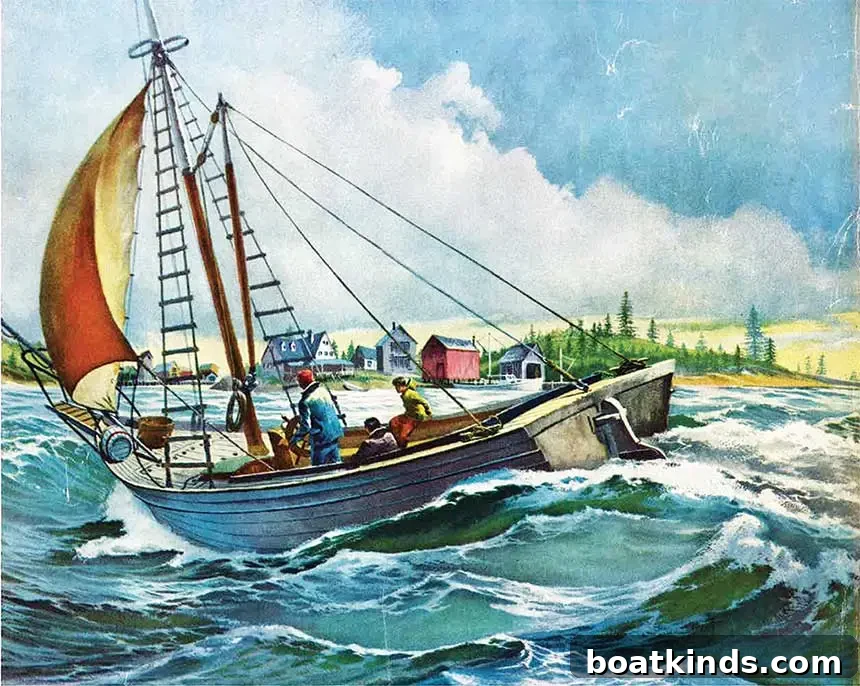
An old clinker-built fishing boat surges through a following sea and wind off the northern New England coast. The helmsman, wearing a red hat, leans with the motion as the bow thuds into the next wave; passengers brace along the cockpit coaming. Fishing gear—an unmistakable harpoon, a barrel float and a tub of line—crowds the foredeck. The portside hatch to the small cuddy is closed and the boom is hauled up. Everyone is bundled in jackets against the cold, wet spray.
This striking 1950s magazine cover, painted by James E. Mitchell, captures raw maritime energy: green water streaked with whitecaps, a heavy sky of migrating clouds, taut rigging and the constant, urgent sense of holding on. The composition emphasizes motion and tension—the bow digging into a swell, hands gripping a wheel—and it showcases the narrative power of mid-century illustration. At the time this work was published, many periodicals still commissioned original paintings for their covers; before photography completely dominated magazine art, talented illustrators like Mitchell set the visual tone for stories about boating and seafaring life.
Mitchell was a master of marine illustration and fine art. A New York native born in 1926, he trained at Brooklyn’s Pratt Institute and later studied in Paris, grounding his work in solid academic technique while refining a lively, expressive approach to maritime subject matter. From the late 1950s into the early 1970s he worked primarily in oils and casein, a milk-based paint that allows for bright, quick layers and a slightly matte finish—qualities well suited to depicting spray, clouds and weathered varnish on deck.
His illustrations and editorial work frequently explored boating themes. Mitchell produced covers and feature art for magazines and wrote on a range of nautical topics. Among his published pieces were essays and sketch projects such as “Hydrofoils: A Sketchbook for the Future,” “Motor Boating: History in the Making” and the adventurous “Pirates of Guadeloupe.” He also documented offshore racing firsthand: his sketchbook from the 1972 Southern Ocean Racing Conference, an around-the-world sail race, stands out as an example of his direct, observational approach.
Mitchell’s career bridged illustration and the gallery world. Over the years he mounted solo exhibitions in New York and Miami and served on the board of the American Society of Marine Artists, an organization that supports and promotes maritime painting and drawing. His ability to move between commercial illustration and serious marine art made him one of the relatively few artists of his generation to be respected in both arenas.
Today Mitchell’s paintings and illustrations remain sought after by collectors and institutions. Examples of his work are held in several prominent maritime collections, including the Submarine Force Library & Museum in New London, Connecticut; the U.S. Merchant Marine Academy in Kings Point, New York; and The Mariners’ Museum in Newport News, Virginia. These holdings reflect his lasting reputation as a chronicler of life at sea—someone who captured both the technical details of vessels and the elemental drama of weather, water and human effort.
Beyond the specific details of any single image, Mitchell’s art exemplifies a broader moment in mid-20th-century visual culture: an era when hand-painted covers conveyed mood and narrative in a single, carefully composed image. As photography became more prevalent, the demand for painted magazine covers declined, but the quality and impact of those illustrations endure. Mitchell’s covers and essays continue to remind viewers of an era when illustration was the primary visual language of adventure, technical reporting and maritime romance.
This article originally appeared in the September 2019 issue.