
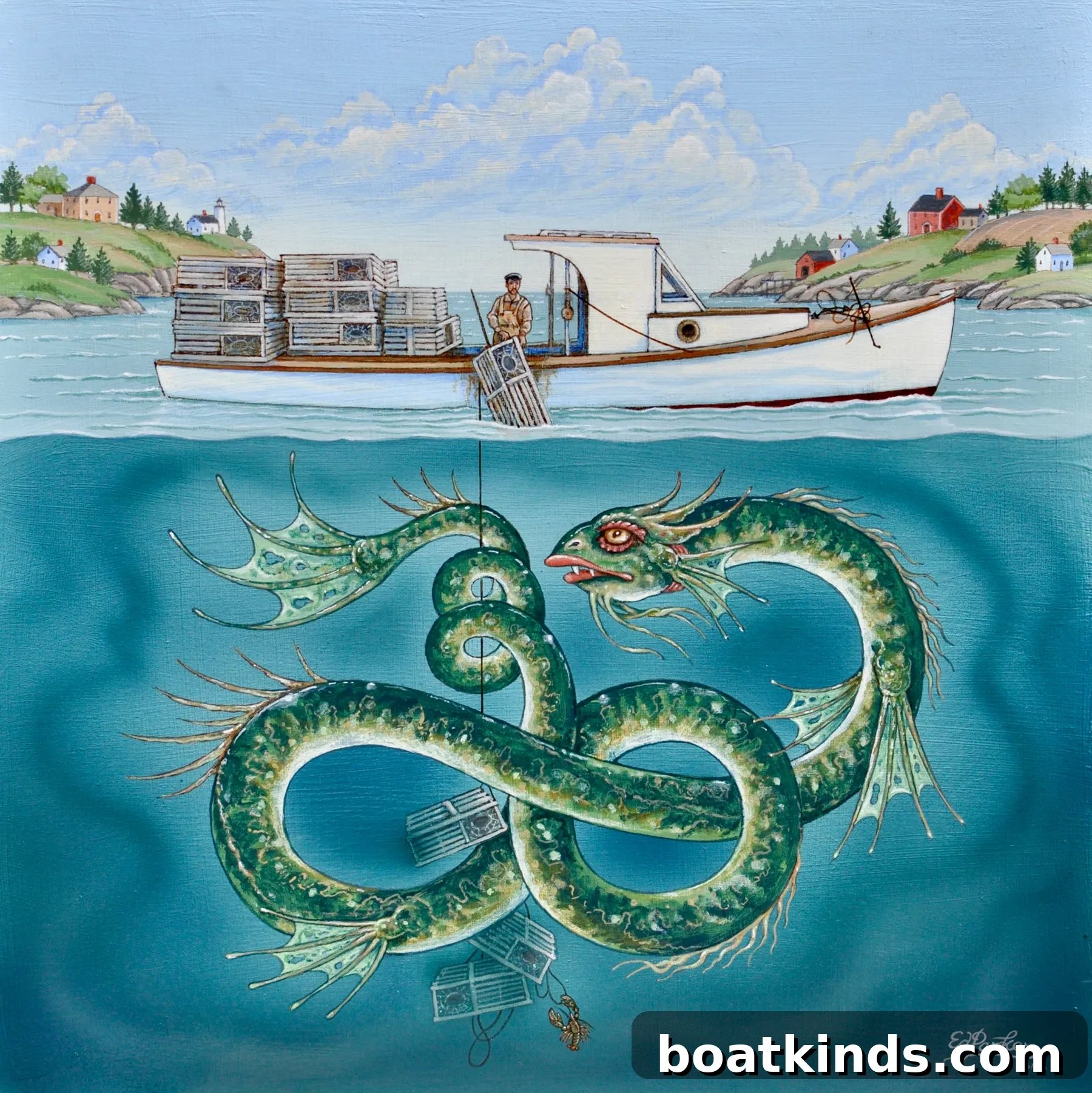
In Ed Parker’s painting The Lobster Trap, a lone Maine lobsterman lowers a string of crates into calm blue water beneath a clear sky. At first glance the scene appears serene and routine, but just beneath the surface a large, entwined sea creature clings to the lines, an unexpected presence that transforms the image into a warning. The composition contrasts everyday coastal labor with an unsettling, hidden force, and Parker uses that tension to explore how climate change is reshaping both the marine environment and the human communities that depend on it.
Parker has said the painting grew out of a report he read in The Boston Globe about dramatic environmental shifts affecting lobster fisheries in the Gulf of Maine. The article noted that ocean temperatures in that region have been rising faster than in most other places on Earth, with scientists pointing to melting ice in Greenland and the Arctic as one contributing factor. Freshwater flows from melting ice alter circulation patterns, and as the water warms, lobsters and other species begin migrating toward cooler, more northerly habitats. For New England’s lobster industry—an economic and cultural mainstay—those shifts carry immediate consequences: shrinking catches, changing seasons, and uncertainty about the future.
In Parker’s work the sea monster functions as a layered symbol. On one level it represents the literal threat to marine life and fisheries; on another it stands for the broader losses that follow ecological upheaval—the erosion of local traditions, the disappearance of distinct coastal cultures, the departure of younger generations who no longer see a viable livelihood in the fishery. “The culture is in as much jeopardy, I think, as the fishery itself,” Parker said in a telephone interview. “They’re so interlinked and younger people don’t see a lot of future in it.” The hidden creature, then, is less a monster from folklore than a visual metaphor for climate-driven change and the anxiety it produces in coastal communities.
Born in New England in 1946, Parker traces his impulse to make art back to an early, instinctive desire to tell stories visually. He studied at the Massachusetts College of Art and the Rochester Institute of Technology, and his career has moved through stages—from visual design to illustration and finally to painting—each period informing the next. Parker’s paintings draw on folk-art traditions in their narrative quality and pared-down forms, but he resists being confined by the label “folk artist.” Folk art, he notes, blends the real and the imagined in storytelling, and the sea offers ample room for that interplay. “We know more about outer space than we do about the ocean,” he said, suggesting that the ocean’s mysteries provide rich material for both imagination and social commentary.
Critics have recognized how Parker’s work marries historical references with contemporary concerns. The Atlanta Journal once described him as “Grant Wood with a Yankee sense of humor,” a phrase that captures how his paintings weave 19th-century maritime imagery and communal memory into depictions of modern threats: ecological decline, economic disruption, and cultural loss. By encoding allegory into everyday scenes—fishermen, traps, coastal landscapes—Parker invites viewers to look beneath the surface and consider what lies hidden in seemingly ordinary moments.
That invitation is central to what Parker considers effective art: work that prompts questions rather than delivering tidy answers. His paintings aim to generate discussion, to unsettle comfortable assumptions, and to draw attention to the human stakes of environmental change. The Lobster Trap, with its quiet sea and ominous creature, acts as a visual conversation starter about the future of Maine’s fisheries, the livelihoods they support, and the broader ecological forces reshaping northern waters.
Parker’s portrayal of a lobsterman at work, set against an ambiguous and partially concealed threat, reminds viewers that climate change is not an abstract issue but something that alters daily life for individuals and communities. The painting asks us to consider how cultural memory, economic stability, and biodiversity are intertwined, and how art can make those links visible and urgent without resorting to didacticism.
This article was originally published in the May 2024 issue.