
Marine radar has taken a significant step forward. Major manufacturers—Garmin, Furuno, Raymarine and Simrad—have released new solid-state radar systems and complementary electronics that give boaters the confidence to navigate safely at night, in fog or rain, and in busy waterways. Two of the new units, from Garmin and Furuno, incorporate Doppler processing to display real-time motion of targets, simplifying the interpretation of radar returns and improving situational awareness.
Industry observers say Doppler target-speed discrimination could be a genuine breakthrough for recreational boaters. Panbo.com editor Ben Ellison notes that Doppler’s ability to show direction and relative speed “takes much of the guesswork out of radar reading,” and many experienced boaters are likely to have “come to Doppler” moments once they see how it highlights moving contacts.
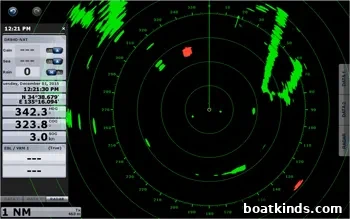
Doppler systems color-code approaching and receding targets to make interpretation immediate: Garmin’s implementation marks targets moving toward a vessel at 5 knots or faster as red and slower or stationary targets as green, while Furuno’s threshold is 3 knots. This clear visual cue helps skippers prioritize threats and make faster, safer decisions.
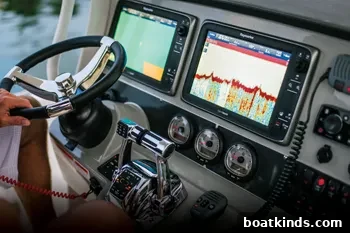
In addition to radar advances, manufacturers are introducing higher-resolution multifunction displays (MFDs), compact autopilots suited to smaller outboard-powered boats, enhanced sonar solutions, and thermal-imaging cameras for engine-room and situational monitoring. Collectively these innovations help create integrated, modern electronics packages that are easier to install and operate.
Garmin
Garmin launched a broad slate of products that span radar, chartplotting, autopilots and wearable instruments. Leading the lineup is the Fantom solid-state Doppler radar, supported by the high-resolution GPSMAP 84/8600 glass helm MFDs and the quatix 3 marine GPS smartwatch that streams NMEA 2000 data like speed, water temperature and fuel level.
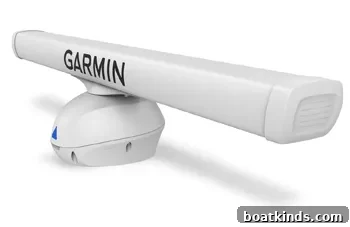
• GMR Fantom radar ($6,999–$7,499): A 40-watt solid-state, pulse-compression Doppler radar with MotionScope moving-target detection. Approaching targets faster than 5 knots appear red; stationary or slower targets appear green. Pulse compression provides high-resolution images from about 20 feet to 72 nautical miles. Available with 4- or 6-foot open-array antennas.
• GPSMAP 84/8600 ($7,399–$11,999): All-in-one “glass” helm displays that deliver very high screen resolution and fast chart drawing. Available in 17-, 22- and 24-inch sizes, these MFDs offer in-plane viewing for easier readability at acute angles.
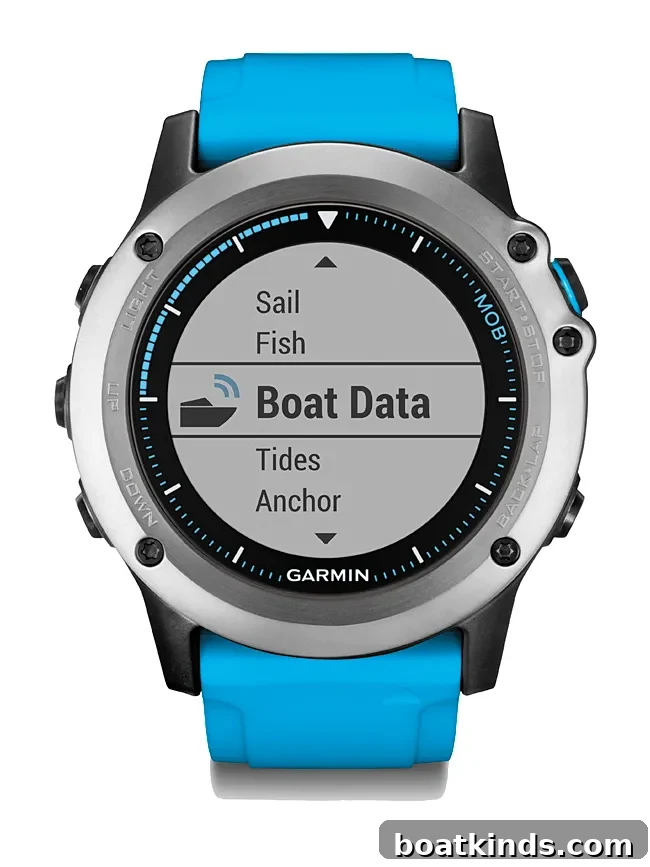
• quatix 3 marine GPS smartwatch ($599): Streams NMEA 2000 data from compatible electronics, including boat speed, depth and wind. It also includes multisport functionality and is readable in sunlight and water-rated to 100 meters.
Furuno
Furuno’s newest radar, the DRS4D-NXT, brings Doppler to recreational solid-state radar and emphasizes improved target clarity and safety. Furuno also released high-resolution standalone fishfinders and has integrated crowdsourced chart updates through the ActiveCaptain network into its top MFD platform.
• FCV628/588 fishfinders ($895 and $1,595): These standalone units incorporate RezBoost technology to sharpen sonar imagery using a conventional narrowband transducer, eliminating the need for more expensive broadband transducers in many installations.
• DRS4D-NXT radar ($2,600): A solid-state, pulse-compression radar with Doppler frequency-shift sensing (Target Analyzer). Echoes from vessels approaching faster than 3 knots show red; stationary or slower echoes show green. It includes RezBoost for clearer images, Bird Mode for automatic gain and sea-state adjustments, and Fast Target Tracking that briefly displays a selected target’s speed and course vector.
Raymarine (FLIR Maritime)
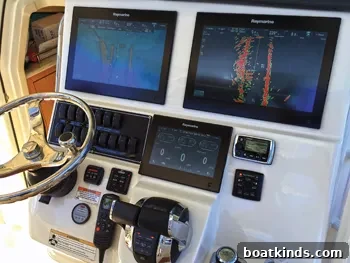
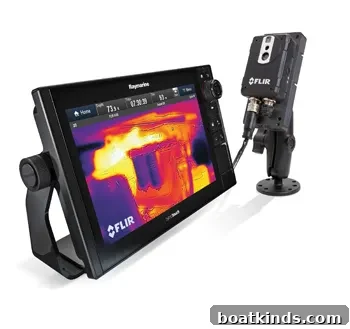
FLIR Maritime, which owns Raymarine, focuses on bringing advanced capabilities to straightforward, do-it-yourself installations. Its top new products include the Quantum solid-state radome radar, the eS Series MFD family and the FLIR AX8 thermal-imaging monitoring camera.
• Quantum CHIRP radar ($1,599.99): The first recreational radome to use CHIRP pulse-compression for superior close-range definition. It covers targets from about 9 feet to 24 nautical miles and is intended for boats under 35 feet. The unit uses Wi‑Fi for simplified cabling and installation.
• eS Series MFDs ($1,099–$3,549): Raymarine’s core MFD line running Lighthouse II software. Available in 7-, 9- and 12-inch screens with HybridTouch (multitouch plus keypad/knob control), these units include built-in Wi‑Fi, GPS and sonar and offer improved processing and memory over earlier models.
• FLIR AX8 thermal imaging system ($1,199): A compact thermal and visible camera package designed to monitor engines and other critical equipment. Integrated alerts can be displayed on compatible MFDs to warn of developing problems.
Simrad
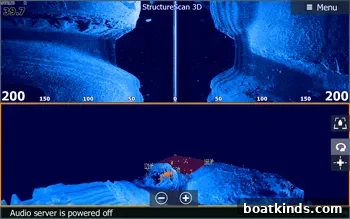
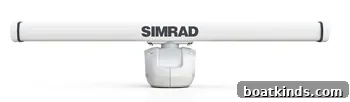
Simrad was an early mover to recreational solid-state radar and has continued to innovate with HALO radar and StructureScan 3D sonar. Simrad also expanded standalone plotter/sounder functionality with the GO XSE series.
• GO7 XSE ($599–$749) and GO5 XSE ($419–$469): Standalone plotter/sounders for smaller boats that include big-boat features such as NMEA 2000 connectivity, autopilot control head capability and support for ForwardScan forward-facing sonar.
• HALO pulse-compression radar ($4,500–$5,500): Combines close-range broadband accuracy with long-range detection, offering ranges from 20 feet to 72 nautical miles and modes optimized for harbor, offshore, weather and bird detection.
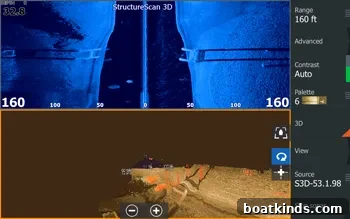
• StructureScan 3D ($999.99): Provides a three-dimensional sonar view showing fish, bottom contours and structure relative to the boat’s position. It currently integrates with Simrad’s NSS evo2 and NSO evo2 systems using the StructureScan 3D Skimmer transducer and module.
Magnetron vs. Solid-State Radar
Traditional magnetron radars emit a single, high-powered pulse on one frequency, which is effective but limited in the detail it can provide. Solid-state radar uses pulse compression and multiple frequencies to build a richer picture of the environment. As David Laska of L&L Electronics explains, solid-state radar is like switching from a single pencil to a set of colored pencils: it produces more information and greater target separation.
That extra information enables advanced processing such as Doppler frequency-shift detection. Solid-state systems also transmit at much lower power—typically 25 to 100 watts—so they draw less battery power, emit lower RF levels, and are ready to operate without the warm-up period required by magnetron radars.
Overall, the recent crop of solid-state radars and modern MFDs, sonars and thermal cameras are making navigation safer, easier and more accessible for recreational boaters. Whether you’re upgrading an older system or specifying electronics for a new boat, these technologies provide clearer situational awareness and more flexible installation options.
This article originally appeared in the June 2016 issue.