
The 1901 America’s Cup Trials: Herreshoff, Lawson, Constitution and Columbia
In 1901 the satirical magazine Puck ran a memorable Sept. 25 cover depicting “The Wizard of Bristol,” Nathanael Herreshoff, alongside Boston yachtsman Thomas W. Lawson. The cartoon captured their frustration as both men watched their prospective defenders falter in the run-up to the America’s Cup. For Herreshoff, a designer and builder whose creations had been the defending victors since 1893, the setbacks were rare and unwelcome. The episode highlights a pivotal moment in early 20th-century yacht design and competition, illustrating how small flaws in construction, spars, steering and hull form could decide the fate of a Cup challenge.
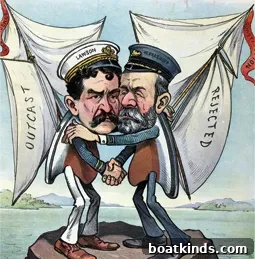
Herreshoff’s new entrant that year was Constitution, conceived as an improved, faster version of Columbia—the yacht that had claimed the Cup in 1899. Constitution aimed to refine Herreshoff’s successful formula, but in practice she proved uneven. On certain points of sail Constitution was quick, while on others she lagged behind. Persistent problems with her spars undermined performance, and her skipper, Uriah Rhodes, frequently voiced complaints about sail shape and handling. Those shortcomings made it difficult for Constitution to deliver the consistent, all-weather performance expected from a defender of the America’s Cup.
Throughout the season Constitution faced Columbia, commanded by the accomplished skipper Charlie Barr, in twenty-two races. Eighteen of those contests were completed; each boat recorded nine wins. The head-to-head results showed that while Constitution could match Columbia in bursts, Columbia was the steadier boat across a broad range of conditions. Race selection for Cup defense favored reliability and versatility, and Columbia’s consistency earned her the nod to represent the defending club against Sir Thomas Lipton’s Shamrock II. In the subsequent America’s Cup match, Barr and his crew prevailed decisively—winning the Auld Mug in three straight races—proving that a proven, dependable design could outperform a faster but less balanced newcomer.
Meanwhile Boston yachtsman Thomas W. Lawson sought to win the right to sail for the Cup by taking on the New York Yacht Club requirement that defenders be members. To qualify, Lawson participated in a trial series organized by the newly formed Newport Yacht Racing Association. His entry, Independence, was designed by noted Boston naval architect B.B. Crowninshield and showed some promising traits, including burst speed in certain conditions. However, the boat struggled in head-to-head trials.
Independence raced four times against Constitution and Columbia combined and twice against Columbia alone, losing every contest. Mechanical and structural issues compounded her troubles: faulty rudder and steering systems made precise handling difficult, and damage to her bow during delivery to Newport caused water ingress in the first two races. Those early mishaps compromised performance and reliability at a critical stage. With significant defects and little prospect of rapid improvement, Independence was withdrawn from competition and scrapped just three months after her launch.
Herreshoff took careful note of Independence’s characteristics. He observed that Independence’s flat, scow-like hull form produced sudden bursts of speed under the right conditions, despite her other flaws. Those observations influenced his thinking for the next defender. In 1903 Herreshoff delivered Reliance, a yacht that would incorporate lessons learned from both Constitution’s mixed performance and Independence’s hull geometry. Reliance became one of the most famous defenders in America’s Cup history, illustrating how iterative design—learning from competitors as well as from one’s own failures—drove advances in yacht performance.
The 1901 trials underline how the America’s Cup has always been as much a contest of naval architecture and engineering as it is of seamanship. Small differences in hull shape, weight distribution, spar design and steering systems can tip a closely matched series. They also show how designers like Herreshoff analyzed setbacks, adapted promising ideas from rivals, and pushed the boundaries of yacht design. The season stands as an instructive chapter in the evolution of competitive sailing and the relentless pursuit of speed and reliability on the racecourse.
October 2013 issue