
“There’s the emotional side—moments of terror, tedium, anxiety,” says New York–based artist and casual sailor Zoë Sheehan-Saldaña, 49, describing her first Race to Alaska, a 750-mile dash from Port Townsend, Washington, to Ketchikan, Alaska. The event allows only wind and muscle power and forbids outside assistance. “Then there were moments so beautiful you couldn’t believe you were there. Being so close to the water made me feel intensely vulnerable. If anything goes wrong, you’re fully in it—there’s no boundary.”
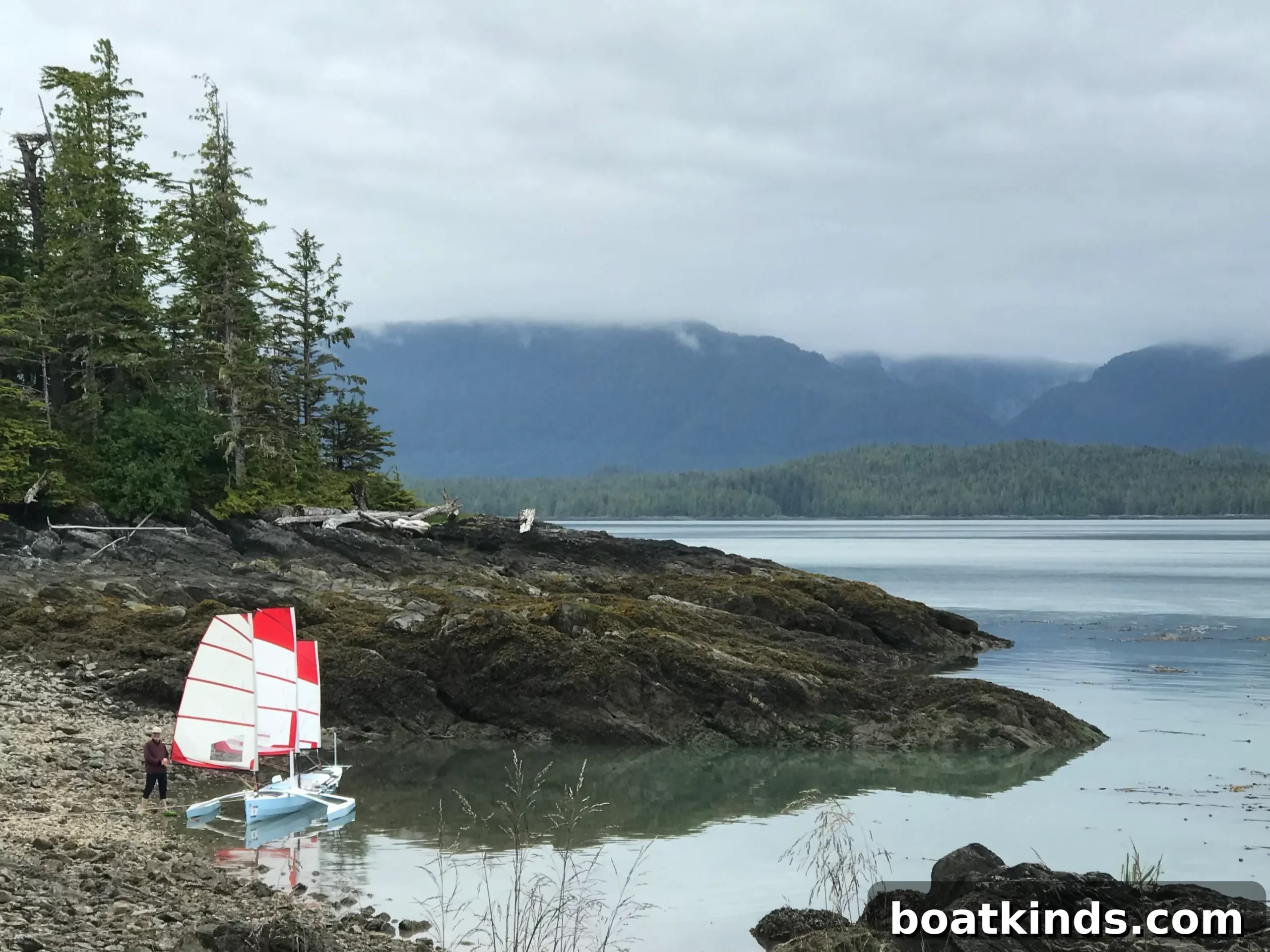
Sailing a small, self-built plywood trimaran with three rigs and minimal living space, Sheehan-Saldaña and her partner Joachim Rösler faced towering seas, fierce currents and winds that swung from calm to gale in an instant. The two alternated hard rowing with smart sailing, endured torrential downpours and basked in moments of perfect sun. They found solitude and the company of whales amid snowcapped peaks, dark coastal forests and the variable waters of the Inside Passage. At the finish in Ketchikan they simply rang the bell and cracked a beer.
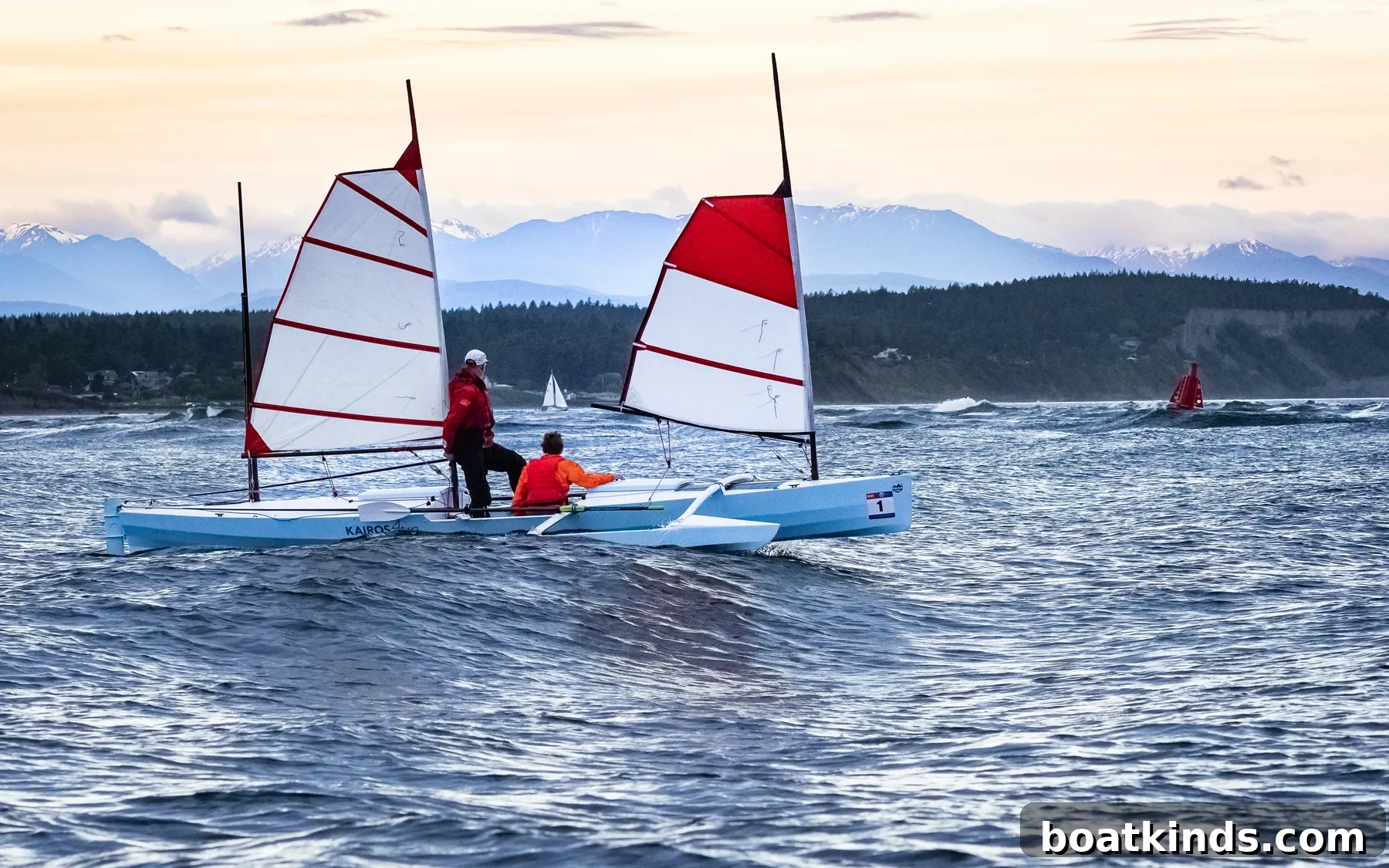
Launched by the Northwest Maritime Center in Port Townsend in 2015, the Race to Alaska—known as R2AK—is a rugged, egalitarian event that attracts a wide range of boats and sailors. The website jokingly claims the only rule is “no rules,” but in reality the regulations are intentionally sparse. Entrants may bring almost any craft: high-tech carbon racers, beach cats, trimarans, home-built contraptions, century-old fishing cutters, paddleboards, kayaks, rowing shells, sharpies or salvaged hulls repaired on a shoestring. When there’s no wind you may row, paddle or pedal, but you may not rely on a shore support crew. Pass the pre-race safety inspection and you’re cleared—then you’ll quickly discover what you’re made of. If you don’t finish, your race ends as a DNF; otherwise, you’ve won, even if you don’t take home the $10,000 nailed to a piece of firewood for first place or the second-place set of steak knives.
“You can’t race on adrenaline alone. You have to find a rhythm and plan for shore support every three to five days,” warns Rösler, 66, a retired publishing executive from upstate New York. He’d attempted R2AK twice as a solo sailor before—finishing once and being sidelined the other time by a technical failure that couldn’t be fixed with just blood, sweat and duct tape. He’s long been fascinated by the race not only for its adventure and route through the Inside Passage, but for how it challenges conventional boat design and tactics.
Preparation and strategy matter because conditions often defy forecasts. “Mentally it’s a marathon,” he says, likening the planning to a chess match where you must think several moves ahead. Raised on Lake Constance near the Swiss border, Rösler learned on traditional keelboats and athletic dinghies. After moving to the U.S. more than 30 years ago—partly to pursue paragliding, where he met Sheehan-Saldaña—he tried other long coastal challenges such as the Everglades Challenge. “My R&D is 50 years of boating,” he jokes, explaining why he decided to build a custom two-person boat for R2AK.
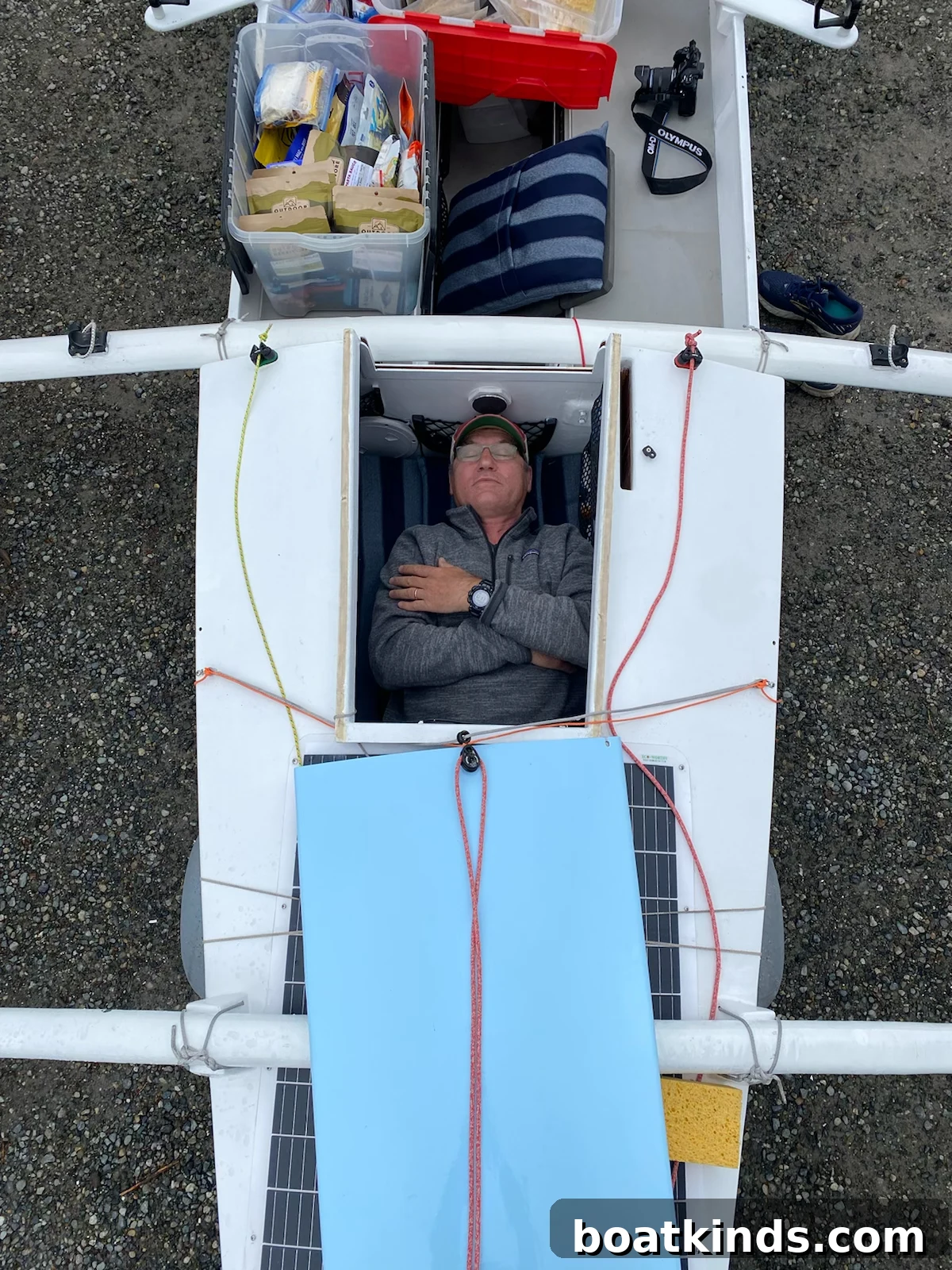
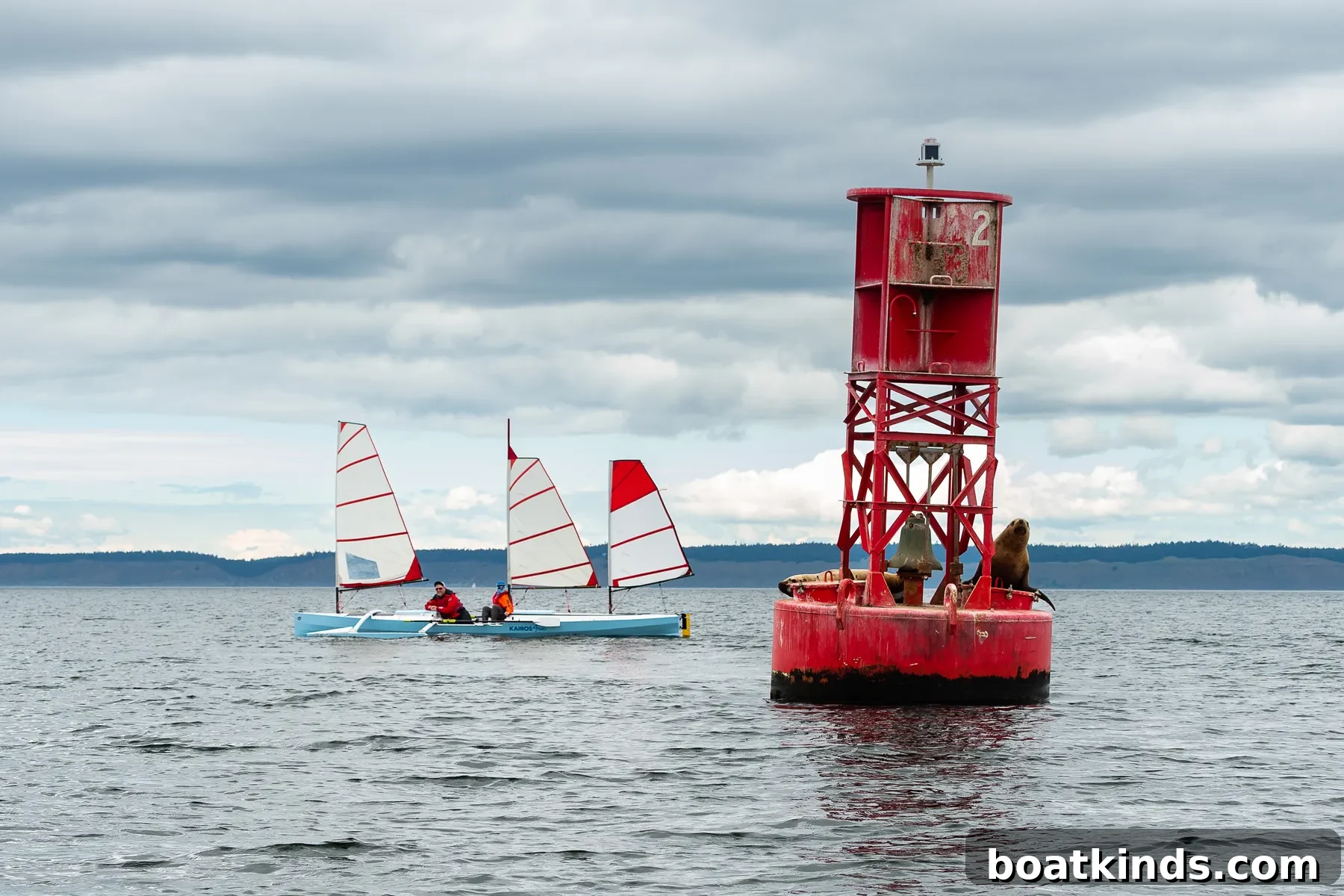
Rösler worked in his garage with sheets of plywood, fiberglass and epoxy to build a larger version of a RowCruiser by Canadian designer Colin Angus, whom he admired for rowing and sailing around the world under human power. He christened the boat Kairos and modified the design to carry two people: two small cabins—one forward for his 6-foot frame and a smaller aft berth for Zoë—and a central rowing station with a sliding seat. “Having a dry, comfortable spot to stretch out is crucial for rest,” he explains. By day they’d move; by night they’d sleep in protected anchorages.
Kairos 4Two retained the short amas from Rösler’s previous boat and used two carbon oars. It carried three interchangeable carbon masts with full-battened sails that combined to a maximum area of 130 sq. ft., plus an off-center daggerboard for sharper tacking in flat water. With rudder and daggerboard raised the draft was only two inches, allowing access to shallow refuges off-limits to larger craft. Toilet facilities were basic—bucket and toss, preferably downwind of your partner—and freshwater was carried in plastic bottles for about five days, with streams available for refilling. Rösler paid attention to small details like secure bottle caps that won’t pop off if dropped or squeezed.
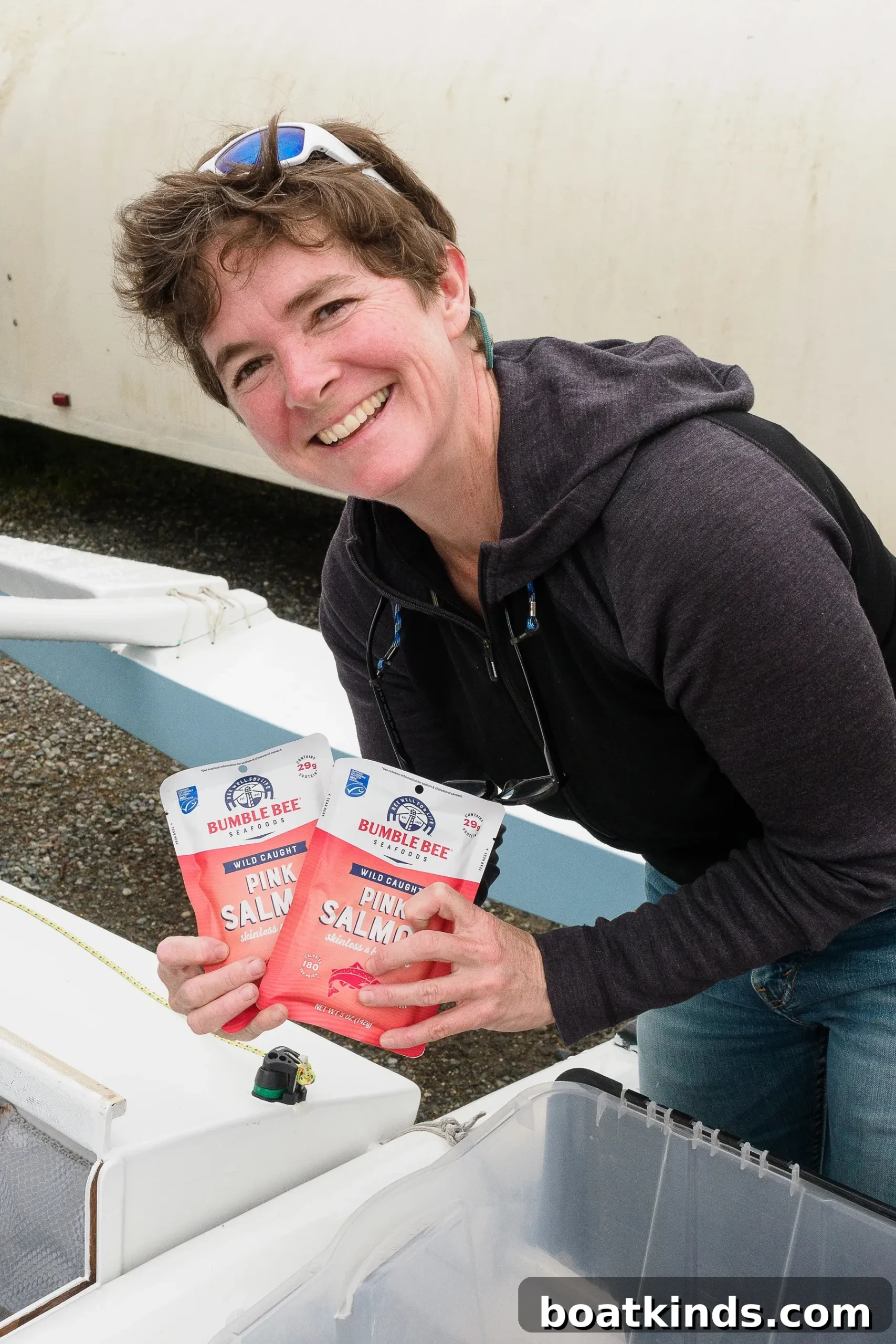
Team Fix oder Nix—Rösler and Sheehan-Saldaña—provisioned in the Maritime Center parking lot while other teams were still finishing boat builds nearby. Rösler took care of simple but critical items: protecting phone charging cables from saltwater and taping fingers to prevent blisters. “I still get them,” he admits, “but it hurts less if I tape before they occur.”
On a shake-down sail off Point Hudson, Kairos 4Two felt light and efficient in light to moderate airs, helped by a narrow 3-foot-10-inch main hull and wave-piercing amas lashed to the akas with spectra line. Control lines, sheets and a carbon tiller were all within reach in the cockpit; even a converted frog jigging pole lived there for miscellaneous tasks. The autopilot ran on a lithium polymer battery recharged by a 130-watt solar panel on the foredeck, and navigation phones were backed up by portable power banks.
Reefing required a crew member to go forward, lower the mast, strip and roll the sail for stowage, so reducing canvas early was essential. With water temperatures near 50°F, a man-overboard scenario had grave implications, so prudence ruled: they sailed in dry suits and PFDs and only changed into dry clothes or took sponge baths once safely at anchor for the night.
“My measure of success is that we still like each other after we cross the finish line,” Sheehan-Saldaña joked the night before the start. She trusted Rösler’s risk management, and he promised to temper his pace given her lesser experience. That promise was tested within an hour of the 5 a.m. start, when a strong ebb ran into a building westerly and produced giant swells in the Cabbage Patch off Point Wilson. Some boats capsized and needed Coast Guard rescue; Fix oder Nix avoided capsizing but spent two frustrating hours making negative or negligible progress, surfing erratically until they cleared the worst of it near Whidbey Island. Rösler steered while facing aft and Zoë bailed out the cockpit.
By nightfall they had logged distance but not forward progress, so instead of pushing on to Victoria, B.C., the first-stage finish, they returned to Point Hudson and waited for a weather window. They managed the 40-mile crossing in the early hours two days later. A light early dusting of ice and sea spray affected them later when they encountered rip currents and tidal rips, causing them to be more cautious than perhaps necessary.
Rösler’s tactical philosophy is simple: don’t fight the elements when they’re stacked against you; wait and take advantage when conditions turn favorable. “When conditions were in our favor, we maxed them out. We never missed an opportunity,” he says.
Sheehan-Saldaña found the water and wind interactions unlike any she’d experienced. “In the Royal Princess Channel we rowed into a constant opposing current for two days. It never turned to a flood,” she recalls. In the Grenville Channel a supportive current ran into a strong headwind; later the northwest wind kicked up to 15–25 knots, leaving them bobbing in Lowe Inlet for a day until it eased.
They finally rang the finish bell in Ketchikan after 21 days, 7 hours and 25 minutes—more than 17 days after the Riptide 44 team skippered by Jonathan McKee. Officially 18th out of 19 finishers, their placing belies the larger story: more than a dozen teams abandoned the race, and for Fix oder Nix the priority was the experience and keeping their relationship intact. Aside from losing a cell phone to the salt of Victoria Harbor, they completed what they set out to do. Will they return? No—at least not anytime soon.
“We can suffer in some other environment,” Sheehan-Saldaña laughed in a post-race chat. “We did very well together. We still get along.”
This article was originally published in the November 2022 issue.