
Low Chart-Update Rates Raise the Risk of Navigational Surprises
With electronic chart update rates reported as low as 8 percent, the Alliance for Safe Navigation is warning recreational boaters about the growing risk of navigational surprises. Many boaters assume their local charts—paper or electronic—remain accurate year after year, but both natural forces and human activity constantly alter depths, channels, markers and other navigational features.
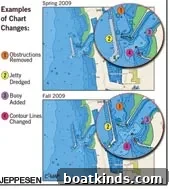
Shifting sandbars, dredging, relocated channel markers, new obstructions and temporary security zones can appear with little warning. Some changes are obvious on the water; others are subtle and won’t be visible until a grounding or collision occurs. Because of this, keeping nautical charts up to date is a central element of safe navigation, whether a boater relies on paper charts, chart plotters, or electronic navigation on a tablet or PC.
Boating safety professionals note that recreational charts are often several seasons out of date. Bob Sweet, national education officer for the U.S. Power Squadrons, says many pleasure boaters regularly use charts that are three to five years old. Ken Cirillo, business development executive for Jeppesen (formerly C‑Map/USA), adds that complacency is common: “People are not as concerned about safety as they should be.” Jeppesen and member organizations in the Alliance for Safe Navigation have published guidance to highlight the scope of the problem and encourage routine updates.
The alliance’s white paper summarizes government and industry research showing the real-world consequences of outdated or inaccurate charts:
- Approximately 6,400 recreational boating accidents occur in the United States each year.
- Collisions account for about 80 percent of all accidents, producing nearly 100,000 insurance claims and more than $450 million in annual losses.
- From 2004 through 2007, more than 2,500 accidents were caused by striking a fixed object.
- In that same period, over 1,400 reported groundings resulted in more than $16 million in damages.
- Groundings rank as the third-most common reason for assistance calls to TowBoatU.S., after battery problems and engine failure.
“Relying on charts that are even a few seasons old is an unnecessary gamble that could cost you your boat—or worse,” Cirillo says. He notes that navigational data and charting technology have both improved significantly over the past decade, but many boaters have not adopted a regular update routine.
Historically, boaters updated paper charts by making manual corrections from the Coast Guard’s weekly Local Notice to Mariners, which reports hazards to navigation, buoy changes, obstructions and dredging. Since 2000, sport boaters have had another affordable option: official NOAA Print-on-Demand nautical charts are available through providers such as OceanGrafix, which incorporate ongoing updates and corrections for a modest fee.
The rise of consumer GPS and digital chart displays has transformed how many boaters navigate. A survey by OceanGrafix and the Power Squadrons found that roughly 70 percent of recreational boaters use paper charts primarily as a backup to electronic chartplotters or PC-based navigation systems. Chart producers typically offer regular digital updates, often priced in the neighborhood of $100 per year. Despite those options, the survey also found that many boaters depart with outdated charts, whether paper or electronic.
Electronic charts offer clear advantages—simpler updates, flexible displays and features such as alarms for approaching hazards—but adoption of update routines remains low. Cirillo reports that only about 8 to 10 percent of Jeppesen customers regularly update their electronic charts. Jeppesen’s Club Jeppesen Marine, with roughly 5,700 members, provides an annual update option for about $79 per year, illustrating that affordable subscription-based updating exists but is underused.
Part of the challenge is convenience. Updating electronic charts is not always a plug‑and‑play experience, and many boaters delay action simply because the process feels cumbersome. Cirillo and others advocate for navigation software and hardware that make updates easier, and they have encouraged insurers to provide premium discounts to policyholders who document regular chart updates. Some marine service companies have been receptive to the idea; larger mainstream insurers have sought documented proof of regular updates before offering incentives—one reason the alliance produced its white paper.
To better understand barriers to routine updating, the Alliance for Safe Navigation plans further outreach and surveys of pleasure boat owners to determine whether cost, a false sense of security, inconvenience or other factors are the main deterrents.
Members of the Alliance for Safe Navigation include Jeppesen, the U.S. Power Squadrons, OceanGrafix, BoatU.S. and Sea Tow, with sponsorship support from NOAA. The alliance emphasizes that keeping charts current is a practical, cost-effective way to reduce the risk of collisions, groundings and expensive damage.
Boaters should make chart updates a routine part of voyage preparation: check the latest Local Notice to Mariners, compare electronic and paper charts, and consider subscription update services or periodic print-on-demand charts to ensure navigation information reflects recent changes. Small investments in up-to-date charting can prevent large losses and keep recreational boating safer for everyone.
This article originally appeared in the August 2010 issue.