
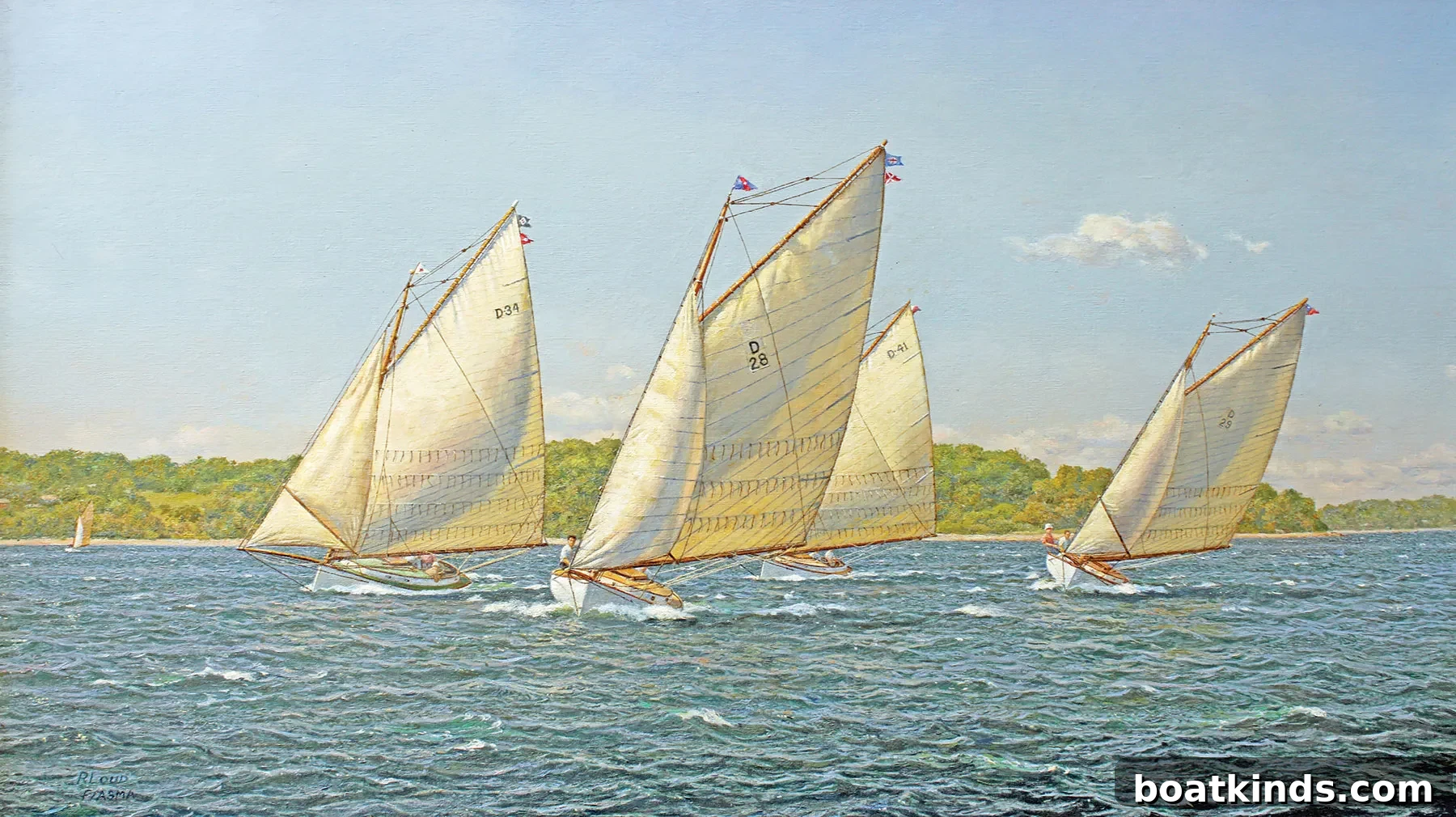
Catboats Racing off Cape Cod — Richard Loud (23×40 Oil Painting)
This bold 23×40 oil painting, titled “Catboats Racing off Cape Cod,” captures a fleet of catboats from the Quincy Yacht Club beating to windward. At first glance it is an exciting nautical racing scene; on closer inspection it reveals layers of history, craft, and personal memory that inform Richard Loud’s work. The painting serves both as a vivid maritime image and as a testimony to the artist’s long connection to New England boating traditions.
Loud draws on decades of direct experience with boats and boatpeople. He was a member of the Quincy Yacht Club in the 1960s and grew up amid the sights, sounds, and technical knowledge of his father’s boatyard in Quincy, Massachusetts. Those formative experiences—watching hulls take shape, hearing the slap of halyards, and absorbing the visual archive of old race photographs—give his depiction of catboat racing a lived-in authenticity. The painting is not just a scene from memory; it is a reconstruction informed by intimate familiarity with boats, rigging, and regional style.
Quincy, located on a bay south of Boston, was a focal point for regional catboat racing in the 1920s. Local builders such as C.C. Manley adapted traditional fishing catboat designs into competitive racing craft, producing fast, seaworthy hulls that sometimes reached 28 feet in length. Loud’s painting pays particular attention to the features associated with the local “D” Class cats: pronounced bowsprits, sweeping headsails, and the stout, balanced hulls that allowed these boats to excel upwind. These historical details anchor the work in a specific time and place, giving viewers an informative glimpse of early 20th-century New England racing boats.
Technically, the painting balances representation and impression. Loud’s background includes time spent as a deckhand on a 114-foot motor yacht and work as a draftsman when he was a young adult. Those hands-on roles sharpened his eye for proportion, motion, and the interaction between a vessel and its element. In this piece, the wind seems to move the canvas: sails brim and sheets tighten; spray arcs off bows; rigging vibrates with tension. Details such as sail shape, crew positioning, and wake patterns are rendered with enough precision to satisfy boating enthusiasts, while brushwork and atmospheric color maintain an emotive sense of sea and weather.
Maritime artist John Stobart commented on Loud’s approach and skill, noting that “His love of the turn-of-the-century yachting scene and dedication to the excellence of the craft sets him high above others in the field. But the real guts of Richard Loud’s work lies in an intuitive understanding of how ships relate to their element, how the wind hums in their rigging and the water dances around their hulls.” That praise highlights Loud’s dual strength: technical competence informed by emotional sensitivity to maritime life.
Beyond historical accuracy and technical skill, “Catboats Racing off Cape Cod” communicates the exhilaration of small-boat racing—the tight angles of attack, close-quarters competition, and the constant negotiation between wind and hull. The painting invites both sailors and art lovers to linger over compositional choices: the rhythm of overlapping sails, the balance of light and shadow on the water, and the way figures are suggested rather than fully detailed, preserving the painting’s energetic immediacy.
For collectors and admirers of maritime art, this work is representative of Loud’s ability to translate regional nautical history into compelling visual narrative. It functions as historical document, aesthetic statement, and personal homage to a culture of boatbuilding and racing centered in Quincy and along Cape Cod’s coastline.
This article was originally published in the July 2021 issue.