Dick Pulsifer fashions functionality and beauty from a century-old tradition in his Maine workshop

We are, in many ways, shaped by our surroundings, and that is certainly true of Dick Pulsifer, a wooden-boat builder in Brunswick, Maine. As a boy he grew up to the rhythm of single-cylinder “one-lunger” engines powering small wooden fishing boats along the New Meadows River in the pre-dawn hours. Imagine the clatter and staccato of a Chitty Chitty Bang Bang–style motor and you have the sound that stayed with him.
Those inshore fisheries became his world, and for decades he has built the boat that captured his imagination: a proven Hampton-type hull that has served New England fishermen for more than a century. Pulsifer Hamptons are strip-planked wooden launches, practical for hauling lobster traps or taking the family out for a day on the water. Each 22-foot Pulsifer Hampton is handcrafted and takes roughly 450 hours to build; at the market peak a few years ago Dick completed five- and six-boat years, but demand has softened as the economy reduced discretionary spending. New boats are priced at $47,250.

Visiting Dick’s shop is like stepping back in time. He maintains the wooden-boat tradition in every detail and continues to produce a few boats a year despite a challenging market. “The boat in the back shed, the one I’ll take to the Portland boat show, was built on spec, and so is this one I’m working on now,” Dick says. He notes the frustrations of slow sales but emphasizes that buying quality components in volume still saves money; he currently has about $5,000 invested in shaft logs and shafts from Ron Thomas in Franklin. Ron’s shaft logs, Dick says, are almost pieces of art—built heavy and durable enough to feel substantial when you swing one around the shop.
The man behind the boats
Dick’s path to boatbuilding was almost accidental. To avoid the draft in the early 1960s he joined the Navy and served from 1963 to 1967. Returning to Brunswick, a one-lunger engine he acquired from friends at Bowdoin College found its perfect platform in a Hampton launch he discovered in 1969. He ran that boat for 18 years while working in the boat trade. By 1987, after the original launch had deteriorated, he built his own Pulsifer Hampton, hull No. 27, to carry the faithful one-lunger.

Dick values authenticity. The original Hampton he owned had archaeological value as a locally built hull, and he rejected the idea of fiberglassing it. “You can’t refasten strip-planked boats easily since the planks are edge-nailed and inaccessible,” he says. Fiberglass may prolong some old boats, but for Dick it disfigures their character.
He’s a traditionalist in other ways: he prefers letters or phone calls to email or cell phones, though he maintains a website for necessary modern visibility. In his shop he listens to classical music on NPR while he works. He also appreciates exhibits that preserve the region’s fishing heritage—like the lobstering display at the Maine Maritime Museum that shows the wooden boats with automotive engines he remembers from childhood.

“The Pulsifer Hamptons are made to fish,” he says. “Haul lobster traps, firewood, dogs and camp supplies; swim from; tow kids on floats; or just cruise around. They’re not picnic boats.” He mostly works alone but occasionally mentors Bowdoin College students who help in the shop. His building philosophy follows the original local practice: use available materials—selectively—and build boats that serve fishermen, not trends.
A versatile sea boat
The Pulsifer Hampton is a Down East design with a fine entry, round bilges, a built-down (hollow) keel, plumb stem and flat buttocks aft that provide lift for planing. The built-down keel is created by a radius in the ribs so the hull curves down to meet the keel, adding low buoyancy that reduces immersion at the bilge and increases weight-carrying capacity. The full keel resists the rudder in a turn but stops short of the stern to reduce the tendency to run straight; round bilges allow the stern to slip sideways more readily than a hard-chine boat, a useful trait for hauling traps. Built-down boats are known for seaworthiness more than outright speed.
Compared with modern wide, heavy hulls, the modest-beam Pulsifer Hampton is efficient and comfortable in a seaway. Riding a semidisplacement hull with the center of gravity slightly forward, it runs comfortably up to a 13-knot top end without a pronounced hump speed—the boat simply accelerates smoothly as you add throttle. The balanced rudder steers easily and makes handling at low speeds or when backing straightforward. Dick builds a solid barn-door rudder from 1-1/8-inch oak, fastened with 3/4-inch silicon bronze rods.
Typical propulsion is a 290-pound, 29-hp Yanmar diesel with a deep 3.22:1 gear turning a 1-1/4-inch stainless-steel shaft and a 17-inch-diameter by 16-inch-pitch four-blade Michigan DQX propeller. The 2,200-pound boat planes easily at about 11 knots and reaches just over 13 knots wide open, with fuel consumption topping out around 1.5 gallons per hour—an efficient small diesel platform.
Part of reliable operation lies in clean fuel. Dick advises owners to fill a container and let any sediment settle before transferring fuel to the tank to avoid drawing sludge or water from the nozzle. Owners typically log about 100 hours a season, often starting mid-June when the water warms; Dick estimates roughly 20 gallons of diesel used in 60 hours of running time for typical seasonal use.
The makings of a Pulsifer
All the wood used in a Pulsifer Hampton—white pine, cherry, cedar, and red and white oak—is local, much of it harvested from Dick’s own 25-acre waterfront property. Major structural members—stem, knee, keel, deadwood, horn timber and sternpost—are red oak for its ability to absorb preservative. Cedar is prized for stability with changing moisture; pine is used carefully because it dries more. All lumber is air-dried on stickers for months or years and is winter-cut to reduce sap content.
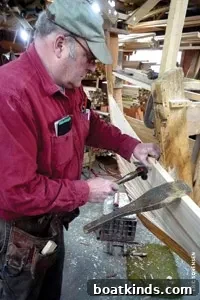
Dick builds efficiently: he makes groups of parts—six transoms at once, long runs of planed strips—to save time and reduce one-off mess. Strip planks are ripped from clear, knot-free pine to ensure reliable spring and fairing. The backbone is bolted together, temporary molds are set, the transom is braced, and the strip planking begins. Strips are edge-nailed with silicon bronze ring nails and are fastened to ribs and floor timbers every fourth or fifth plank, more often at the turn of the bilge. Oak floor timbers are screwed with bronze fasteners and bedded with 3M 5200 adhesive. Keel bolts are back-bored and bunged; moisture-tight joints are achieved with pine plugs dipped in pine tar that swell once in the water.
Once planking is well advanced, oak ribs are steam-bent and fitted, the sheer clamp is shaped to the hull, and mechanical installations—shaft log, engine beds, spray rails, deck beams and hatches—are installed. The hull exterior is faired using lightweight auto body filler, followed by aggressive sanding and a grain-raising process using hot water to lift compressed fibers, then additional sanding and priming. Finish coats are oil-based marine enamels; the bottom is treated with water-based antifouling for shop comfort.
Tender loving care
With proper maintenance, a Pulsifer Hampton will last for decades. Dick cites his first boat from 1973, Walrus, as evidence that well-cared-for wooden boats endure. He emphasizes the practice of keeping a boat “salted” during the season—rinsing with salt water rather than fresh water—to help preserve timbers and hardware. He also avoids gluing strip planks so water can wick between seams and ventilate the structure; ample air circulation through vents, gaps and hatches helps prevent rot.
Bilge protection follows a traditional formula often called schooner deck finish, a mix of pine tar, turpentine, linseed oil and a small amount of Japanese dryer. This, plus a wood preservative, helps protect the structure before the deck goes down. The Pulsifer’s deck sits near the waterline so water drains into the bilge; robust bilge access hatches and vents make maintenance straightforward. Dick notes that the aft deck is installed tight as a drum, and interior decking is arranged for easy removal where needed.
Dick currently maintains about 50 of the 107 Pulsifer Hamptons built to date, refinishing them each fall and storing them for winter so they’re ready for spring launching. Annual fall work typically includes a fresh coat of bottom and topside paint and a clear alkyd coating on side decks and interiors to preserve the wood’s natural look.
For enthusiasts who value tradition, craftsmanship and seaworthy performance, Pulsifer Hamptons are efficient, versatile 22-foot diesel launches that reward the extra care wooden boats require. They are built to work and to teach new generations about life on the water—without iPod hookups or flat-panel distractions, at least from Dick’s shop.
Contact information: Phone (207) 725-5457. Website: www.pulsiferhampton.com. Email: [email protected].
This article originally appeared in the October 2010 issue.