
Retrofitting Boat Refrigeration with Isotherm’s Quick-Mount Bracket

Retrofitting a Isotherm refrigeration cooling system on a boat has become a straightforward, homeowner-friendly project thanks to Isotherm’s quick-mount bracket. For many owners, installing new refrigeration equipment is one of the most satisfying improvements you can make to a boat: it’s practical, improves comfort at sea, and—done right—can be completed without specialized plumbing or complex fabrication.
Compact Design, Smaller Footprint
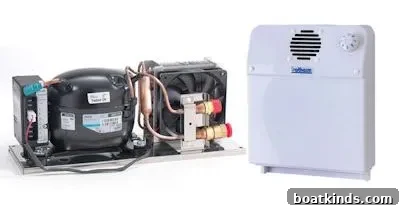
Isotherm’s line of refrigeration components is notable for its compact design and small footprint, which makes finding a suitable installation location on board easier than with many traditional systems. The range includes very small units designed to cool a single refrigerator compartment and larger models capable of cooling both a refrigerator and a freezer simultaneously. That range of sizes gives boat owners flexibility to pick a unit that matches their cabinet space and cooling needs without oversizing the compressor/condensing unit.
Air-Cooled Convenience: No Plumbing, Less Fuss
One of the biggest practical advantages of Isotherm’s air-cooled systems is the lack of plumbing required for the condenser. Air-cooled refrigeration eliminates the need to run seawater or freshwater lines for heat exchange, which simplifies installation and reduces potential leak points. For DIYers, that means fewer tools, less risk of water intrusion, and a shorter install time overall. Defender Purchasing Coordinator Scott Crawford sums it up well: “These little units from Isotherm are very effective, and as far as installation goes, an air-cooled system is as easy as it gets.”
Placement and Ventilation: Key to Performance
Choosing the right location for the compressor and condensing unit is critical to achieving optimal cooling performance. Because air-cooled systems rely on ambient air to condense refrigerant, the unit must be placed where there is adequate ventilation and airflow. Avoid small, unventilated lockers and engine compartments where heat can build up and reduce efficiency. Similarly, locating the unit where the fan can draw in cool bilge or deck-level air will help the system shed heat more effectively and lower operating temperature.
Good ventilation also helps the compressor run cooler and quieter, improving longevity and comfort on board. Take care to provide unobstructed intake and exhaust paths and consider simple baffling or ducting if the chosen space tends to collect warm air.
Energy Use and Warranty
Isotherm products are engineered for efficiency. Depending on the model, typical maximum power draw falls in the range of roughly 2.5 amps to 6 amps, which makes these units suitable for a wide range of electrical systems found on boats. Lower current draw can reduce demands on battery systems and shore power while still providing reliable cooling.
Isotherm supports its compressors with a five-year warranty, reflecting the manufacturer’s confidence in the design and offering boat owners additional peace of mind after installation.
Why This Is a Good DIY Upgrade
For many boat owners, the combination of a compact footprint, air-cooled simplicity, low power draw, and a robust warranty makes Isotherm’s refrigeration line an attractive retrofit option. The quick-mount bracket reduces installation time and complexity, while the lack of plumbing lowers the chance of leaks and the need for specialized hoses or seacocks. When paired with sensible placement and adequate ventilation, these systems turn a potential refrigeration headache into a manageable, rewarding DIY project.
When planning a retrofit: measure the available space, select the model that matches your refrigeration capacity needs, prioritize a ventilated location for the compressor/condensing unit, and follow the manufacturer’s installation guidance. If you prefer professional help, most marine service shops are familiar with air-cooled refrigeration installs and can assist with mounting, electrical connections, and final commissioning.
For additional details about specific Isotherm models and installation options, refer to the product documentation provided by the manufacturer or consult your chosen marine parts supplier.