
St. Augustine, Fla., serves as a convenient stopover for sportfishing skippers and bluewater sailors traveling the Eastern Seaboard. The city offers several substantial boat maintenance facilities and attracts a steady flow of transient traffic—large yachts that typically run offshore rather than on the Intracoastal Waterway.
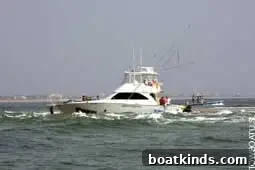
“We have several significant boat maintenance facilities here,” says Carl Blow, commissioner for the Florida Inland Navigation District. “We get a lot of transient traffic, guys moving up and down the East Coast—rather large yachts that tend to run offshore, not in the Intracoastal Waterway.”
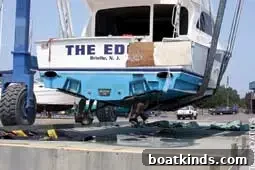
Despite St. Augustine’s strong marine services, recent shoaling in the St. Augustine Inlet has caused multiple groundings of both power and sailboats over the last year. Last November, TowBoatU.S. captain Norm Manley capsized while attempting to free a sailboat from a shoal and spent more than three hours in the water, nearly drowning. This spring a 48-foot Viking convertible, owned by a New Jersey charter company and named The Edge, struck the shoal and suffered heavy damage.
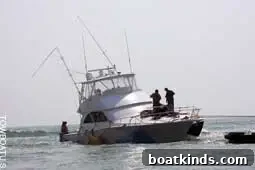
The Viking’s props and running gear were damaged on impact, and surf pummeled the sportfishing boat for three days before salvors could refloat her. At high tide only the flybridge remained visible, and waves repeatedly crashed over the stern. “The breakers were crashing over the stern,” says Capt. Scott Stebleton, owner of TowBoatU.S. St. Augustine, which conducted the recovery. “They ripped out 1-inch-thick granite countertops.”
Stebleton estimates that the 50,000-pound yacht nearly doubled in effective weight because of sand and water taken on during those three days. Salvors used about eight lift bags—providing roughly 44,000 pounds of buoyancy—to raise the vessel. Once pumped out and under tow, the hull remained sound and no further dewatering was required. The three people aboard— the captain and two passengers, all in their 50s—were unharmed and removed from the boat during the rescue.
The Viking grounded about 5:30 p.m. on May 5, just south of the inlet entrance and east of the south breakwater. Conditions at the time included 2- to 4-foot waves and 15-knot winds. The shallow water and building surf made it unsafe for the larger salvage vessels to approach, so crews elected to wait for a higher tide to attempt towing. When conditions worsened and the vessel began taking on water and listing to starboard, rescuers prioritized people over salvage.
Because the only craft able to reach the stricken Viking was St. Johns County Fire and Rescue’s personal watercraft, the crew performed a delicate stern-side boarding in heavy surf. Public information officer Jeremy Robshaw, who was the rescue swimmer for the operation, and Fire and Rescue Lt. Dan Power used the PWC to come alongside and transfer the passengers one at a time. Robshaw tethered the woman, then both jumped into the water and were picked up by the PWC. The two men were later retrieved the same way after the Coast Guard—monitoring the incident over VHF—ordered everyone off the vessel as weather and flooding risk increased. “The weather started to kick up and the boat was taking on water, so we said, ‘Let’s get the folks off and worry about the salvage issue later on,’ ” says Coast Guard Cmdr. Patrick Schreiber, chief of response for Sector Jacksonville.
Salvors worked over three days to refloat the Viking. Stebleton ultimately called TowBoatU.S. Fort Lauderdale for larger equipment and additional lift bags to complete the recovery. Investigators could not establish the Viking’s exact speed at grounding, but damage to the props and shafts suggests the vessel was on plane. “The operator should have been paying more attention,” Blow says. “The bottom line is [St. Augustine] is a safe inlet if you just take a little time to look for the [navigation] buoys. Too many people are dependent on electronics these days. They’re looking at the GPS/radar combination. People are too glued to the screen.”
About two years ago a sandbar began building near the south side of the inlet channel just east of the beach and has since extended between two permanent aids to navigation—green lighted buoys 5 and 7. “This isn’t the first grounding,” Blow notes. “We’ve had several. What’s happening is these guys are coming in the inlet and favoring those green buoys, especially at night. If they’re really favoring them, they run right into the bar because it has grown in between the two green buoys.”
Local officials requested buoy adjustments about six months ago after an 80-foot powerboat grounded. The Coast Guard’s larger 49-foot buoy tender, however, has been in maintenance in Virginia since October, leaving only smaller 26-foot cutters to place temporary markers. Robert Lehmann, officer in charge of the Coast Guard Aids to Navigation Team in Jacksonville Beach, says the 49-footer is expected back in early August, after which the Coast Guard plans to shift the channel markers to the north/northeast to better indicate the safest water.
In the meantime the Coast Guard deployed temporary green buoys (5A and later 5B) near the shoal to warn mariners. Lehmann acknowledges these are not ideal permanent marks but are the best option given current resources. Temporary buoys have helped, but in a following sea they can be hard to see—especially at night or in rough conditions. The Coast Guard continues to broadcast Local Notices to Mariners about the shoaling twice daily and advises boaters to consult the U.S. Coast Pilot and obtain local knowledge when transiting the inlet.
St. Johns County and the city of St. Augustine consider dredging the long-term solution. City director of general services Jim Piggott says the county plans to dredge around temporary marker 5A and another shoal at Porpoise Point on the north side of the inlet entrance. Local waterfront residents have raised concerns that dredging could cause shoreline erosion, which may delay permitting, but officials expect dredging to begin within nine to 12 months despite opposition.
St. Augustine’s harbormaster, Sam Adukiewicz, says the harbor supports a wide range of recreational craft from 20 to 120 feet. The municipal marina provides 90 slips and the city operates 165 moorings, two of which can accommodate vessels up to 120 feet. Shoaling is therefore both a safety and an economic issue: officials want to preserve the inlet’s reputation as a safe, accessible harbor for transient yachts and working vessels and to prevent insurers from restricting coverage for boats using the inlet.
This article originally appeared in the July 2011 issue.