
Steve Brady revived fond memories of his youth by restoring a 1974 Sea Ray SRV180 runabout.
As a teenager in the mid-1970s, Brady spent summers blasting around Long Island Sound in a variety of powerboats. One of his favorites was an 18-foot Sea Ray runabout he drove with reckless enthusiasm. “It was silly kid stuff,” he admits. “My friend Greg and I were really into wave jumping and trying to get the engine out of the water, and that boat was a real hit for wave jumping.”
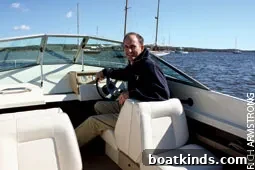
Those wild rides left a lasting impression. Now 49, Brady remembers the boat’s short nose and balanced design as unique among Sea Rays. He always thought it was a classic, and he promised himself that if he ever found one again he would restore it. He kept that promise, and the result is a thorough, meticulous rebuild of a 1974 Sea Ray SRV180 that would withstand the kind of abuse his teenage self once put boats through.
Brady’s restoration is one of the most complete projects the author has encountered in recent years. He rebuilt rotted stringers and the deck, had the transom reconstructed and the hull-to-deck joint reinforced. He repowered the boat with a rebuilt 1986 140-hp Evinrude outboard, replaced seating, refreshed the windshield, redesigned and fabricated a new dash, reinforced hardware, and installed a new steering system. The boat received a professional Imron paint job and a careful finish.
The rebuild took about two years, during 2008 and 2009. Brady estimates he logged at least 150 hours on hands-on work, not counting the time spent researching parts, materials and methods online. “People kept asking me, ‘When are you going to be done?’” he says. “I kept telling them, ‘You’re missing the point; it’ll be done when it’s done.’ It’s the process and the project that makes it worthwhile.”
He could have rushed the job and finished in six months, but he chose to savor the process. The patience paid off. Brady found the Sea Ray in a Middletown, Connecticut boatyard where he had taken his father’s Grady-White for service. The boat was owned by someone who used it occasionally but hadn’t maintained it, and it was left to decay. He bought the boat and trailer for $1,000 and set about restoring it to its former glory.
The heavy lifting began with stripping the boat down to the hull. The wood-cored stringers and cockpit sole were rotten and the foam flotation between the stringers was saturated. Brady removed the deck and all foam flotation, letting the hull dry for a month. He photographed the original stringer grid so he could duplicate the structure and relied heavily on online resources to determine which materials and methods to use.
Using two-part epoxy, epoxy fillers and marine plywood, Brady fabricated new stringers and encapsulated them in fiberglass. He used expansion flotation foam between the stringers and leveled the foam to accept a new wood-cored deck encapsulated in fiberglass and epoxy. “If you’re going to bother doing it you can’t skimp on the materials because the labor is the same,” he explains. “You might as well make an investment in epoxy-grade materials; it makes it stronger.”
Boat Works in South Windsor handled the transom reconstruction and reinforced the hull-to-deck joint. When Brady brought the Sea Ray in, the transom’s structural integrity was virtually nonexistent: plywood was rotted and delaminating, and the motor well had cracks. The shop built a new transom by sandwiching fiberglass with two layers of 3/4-inch marine plywood, bonding the assembly with epoxy resin using vacuum bagging, and then glassing over the laminated core. The finished transom is stronger than the original factory structure.
Boat Works also separated the deck cap from the hull to access the transom core, beefed up the deck cap lip, and refastened the hull-to-deck joint. Where the transom and aft deck had separated, the crew fiberglassed the area into a one-piece structure. The improved strength convinced Brady to upgrade the original 115-hp engine to a rebuilt 140-hp Evinrude, providing extra power for towing water skiers.
Brady purchased the rebuilt Evinrude from an outboard exchange shop that specializes in stripping and rebuilding older engines. He traded in the original 115-hp unit and paid $4,800 for the rebuilt 1986 140-hp outboard. The Sea Ray now reaches a top speed of about 50 mph and pulls a skier comfortably at 35–40 mph.
After structural work was complete, Brady focused on cosmetics and hardware. He coordinated the paint work with a local marine fiberglass and painting shop, which applied epoxy primer and a durable Imron finish. For the windshield and dash, he preserved the original glass and frame, sanding, etching, priming and repainting the frame, reinstalling the glass with new seals and silicone. He redesigned the helm, splitting the original full-width dash into two sections to accommodate four Faria gauges and a new stainless-steel steering wheel. He fabricated a center step between the dash halves for foredeck access and added a handrail for the companion seat.
Brady replaced worn fittings with stainless hardware, through-bolting deck fittings with plywood backing blocks, and installed non-skid pads on the gunwales’ recessed boarding areas. He fitted a new rack-and-pinion steering system and installed throttle and control components that came with the rebuilt outboard.
For interiors, he installed new carpeting, vinyl surfaces in a period-correct style, and back-to-back seats purchased from a marine upholstery manufacturer. The original 12-gallon aluminum fuel tank had been removed before he acquired the boat; Brady chose an alternative fuel arrangement instead of reinstalling a permanent tank. He fitted three 6-gallon portable tanks—one in the stern opposite the battery and two in the bow—and plumbed a second fuel line under the deck with a valve to switch tanks. This setup avoids concerns with corrosion and makes refueling convenient.
The restored Sea Ray has drawn many compliments. “They say, ‘Wow, is that boat new? It’s beautiful,’” Brady says. The Boat Works crew was similarly impressed when they saw the finished paint and fairing. Brady acknowledges he spent more on the restoration than the boat’s market value, but that was never the goal. He enjoyed the process and reclaimed a treasured part of his youth.
Major documented costs included $3,000 for the Imron paint job, $4,800 for the rebuilt outboard (less the trade-in), and about $2,400 for the rebuilt transom. Before taking on the Sea Ray, Brady had owned a 2000 Chris-Craft express cruiser and several other boats, and his lifelong exposure to boating informed his attention to detail throughout the refit. “I love boats,” he says. “I’ve been around them all my life, so I was passionate about the details.”
This article originally appeared in the January 2012 issue.