
Walter Cronkite: Anchorman and Passionate Sailor
Walter Cronkite, long known as “the most trusted man in America,” is remembered not only for his steady presence at the CBS Evening News but also for his deep love of sailing. Cronkite, who died of cerebrovascular disease on July 17 at his New York City home, was 92. Alongside his journalistic legacy, he leaves behind a reputation as an adventurous and skilled yachtsman who sailed a succession of boats named Wyntje (pronounced WIN-tee).
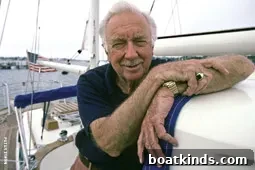
Whether in the newsroom or at the wheel, Cronkite relished taking charge. Gary Jobson, a longtime friend and sailing colleague, recalled Cronkite’s eagerness to report on the 1977 America’s Cup aboard Ted Turner’s Courageous for a 60 Minutes segment. While sailing off Newport, R.I., Cronkite cheekily asked Turner, “Ted, how about letting me steer?” Turner replied, “Sure Walter, if you let me do the evening news.” Cronkite never relinquished his anchor chair, but he did manage a few minutes at the helm of Courageous — a moment that helped spark a lasting friendship with Jobson, then the 27-year-old tactician on Courageous.
Jobson later crewed for Cronkite in the 1981 Marion to Bermuda Race aboard Cronkite’s Westsail 42, Wyntje, just weeks after the anchorman retired from the CBS Evening News. With a Rolling Rock in hand, Cronkite entertained his crew with firsthand accounts of the major stories he had covered — from President Kennedy’s assassination to the lunar landing. Sailing with him offered Jobson, and others who sailed with Cronkite, a close-up view of history and a glimpse of the man behind the authoritative voice they watched on television.
Cronkite was born on November 4, 1916, in St. Joseph, Missouri, the son of a dentist, Walter Leland Cronkite, and Helen Lena Fritsche. He began writing for his high school paper, interned at the Houston Post, and attended journalism school at the University of Texas while working as a reporter. He left school to pursue reporting full time, joining United Press in 1937 and later serving as a war correspondent. Throughout his career he demonstrated a restless taste for adventure that would carry into his personal life.
In the late 1950s, Cronkite raced cars as an amateur with teams like Lotus and Lancia, competing at venues such as Lime Rock Park and Sebring. CBS, concerned about the dangers, urged him to stop racing, and he turned to sailing — a sport he could enjoy with his wife Betsy (who died in 2005) and their children Nancy, Kathy and Walter. Cronkite often described learning to sail in a deliberately self-deprecating manner: trial and error, nights in Power Squadron classes, and hard-earned experience on the water.
In his memoir A Reporter’s Life he recounted his first sail on a Sunfish, when club members thrust him into a race after giving only the most basic instructions. He found himself leading the fleet but had no idea how to round the mark, capsizing in the process. Rather than discouraging him, the experience hooked him.
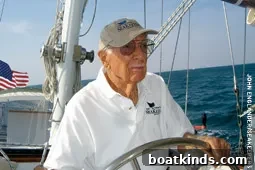
Cronkite sailed from his second home in Edgartown, Massachusetts, cruised the East Coast, wintered in the Caribbean, and visited sailing regions as varied as Scandinavia, Australia and Alaska. He co-authored several sailing books with artist Ray Ellis: South by Southeast, chronicling a voyage from Baltimore to the Florida Keys; North by Northeast, covering Cape May to Canada; and Westwind, about the West Coast cruise. These books reflect both his curiosity about coastal regions and his careful observational style.
Maria Mann, who served as Cronkite’s captain in the 1970s, praised his seamanship in a 2007 interview. She described him as an excellent navigator with a precise understanding of currents and tides, and a strong night sailor who always did his homework. Cronkite preferred to sail actively, not merely loaf along with minimal canvas. In rough weather, she said, he seemed genuinely pleased to be testing the boat’s and his own abilities.
The name Wyntje, applied to several of Cronkite’s boats, has its own lore: it honored the first woman in the Cronkite family to marry in New Amsterdam in 1642. The first Wyntje was a wooden boat that even appeared briefly in the film Jaws. Later Wyntjes included a 1976 Westsail 42 converted into a split-rig yawl, a 1986 Sunward 48 cruising ketch designed by Al Mason of Sparkman & Stephens, and a comfortable Hinckley 64 built in 1979.
Beyond his sailing skills, friends remember Cronkite for his thoughtful nature, modest humor and command of language. Jobson recalled that Cronkite visited him during treatment for non-Hodgkin’s lymphoma, an example of the anchorman’s kindness. Cronkite also shared practical on-air tips with Jobson: make the narrative your own, choose words carefully, speak as if you’re talking to someone directly, and practice until the phrasing feels natural.
Their last public collaboration came in 2007, when Cronkite lent his unmistakable voice to a History of the America’s Cup documentary. The program opened with Cronkite intoning, “The America’s Cup,” and closed with him celebrating the contest’s magnetism and beauty, calling the America’s Cup yacht “spectacular” and noting how it races “for glory and sails into our affections.”
That mixture of appreciation, authority and affection captured much of what people admired about Walter Cronkite: a reporter who celebrated the world he reported on, and a sailor who loved the sea. For many, he will remain a figure who combined journalistic integrity with a genuine passion for life on the water.
This article originally appeared in the September 2009 issue.