
Sustainable Marine Fuel Arrives at St. Andrews Marina in Panama City
Boaters who pulled up to the fuel dock this summer at St. Andrews Marina in Panama City, Florida, encountered something unexpected on the fuel pumps: prominent labels promoting “sustainable marine fuel.” From the helm, boaters read the key selling points in large type—ethanol-free, high octane (93 octane)—and learned that the fuel is a partially renewable, non-alcohol, high-octane gasoline blended with renewable content. According to the program’s organizers, that blend can reduce CO2 emissions by up to 30 percent compared with typical E10 fuels, offering a practical first step toward lower carbon emissions in recreational boating. While not fully carbon neutral, this fuel provides a tangible option for boaters who want to reduce their environmental footprint without modifying their vessels.
“We have a lot of charter fishing and guide boats. We’re in the middle of snapper season, so they come in daily,” marina superintendent Brian Hamilton said in late July, about a month after the fuel began selling. “The biggest thing for them is the price, so we had to work a little bit with our distributor to get the price down to where it’s affordable for these people, but nobody has reported any problems at all.”
The arrival of this fuel followed years of planning and collaboration. St. Andrews Marina is participating in a pilot program organized by the National Marine Manufacturers Association (NMMA) in partnership with Suzuki Marine, Hyperfuels, and LyondellBasell. Their shared goal is to offer a partially renewable, drop-in fuel that reduces emissions while remaining compatible with existing recreational boats—no engine or vessel modifications required.
“We’ve done the research on sustainable marine fuels. Now, we’re demonstrating as an industry that we can actually bring some of these products to market,” said Jeff Wasil, senior director of environmental, health and safety compliance for the NMMA. “If you’re a boater, you really should be excited about this. It gives you an option to do your part without going out and buying a new boat, and without any compromise to the boat’s performance.”
Giving boaters a simple choice at the pump is one of several decarbonization pathways identified in a recent International Council of Marine Industry Associations (ICOMIA) study. The ICOMIA report notes that options such as electric, hybrid and hydrogen propulsion exist, but cost and technology barriers make those solutions difficult for many boaters and builders. Partially renewable, drop-in fuels present a lower-friction alternative because they work in older and newer boats alike.
“That’s the nice thing. You’ve got a 2024 boat or a 1974 boat, it doesn’t matter,” Wasil said. “This stuff is compatible.”
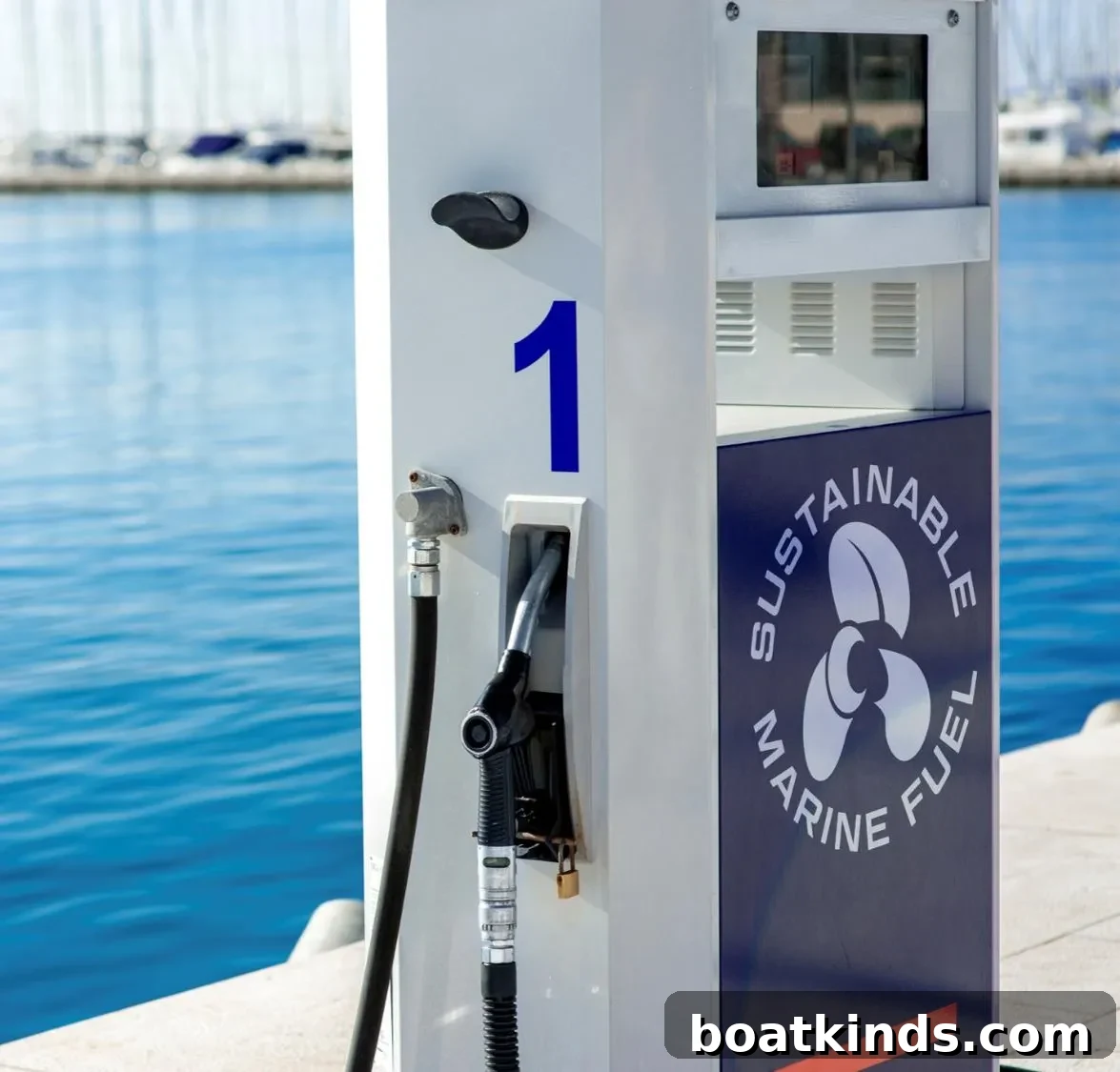
One major challenge for the pilot was logistics: how to get these drop-in fuels to marina docks in practical quantities. Program leaders spent more than two years working through supply-chain hurdles to support just this single Florida location. The NMMA’s contacts at Suzuki—opening a facility in Panama City—helped connect local officials and marina staff, while LyondellBasell supplied the renewable blendstock known as Ideal EMP, a liquid component that can be mixed with existing gasoline to reduce exhaust emissions. Ideal EMP is produced in large volumes at a Texas facility, but getting a few thousand gallons to Panama City proved complicated.
The team explored several options. Local fuel terminals were unwilling to reserve capacity for the small volumes required by the pilot, and barge leases were geared to much larger quantities. Trucking finished product from Houston proved costly—a $5,000 minimum for a truck and driver translated to roughly $1 per gallon in transport costs on a 5,000-gallon shipment, before taxes and other fees. Ultimately, the project settled on a hybrid approach: shipping the blendstock by rail and combining it with local gasoline at a Florida transload facility.
More than 30,000 gallons of Ideal EMP were moved by rail to a transload terminal in Florida. From there, the blendstock was pumped into tanks on a local Bobtail truck. That delivery truck collected gasoline from a nearby terminal, mixed in the correct percentage of Ideal EMP, and then delivered the finished, partially renewable fuel to the marina’s storage and fuel pumps.
This multi-step supply chain enabled St. Andrews Marina to offer pump access to a more sustainable marine fuel without requiring changes to boat engines or fueling equipment. The pilot has also drawn considerable interest from other marinas in the Florida Panhandle that want to sell the fuel locally.
“There has been overwhelming interest from many, many marinas across the greater Panhandle that want to start selling this fuel,” Wasil said. “It’s really starting to happen, and yes it’s very exciting.”
This article was originally published in the November 2024 issue.