
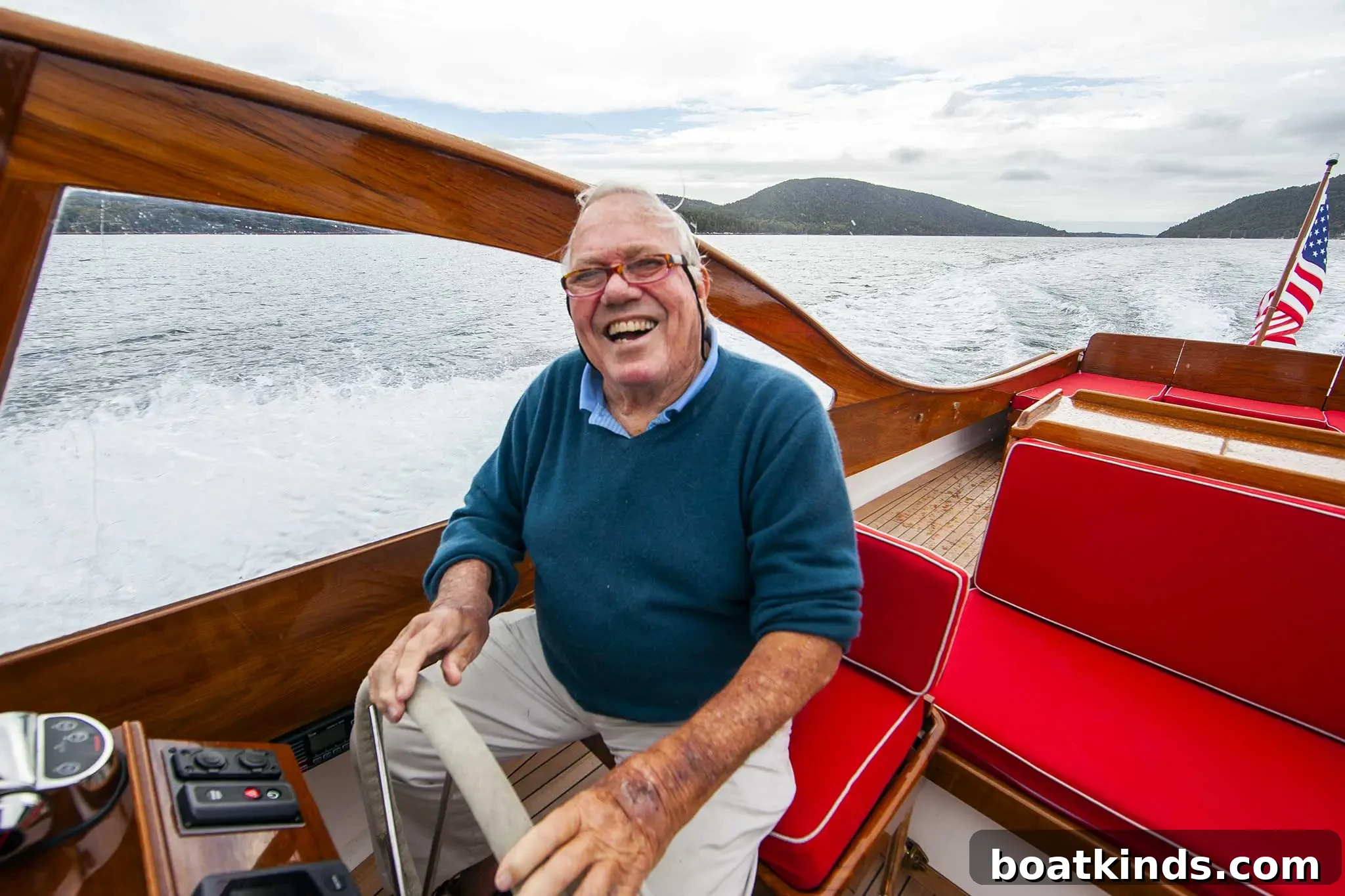
John “Jock” Williams: A Life Forged by Sea and Wood
He grew up on Martha’s Vineyard, spending summers working the docks, learning to rig, and racing sailboats by the time he was a teenager. By 15 he was competing in his own boat, and as the years passed his horizon kept widening: seven Bermuda Races, two trans-Atlantic crossings, the TransPac and nearly every major ocean race along the Northeastern seaboard. Even when he devoted care and attention to restoring the Concordia yawl Nefertiti, preservation was only part of his purpose. For John “Jock” Williams, a boat was always a promise of somewhere yet to go.
It was, however, powerboats that made his reputation and shaped a career dedicated to giving others access to the water. After navigating the South China Sea with the Navy, Williams settled in Maine and began building production boats while mastering composite construction. In Maine he met designer Lyford Stanley, a man who began each vessel as a perfect half-hull — a miniature promise of full-sized boats to come. Their friendship redirected Williams’ life: in 1973 he gave those half-hulls room to grow and founded the John Williams Boat Company in Hall Quarry, Maine.
Over the next five decades Williams built Stanleys as honest working boats for fishermen, and later, as recreational boaters discovered the inherent grace and efficiency of the hull design, he finished them as elegant lobster yachts. By the time he died at 87 on Aug. 9, he had built more than two hundred boats, placing them where they belonged: on water, carrying people to places they wanted to go. One of those boats, a 2000-built Stanley 36, eventually returned to him nearly twenty years later. He bought her back, renamed her Hokulani — Hawaiian for “heavenly star” — and used her as a vessel for stepping back from the yard and finally chasing some long-awaited horizons, including the Great Loop.
Hawaii became his winter home in later years, rooted in part by his wife’s native ties and by the welcoming communities that embraced them. But distance from Maine did not mean leaving boatbuilding behind. In Honolulu his path crossed with that of the Polynesian voyaging canoe Hōkūle’a, a double-hulled craft that has carried an educational mission across oceans using traditional celestial navigation since the 1970s. When the canoe needed new crossbeams, Williams arranged for engineering work at Maine’s university, contributed his skills to their fabrication, and lent his hands to the task. Two years later Hōkūle’a sailed up Somes Sound into the John Williams Boat Company yard, as if the sea itself had linked the two shores he claimed as home.
Although many Mainers described him as “from away,” Williams earned his place in Maine’s maritime story as one of the state’s notable builders of Down East boats — a recognition rarely given and hard won. His final design, a Williams 29 launched the year before he died, captures a lifetime of refinement: a center-console dayboat with warm wood finishes, a graceful tumblehome, and the understated elegance he brought to every vessel. Williams’ boats honor tradition without being confined by it, welcoming and kind to those who take them to sea — much like the man who built them.
More than the boats themselves, Williams treasured the people who gathered around his work. His sense of family extended beyond his wife and three daughters to include the craftsmen and crew at the yard. He turned ordinary days into celebrations, would call the crew together for an unplanned boat ride, or convert a routine workday into a shared lunch simply because the moment felt right. When a newly completed boat slid into the water, the launch was a moment shared equally by hands that built her and the owner who would carry her forward.
Until his final days Williams was still dreaming of the next stretch of water. He planned to send Hokulani to Europe and explore its locks and canals, an example of the restless curiosity that defined him. One lifetime could never exhaust every body of water or every design that captured his imagination, and yet the wake he leaves behind reaches farther than any horizon he pursued. His legacy lives on in the boats he built, the people he mentored, and the bridges he forged between coastal communities from Maine to Hawai‘i.
This article was originally published in the November 2026 issue.