
Brechin Lee Morgan: Sailor, Painter, and Solo Circumnavigator
Long before Brechin Lee Morgan picked up a paintbrush or left Block Island aboard his 27-foot cutter, he had vowed to one day set out on a grand adventure. That sense of destiny began at age seven during a visit to Mystic Seaport, where the sight of the whaling ship Charles Morgan captured his imagination. “I knew right then, beyond a doubt, that as soon as I turned 11, I could be a cabin boy on a whaling ship, and that was going to be my life,” he recalled. The idea of sailing over the horizon and exploring exotic seas lodged in him early and never let go.
Though he eventually learned that whaling ships belonged to another era, Morgan’s determination to be at sea endured. Growing up in Guilford, Connecticut, he used savings from his paper route to buy a small Blue Jay sailboat, which he sailed around the Thimble Islands. After leaving high school, at 17 he worked on charter boats in the Caribbean. Those formative years gave him practical seamanship and a taste for long passages.
Morgan later signed on to a 40-foot wooden sloop based in New Jersey, a vessel whose owner intended to circumnavigate the globe. That ambitious voyage ended abruptly when a hurricane off Bermuda badly damaged the boat on the first leg. Although the planned circumnavigation failed, the experience altered Morgan’s path in another meaningful way: a crewmate who had studied at the Rhode Island School of Design convinced him that pursuing art could be a viable career. At 19, Morgan enrolled at Silvermine College of Art in New Canaan, Connecticut.
Paint and drawing did not come from family expectation—his mother and great-grandfather had enjoyed painting as amateurs—but Morgan discovered his own affinity for art only after starting formal studies. His first assignment at Silvermine required two drawings overnight. After producing a dozen, he realized he couldn’t stop. “I knew then in that instant that I would be painting one way or another for the rest of my life,” he said.
Art did not immediately provide a steady income. For a time Morgan worked as a deckhand with the Tallmadge Oyster Company in Norwalk, Connecticut. He was drawn to the simple, functional lines of the oyster boats—forms that would later reappear in his paintings—but he remembers the work there as the hardest he ever did. Seeking steadier earnings, he opened and ran a sign shop in Norwalk for 23 years, painting in his studio during evenings and continuing to sail whenever he could.
At 51, after decades of dreaming and sailing, Morgan launched the solo voyage that had lived in his imagination since childhood. In November 1998 he departed from Block Island aboard his 27-foot cutter-rigged sailboat, Otter, on what became a five-year, single-handed circumnavigation. Over that period he logged about 32,000 miles, visited 32 countries, and filled 18 sketchbooks with watercolors and drawings, in addition to taking thousands of photographs.
On his return he committed full time to painting, opening a studio and mining the material he collected at sea. For six years his work drew directly from the sketchbooks and photographs accumulated during the voyage, translating memories of light, weather, and motion into canvases that speak of life on the water.
One notable painting from that period is the 48-by-48-inch acrylic Wing and Wing, which recreates the view from Otter’s cockpit as Morgan crossed the Pacific. He describes the scene with tactile detail: the cooling shadow, a steady breeze, the boat making five knots and a daily run of roughly 125 miles, the simple lunch of canned tuna and mayonnaise followed by hot tea. That ordinary but profound moment—motion, light, and calm—became the subject of the painting.
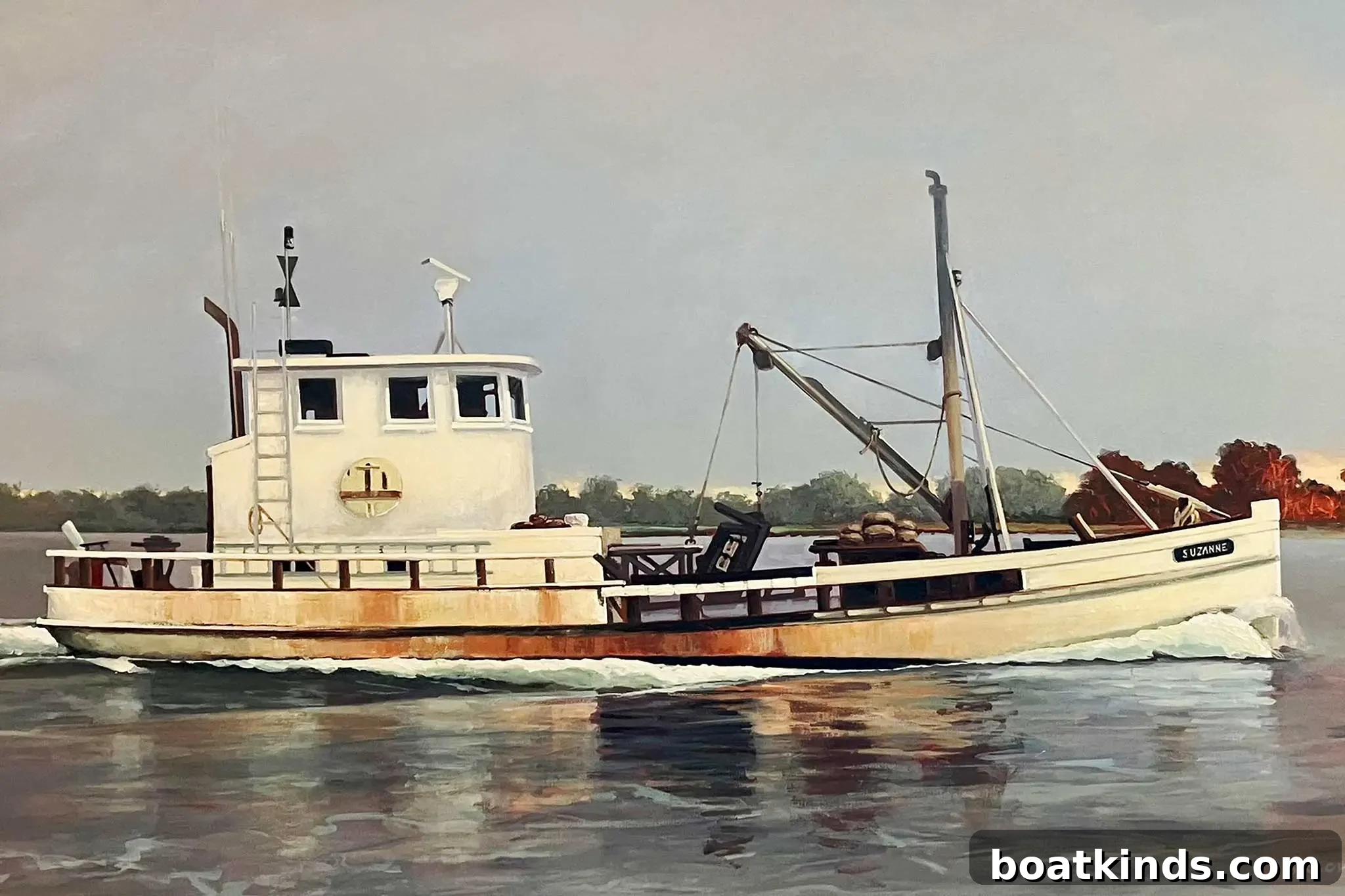
Working boats feature prominently across his body of work. His 36-by-36-inch acrylic of the 1968 tugboat McAllister Girls was inspired by an encounter in New York’s East River while ferrying a 40-foot catamaran south. Another painting, Heading Home, depicts the 1939 oyster schooner Suzanne as she makes her way up the Housatonic River in late afternoon light. “That boat is almost exactly the same as the one I worked on,” Morgan says. “Every single aspect of that boat can bring back a memory.”
Morgan still owns Otter and keeps a studio in Bridgeport, Connecticut. He continues to sail frequently, finding fresh inspiration on nearby runs to places such as Cuttyhunk, Massachusetts, where he fills sketchbooks with studies for future paintings. For him, time at sea is restorative. “Within 15 minutes of getting outside of Bridgeport Harbor, everything just disappears,” he says. “The world goes away. I’m back on the boat. I can imagine myself in those endless days crossing the Pacific again, with just this endless blue horizon extending forever and ever and ever.”
This article was originally published in the September 2026 issue.