
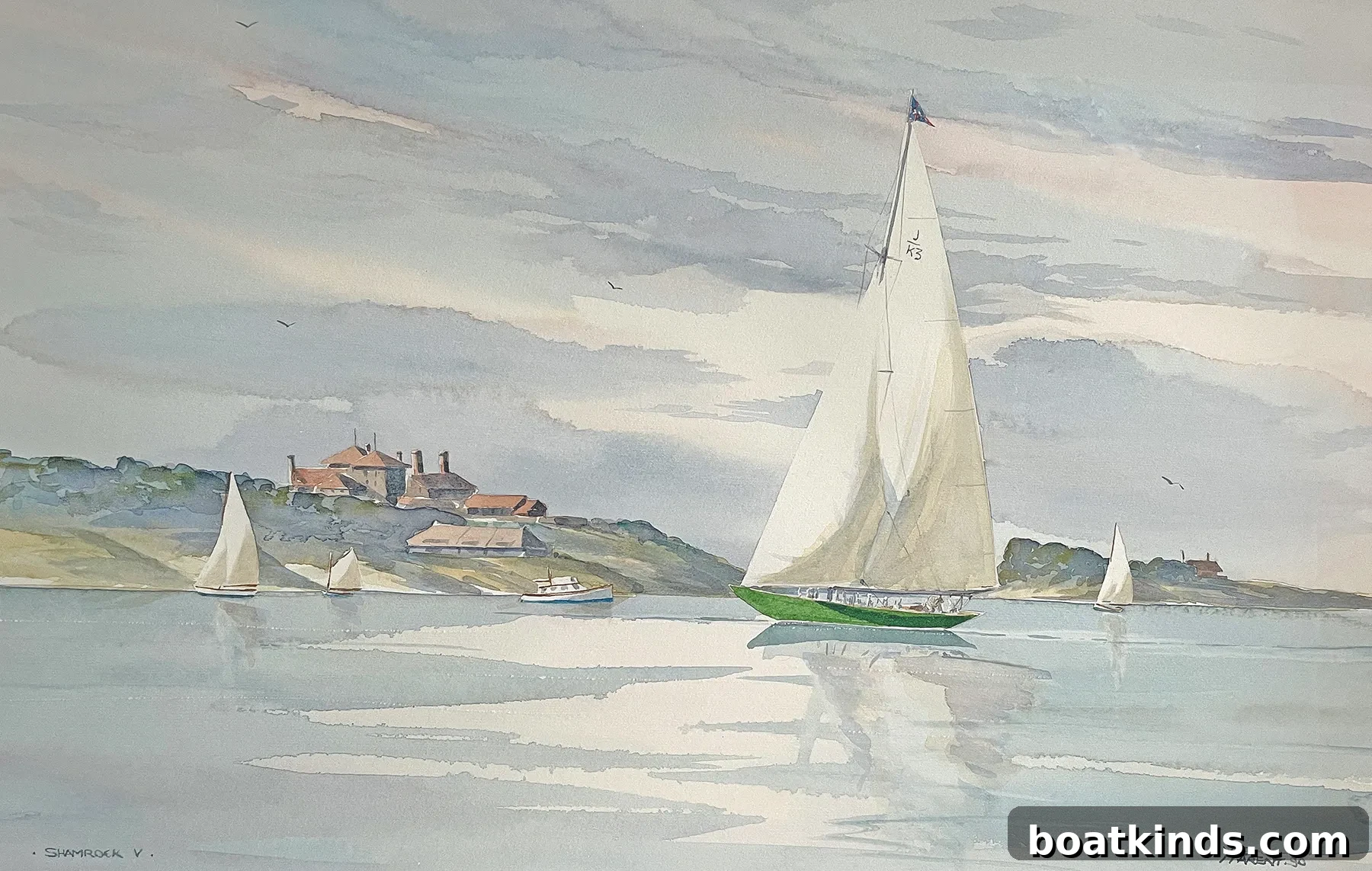
Shamrock V: A J‑Class Yacht, Art, and Newport’s Quiet Harbor
The J‑Class racing yacht Shamrock V slips past Castle Hill Lighthouse on a calm day in Newport, Rhode Island—a scene captured with delicate attention by artist Yves Parent. On the surface it reads as a peaceful harbor view, but the image also holds the layered history of early 20th‑century yacht design, elite ocean racing, and one of the era’s most famous America’s Cup campaigns.
Yves Parent, born in Normandy, brought his experience as an offshore crewman to his work as a watercolorist. His long familiarity with life at sea— crewing in multiple offshore races—gave him an intimate understanding of yachts, sails, light, and weather. Parent devoted much of his artistic practice to documenting notable yachts and racing scenes, translating the technical precision of classic boats into expressive washes of color and light. This painting of Shamrock V is a fine example of his ability to combine nautical accuracy with painterly atmosphere.
Design and Construction of Shamrock V
Built in 1930 for Sir Thomas Lipton, the founder of Lipton Tea, Shamrock V was constructed with mahogany planking over steel frames and featured a hollow spruce mast—materials and methods typical of high‑performance yachts of the period. She was the first British yacht commissioned under the new J‑Class rule and was specifically designed to contest Lipton’s fifth and final challenge for the America’s Cup.
The vessel’s lines and construction reflected the cutting edge of yacht design at the time. Her mahogany planking provided a refined finish and strength, while steel framing offered the rigidity necessary for the stresses of racing. The hollow spruce mast reduced weight aloft for better stability and sail performance. All these choices made Shamrock V a competitive and visually striking example of J‑Class craftsmanship.
The 1930 America’s Cup Campaign
Shamrock V showed strong form immediately after her April 14, 1930 launch, winning 15 of 22 races during British regattas and undergoing continual improvements as her team prepared for international competition. Despite high hopes and extensive preparation, her America’s Cup campaign did not deliver the ultimate prize for Lipton.
In the 15th America’s Cup, Shamrock V faced Harold Vanderbilt’s Enterprise. The series proved decisive: in the first race Shamrock V finished three minutes behind, and in the second she trailed by ten minutes. In the third race the two yachts engaged in a close tacking duel off Newport, during which Shamrock V’s main halyard parted and caused her sail to collapse—an equipment failure that proved costly. Enterprise went on to secure victory in the fourth race, and Lipton, a devoted challenger, never won the Cup. He died the following year.
A Survivor Among the J‑Class Fleet
Following Lipton’s death, Shamrock V changed ownership several times and was refitted on multiple occasions. Remarkably, she never fell into dereliction, a fate that befell many classic racing yachts over the decades. Today Shamrock V holds the distinction of being the only original J‑Class yacht that remains in continuous care and the only original J built in wood to survive intact.
Her survival preserves an important piece of sailing history: a tangible link to the aesthetic, technical, and sporting values of the interwar period. As both a racing machine and a crafted wooden vessel, Shamrock V embodies an era when yacht design balanced elegance with competitive intent—qualities that continue to fascinate sailors, historians, and artists alike.
This image and its accompanying story evoke more than nostalgia; they remind viewers of the craft, competition, and human drama that define classic yachting. Whether appreciated for Parent’s sensitive watercolor interpretation or for the yacht’s storied past, Shamrock V remains an enduring symbol of the J‑Class legacy.
This article was originally published in the August 2022 issue.