More builders are fitting pod drives as boat owners seek easier handling, better efficiency and modern joystick helm control. Pod propulsion has moved from niche to mainstream, adopted by production, semicustom and custom builders across a wide range of planing and semidisplacement boats.
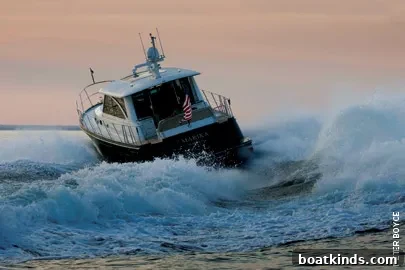
Manufacturers and owners point to several clear benefits: improved fuel economy, lower noise and vibration thanks to underwater exhaust, and dramatically simpler close-quarters maneuvering via joystick control. “There is a fuel efficiency gain, there is definite sound and resonance reduction, and there is an absolutely huge gain in owner confidence in being able to manage a boat and maneuver a boat around the docks,” says Bentley Collins, vice president of sales and marketing for Sabre and Back Cove Yachts. Sabre’s recent sales reflect that shift: of 65 boats sold in two years, only two lacked pod propulsion.
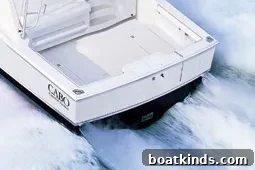
Pod systems from Volvo Penta (IPS), CMD (Zeus) and ZF Marine are now specified across many brands, including Albemarle, Azimut, Cabo, Grand Banks, Hunt, Luhrs, Meridian, Ocean, Regal, Rinker, Rivolta, Sabre, Sea Ray, SeaVee, Tiara, Viking and Zeelander. Since Volvo Penta launched IPS in 2005, followed by CMD’s Zeus in 2007 and ZF’s pod entries in 2009, pod drives have scaled up in size and power and are installed on boats from roughly 31 to more than 90 feet.
Manufacturers report rapid growth: Volvo Penta IPS was adopted by more than 125 boatbuilders across about 275 models, CMD’s Zeus is used by multiple builders in dozens of models, and ZF continues expanding its Pod 2500, 2800 and larger Pod 4000 offerings. Engine and pod pairings have advanced too — Volvo Penta now offers IPS900 and IPS1200 packages, and ZF’s Pod 4000 supports very large engines for high-horsepower applications. CMD’s Zeus packages are matched to a range of QSB, QSC and QSM diesel engines with multiple pod sizes to fit different power bands.
One size doesn’t fit all
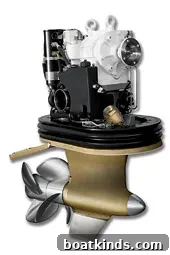
Pods deliver clear advantages but aren’t a universal solution. Installing pods often requires substantial changes to hull design, internal layout and weight distribution. Viking’s conversion of a 50-foot convertible to ZF Pod 4000s required major hull-bottom revisions and vertical trim-tab modifications, and reduced fuel capacity significantly. Viking will offer that pod option only by customer request.
Pod drives produce thrust on a line parallel to the water, which alters trim and typically requires shifting weight forward compared with conventional inboard configurations. That influences tank placement, engine room layout and center-of-gravity considerations. Manufacturers stress that designing a boat from the outset for pods prevents many of these challenges; repowering an existing inboard boat with pods is usually impractical or prohibitively expensive.
Smaller sportfishing boats face additional constraints: stern space for pod equipment and jackshafts can conflict with cockpit ergonomics and covering-board heights critical to fishing operations. Cost is another factor. Pod-equipped packages commonly add tens of thousands of dollars to a boat’s price versus traditional inboards or outboards, reflecting the drives themselves plus integration, joystick systems and dealer support.
Service infrastructure is growing but still catching up with demand. Qualified pod technicians are becoming more common in major boating regions, but builders and OEMs acknowledge the need for deeper dealer training and broader service networks to support the expanding installed base.
Finding the right fit
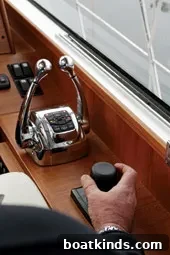
Pod systems are well suited to planing and semidisplacement hulls where they deliver superior efficiency, higher top-end performance with less installed horsepower, and simpler handling at low speeds. For true displacement vessels cruising in the 10–12-knot range, a well-optimized conventional inboard with appropriate gearing and props can remain more efficient.
Volvo Penta has broadened propeller and gear options to bring IPS into lower-speed semidisplacement applications, enabling IPS units up to the IPS1200 to perform efficiently at speeds in the mid-to-high teens. CMD and ZF are also targeting larger boats and multi-pod installations: twin or triple pods permit high horsepower without excessive beam or length, and they free internal space for accommodations — Hunt Yachts, for example, used IPS to gain an extra stateroom in a 52-foot model.
Owners most often praise the joystick and station-keeping features. The joystick transforms close-quarters docking and low-speed handling by vectoring independently articulated, counter-rotating props. Systems such as Zeus’s Skyhook and comparable offerings from Volvo Penta and ZF use GPS to hold position against wind and current, proving useful for fishing, bridge waits or precise maneuvering.
Beyond handling, owners notice quieter operation and lower fuel burn. Examples from builders show notable reductions in installed horsepower yet equal or improved cruise speeds and lower fuel consumption when switching from traditional shaft or V-drive setups to pod drives.
Refinements on the way
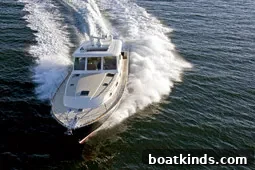
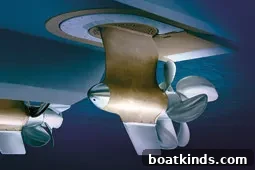
Manufacturers continue refining electronics, ergonomics and integration. New auxiliary joystick stations, sport-specific modes that angle drives for rapid stern response when fighting fish, and improved prop and ratio options for lower-speed semidisplacement hulls are among recent advances. Some builders are experimenting with single-pod center-console applications, although the added cost of integrating a bow thruster for joystick-like control has limited commercial uptake in boats under about 30 feet.
Competition is also spurring new approaches that could lower complexity and cost—for example, concepts that simplify the pod into a rotating foot driven by a conventional transmission and jackshaft arrangement. As more OEMs and aftermarket players enter the field and dealer training expands, pod systems are likely to become an increasingly common choice across a broader range of recreational boats.
This article originally appeared in the March 2012 issue.