
When buying a new boat or repowering an existing one, buyers face more outboard choices than ever. Once defined largely by horsepower, modern outboards now include digital throttle and shift systems, advanced steering options like joysticks, higher-output alternators, integrated electronic controls and other features that go well beyond simply turning a propeller.
“A decade ago, outboards were all about speed,” says Ry Landry, product education manager at Yamaha Motor Corporation. Today, he notes, buyers select engines based on how and where they use their boats. Anglers who need quick runs to fishing grounds may choose maximum power, while cruisers who value economy often select smaller, more efficient packages. Load, operating conditions and intended use are all crucial to the decision.
Brad Leatherman, Yamaha Marine Group’s tournament support manager, adds that he now values having extra power in reserve for safety and rough conditions. “I’d rather have it and not need it, than need it and not have it,” he says. Leatherman also points out that most outboards reach their best efficiency at roughly 4,000 rpm. A lower-horsepower setup can be efficient, but stepping up to higher-rated engines often raises top speed without sacrificing cruise economy, enabling longer runs at the most efficient rpm.
Choosing an outboard package requires balancing purchase and maintenance costs, engine weight, top speed, fuel consumption and availability, handling, electrical load, serviceability and safety. Some systems eliminate hydraulic steering and pumps with electric steering, while others provide quicker hole-shot or sustained planing at lower speed. Builders commonly offer several engine options for a single model to match a buyer’s priorities.
To show how these choices play out in practice, we spoke with three builders of boats in the 30–40-foot range to examine the packages they offer and the trade-offs buyers should consider.
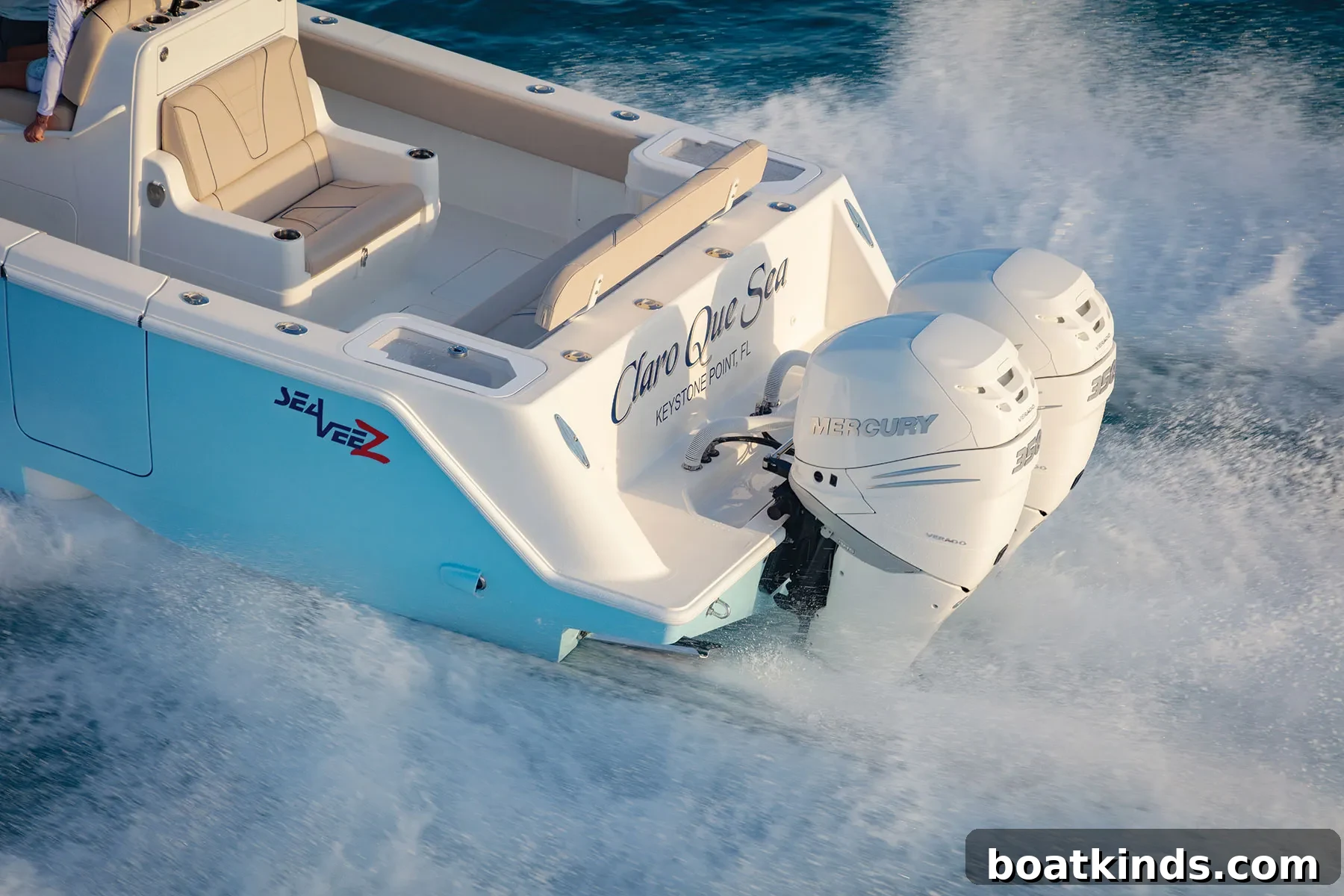
SeaVee 322z
SeaVee Boats rigs its high-performance fishing models with Mercury, Suzuki and Yamaha outboards and will install the package a customer prefers, says Sales and Marketing Director John Caballero. On the twin-stepped-hull 322z center console, SeaVee offers a range of twin-engine options: 300-, 350-, 400- and 450-hp outboards.
The 322z is designed for offshore fishing and, in Luxury Edition trim, adds molded forward seating or removable rear benches. SeaVee reports top speeds between 43 and 48 knots with twin 300s, and up to about 56 knots with twin 400- or 450-hp motors.
Caballero points out that 300-hp engines from Yamaha and Mercury typically consume less fuel because they are lighter and simpler than boosted units. Many buyers choose the 300s for balanced performance and fuel economy. At the other extreme, performance-minded owners favor Mercury’s 450R racing engines for exceptional horsepower-to-weight ratios and acceleration.
Torque is an often-overlooked factor when selecting an outboard. Caballero cites the torque benefits of Mercury’s 300-hp V8-based engines, which can deliver a stronger hole shot and a sensation of rapid acceleration even if top-end speed is slightly lower. Steering technology also matters: hydraulic steering has long been common on larger motors, but electric and fly-by-wire controls have become increasingly reliable and enable instant, precise responses to throttle and steering inputs.
Digital engine controls open the door to add-on features such as joystick maneuvering, dynamic control systems and autopilot modules. Caballero also notes increasing alternator capacity on modern engines to support the growing electrical demands of today’s boats—flir cameras, radar, redundant electronics and large audio systems—so alternator output should be part of the rigging discussion.
Jeanneau Leader 10.5 Series 2
Jeanneau updated the Leader 10.5 into the Series 2 with a reinforced transom and a vacuum-bagged, resin-infused hull featuring a Michael Peters running surface. The redesigned twin-cabin walkaround is stiffer and better suited to higher-power outboards, says Jeanneau America Sales Manager Wade Clevenger.
Jeanneau typically partners with Yamaha, though dealers may fit Mercurys. While the earlier Leader 10.5 could be ordered with twin 300- or 350-hp Yamahas, the Series 2 can accept Yamaha’s 425-hp XTO outboards. Clevenger explains that the 425s deliver stronger hole-shot and higher top-end performance, but a price-conscious buyer will find twin 300s still push the boat to about 41 knots.
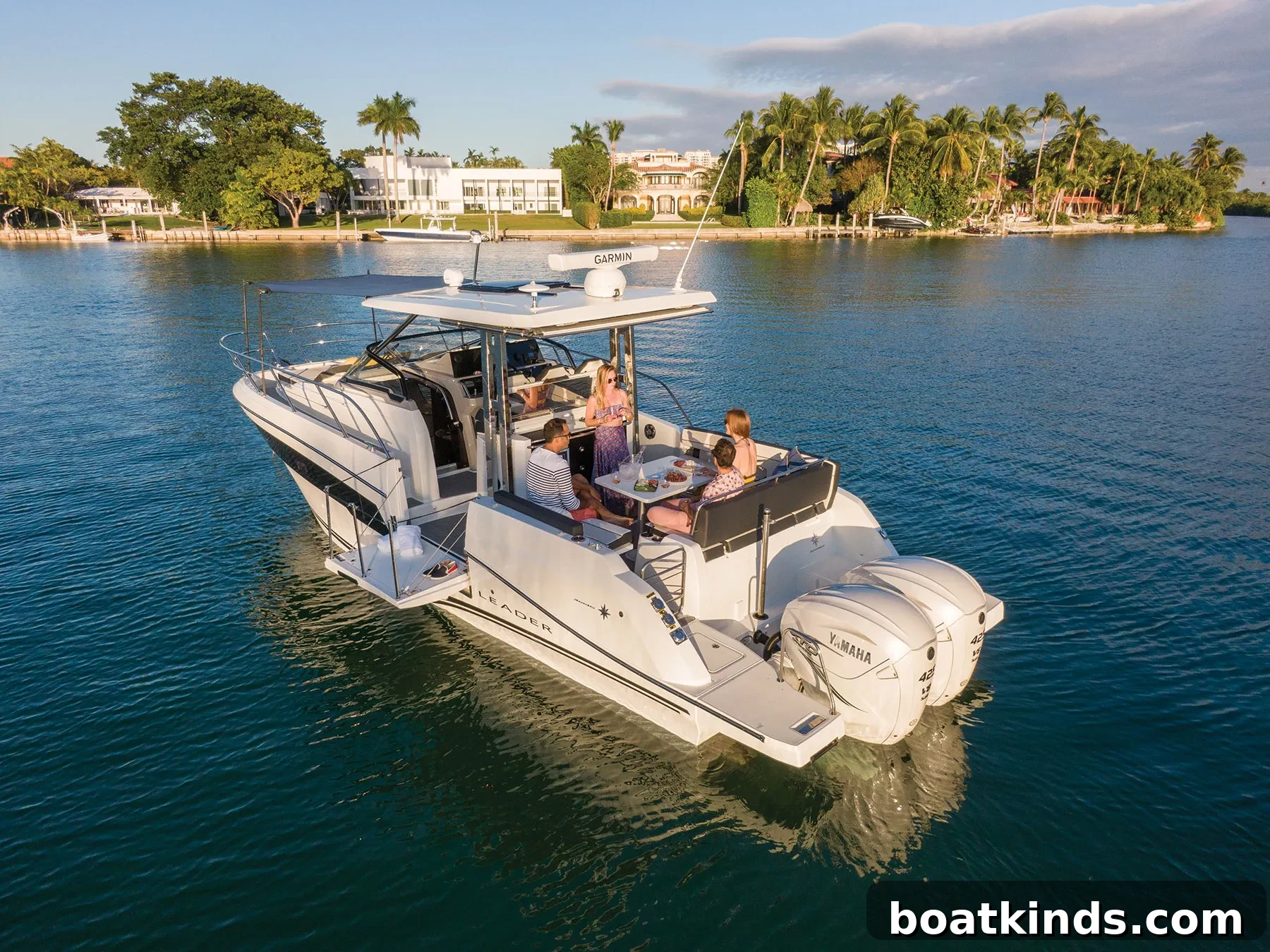
One major update Yamaha introduced with the 425 is electric steering that removes hydraulic pumps and hoses from the transom, cleaning up the layout and simplifying rigging. Yamaha offers multiple steering choices for the 300s: conventional hydraulic, a bolt-on electric steering unit that mimics hydraulic installation, or a fully integrated electronic steering system on the 4.2-liter offshore model. Electric systems reduce plumbing, eliminate steering fluid maintenance and lower the risk of leaks while often drawing less electrical power than hydraulic pumps.
Pricing reflects these options: a Leader 10.5 Series 2 with twin, hydraulically controlled 300s starts around $210,000, while the model fitted with twin 425s has a base price near $240,000. Clevenger says the $30,000 difference makes sense for buyers who want maximum speed; others will prefer the cost and efficiency of the 300s.
Fountain 34CC
Fountain Powerboats offers multiple Mercury power configurations for the 34CC, with twin or triple setups using 300s, 400Ms, 400Rs or 450Rs. “We offer many options because customers want choices,” says Jeff Harris, COO of Iconic Marine Group, Fountain’s parent company.
The 34CC is a twin-stepped center console that fits between typical twin-engine and triple-engine platforms. Harris notes the redundancy benefit of three engines—if one prop is damaged at sea, the boat still runs on two engines—making triples attractive for offshore fishing and tournaments.
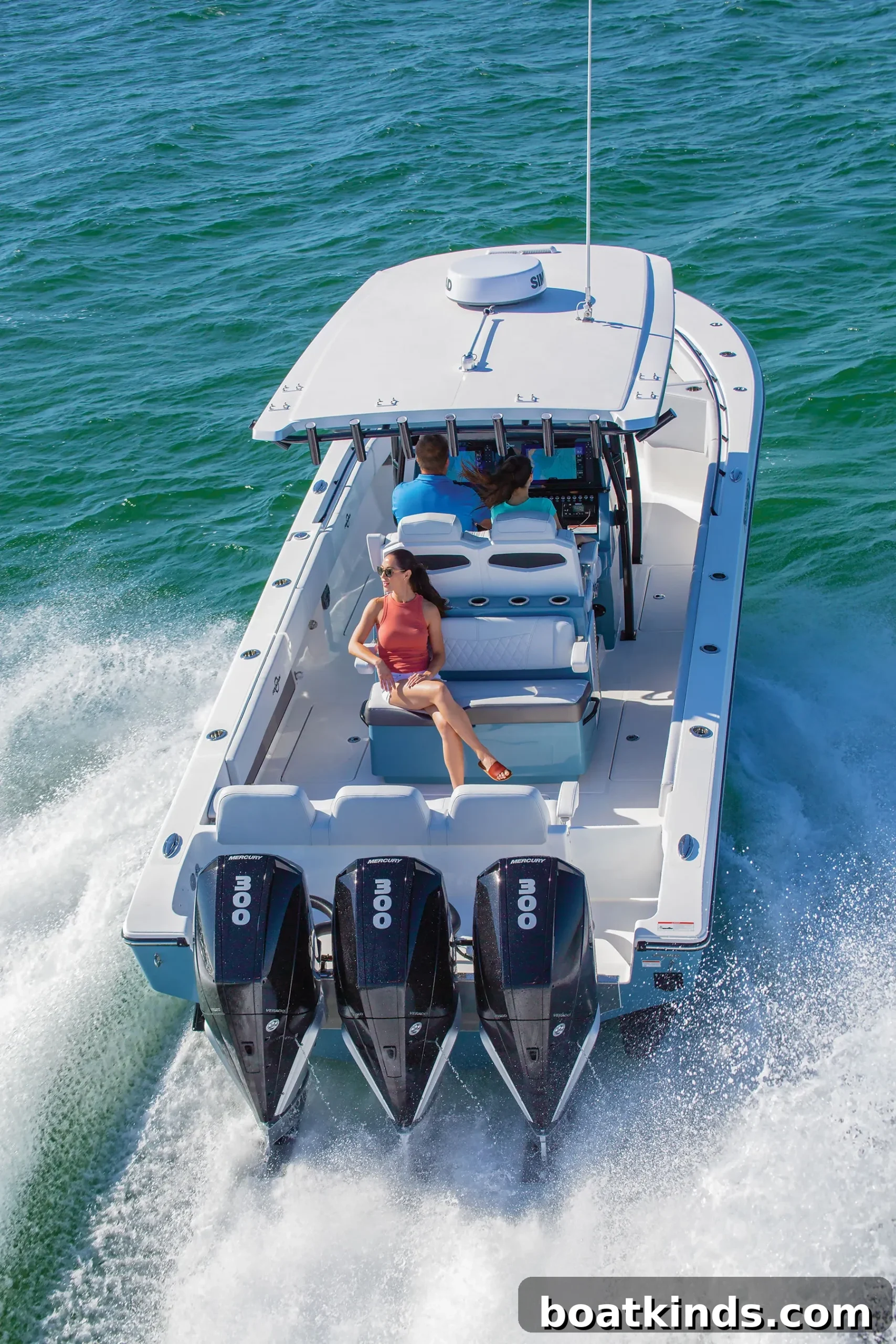
Despite high-performance options, Harris highlights the efficiency and versatility of the twin 300-hp package. The hull is efficient at cruise and the 300s run on 87-octane fuel that’s widely available, making them practical for many owners. The twin 300s also deliver the best range: at a 35-knot cruise the 34CC can cover roughly 650 miles on a full tank. The twin 450R setup reduces that range to about 557 miles at the same cruise speed, and a triple 450R layout drops range further to roughly 410 miles. Wide-open, triple 450Rs can reach about 76 knots but burn around 132 gallons per hour, reducing range dramatically.
By offering many power choices, Fountain can satisfy owners who want top speed and dramatic acceleration as well as buyers focused on fuel economy, range and lower operating costs. Harris notes that Mercury Racing variants include unique components and integrated steering options that differ from the standard 400M engines, giving buyers distinct performance and handling characteristics.
Which package is right depends on priorities. If top speed and performance are the sole goals, high-horsepower racing engines make the choice clear. If fuel economy, range, budget or everyday practicality matter more, smaller, efficient outboards often provide a better overall experience. Consider torque, steering type, alternator capacity, fuel type and range when matching engines to how you actually use the boat.
This article was originally published in the July 2021 issue.