
Correct Craft’s Ski Nautique E: A 19-Foot All-Electric Ski Boat Prototype
Correct Craft has unveiled a working prototype of an all-electric ski boat, the Ski Nautique E, demonstrating that electric propulsion can meet the demands of tow-sports. The prototype is based on a 2008 Ski Nautique hull with an overall length of 19 feet, 6 inches and a beam of 7 feet, 7 inches. According to Greg Meloon, vice president of marketing and product development for Nautique Boats, the boat is capable of making up to 30 skier passes before recharging — roughly 90 minutes of continuous use — making it practical for typical ski sessions.
Propulsion and Battery System
The Ski Nautique E uses marinized electric drivetrains developed by LTS Marine, a Canadian company that adapts automotive electric motors for marine use. Michel Soucy, director of business development at LTS Marine, explains that the system integrates two 103-horsepower electric motors connected through a transfer case to a single shaft and propeller. Power is supplied by two sealed battery banks rated at a combined 77 kW and housed in protective cases on the port and starboard sides of the boat.
Recharge times for the prototype vary with available electrical service: approximately 12 hours on a standard 110-volt supply and around four hours on a 220-volt supply. These charging figures reflect the prototype’s current battery technology and charging configuration, and may evolve as the project develops.
On-Water Demo and Performance
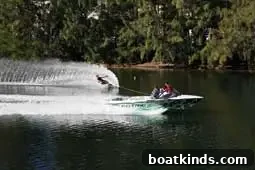
I experienced a demonstration ride during the Miami International Boat Show, when Nautique personnel brought the Ski Nautique E to the Greater Miami Ski Club. Terri Schneider, Nautique’s marketing coordinator, transported the boat to the ski club for a warm, clear afternoon on the water. World champion slalom skier Chris Parrish joined the demo to show how the boat handled towing a high-performance skier.
During the run, the quietness of the electric propulsion was immediately noticeable; the dominant sounds were the water against the hull, wind in the air, and the faint mechanical vibration of shaft and prop. The prototype pulled Parrish out of the water promptly and reached its target slalom speed of 36 mph, with a stated top speed of 40 mph. Parrish, who weighed about 215 pounds during the demo, skied aggressively behind the boat, illustrating that the electric drivetrain could deliver the torque and speed required for serious slalom skiing.
Practical Use and Session Capacity
Meloon points out that typical ski sets involve six to eight passes, so on a single full charge the Ski Nautique E could realistically accommodate three to four skiers through a standard session. That level of capacity makes the prototype more than a concept vehicle — it demonstrates practical utility for recreational and competitive skiing, particularly in environments where short-session use and local charging are feasible.
Production Outlook and Correct Craft’s Strategy
The Ski Nautique E remains a prototype, and no production timeline has been announced. Meloon states that Correct Craft will continue development and keep the public informed as the project progresses. He indicates the company hopes to offer an electric option to consumers within the next few years, though the exact timing remains dependent on further development and market factors.
Correct Craft views alternative power as a strategic priority. Meloon observes that electric power has already made significant inroads in the automotive industry, and because many marine engines are sourced from automotive powertrains, electric or hybrid systems are likely to influence future boat powertrains. He also highlights practical drivers for pursuing electric propulsion: changing fuel availability, stricter environmental regulations on some lakes, and the appeal of near-zero local emissions and quieter operation.
Why This Matters
The Ski Nautique E prototype represents an important step in adapting electric propulsion to demanding tow-sport applications. Key takeaways from the prototype include competitive pulling power and acceleration, quiet operation, practical session duration on a single charge, and manageable recharge times when shore power is available. These attributes address common concerns about electric boats and illustrate how electric drivetrains can be engineered to meet performance expectations for watersports.
Contact and Further Information
For inquiries, Correct Craft can be reached at (407) 855-4141. Manufacturer information: www.nautique.com
This article originally appeared in the July 2011 issue.