Women Lifesavers and the Rise of Water Safety in Early 20th‑Century America
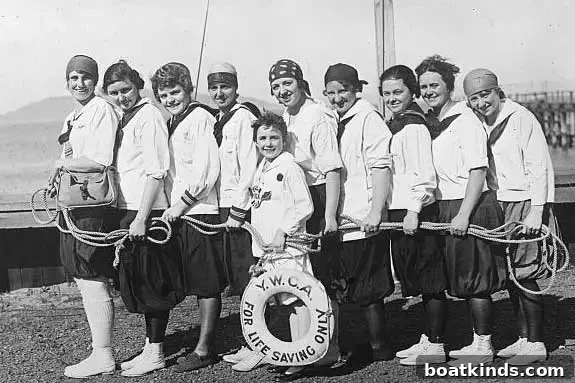
A YWCA Life Saving Unit assembled for service at the Golden Gate in San Francisco in 1920, one of the first women’s lifesaving corps to organize on the Pacific Coast. These women were part of a broader movement to reduce drowning across the United States by promoting swim instruction, standardized rescue methods, and public education about water safety.
In the early 1900s drowning was a major public health problem in America. Annual deaths from drowning numbered in the thousands—roughly 10,000 per year—and many factors contributed: most people had little or no swim training, ferry and steamboat accidents were common, and life preservers were not widely used. Clothing of the period added to the danger, especially for women. Heavy, layered garments could become waterlogged, weighing a swimmer down and even covering the face and arms once submerged, severely limiting a person’s ability to survive or self-rescue.
Wilbert E. Longfellow, a marine journalist based in Providence, Rhode Island, covered waterfront accidents and drownings regularly. The devastating loss of life when the triple-deck sidewheel passenger steamboat PS General Slocum caught fire and sank in New York in 1904—an event that claimed more than 1,000 lives—galvanized Longfellow. He chose to move beyond reporting and to take direct action to improve lifesaving practices and water safety education.
Longfellow worked with existing volunteer lifesaving organizations in Rhode Island and New York to standardize rescue techniques and to organize formal training programs. He helped design drills and demonstrations for groups such as the YMCA, YWCA and the Boy Scouts so that lifesaving skills could be taught widely and consistently. Crucially, he argued that women should be included in this work—not only as recipients of swim instruction but as active lifeguards and demonstrators of lifesaving techniques.
To challenge prevailing assumptions about women’s capability in the water, Longfellow staged public demonstrations. In 1909 he persuaded Adeline Trapp, a noted female lifeguard, to swim a demanding 9‑mile course through Hell Gate in New York wearing a man’s suit. The intent was to show how heavy, restrictive swimwear hindered performance and how women could match or exceed male endurance when freed from such constraints. Trapp completed the course, reportedly outpacing 15 male competitors, an example used to support wider acceptance of female lifesavers.
Longfellow also lobbied for a national approach to water safety. His efforts contributed to the establishment of the American Red Cross Life Saving Corps in 1914, a program intended to bring systematic lifesaving instruction to communities across the country. Initially, however, the Red Cross excluded women from its lifeguard certification program, based on the erroneous belief that women could not perform required duties and that including them would undermine the program’s credibility among men.
In response to that exclusion, Longfellow founded the World’s Life‑Saving Alliance for Women, an independent organization that mirrored the Red Cross curriculum and standards. The Alliance trained women in lifesaving techniques and issued certificates to verify their skills. Its first recorded certificate went to a woman in Maryland in 1914—the same year the Red Cross began certifying men—demonstrating parallel, credible training for female lifesavers and helping to pave the way for eventual inclusion.
By May 1920 the Red Cross formally began admitting women into its lifesaving corps. The wider availability of organized swim instruction, lifeguard training, and public education about water safety produced measurable results. The national drowning rate declined markedly over the following decades—from about 10.4 deaths per 100,000 people in 1914 to approximately 5.2 per 100,000 by 1947. Over that same period the Red Cross trained a large corps of instructors—qualifying roughly 100,000 water safety teachers and issuing millions of swimming and lifesaving certificates—efforts that helped embed lifesaving skills into American communities.
Women lifeguards and volunteer lifesaving units—like the YWCA teams at the Golden Gate—played an important role in changing public attitudes, improving safety standards, and reducing avoidable deaths by drowning. Their service and advocacy helped transform lifesaving from a localized volunteer response into a professional, inclusive movement dedicated to preventing drownings through training, equipment, and community outreach.
This article was originally published in the September 2026 issue.