
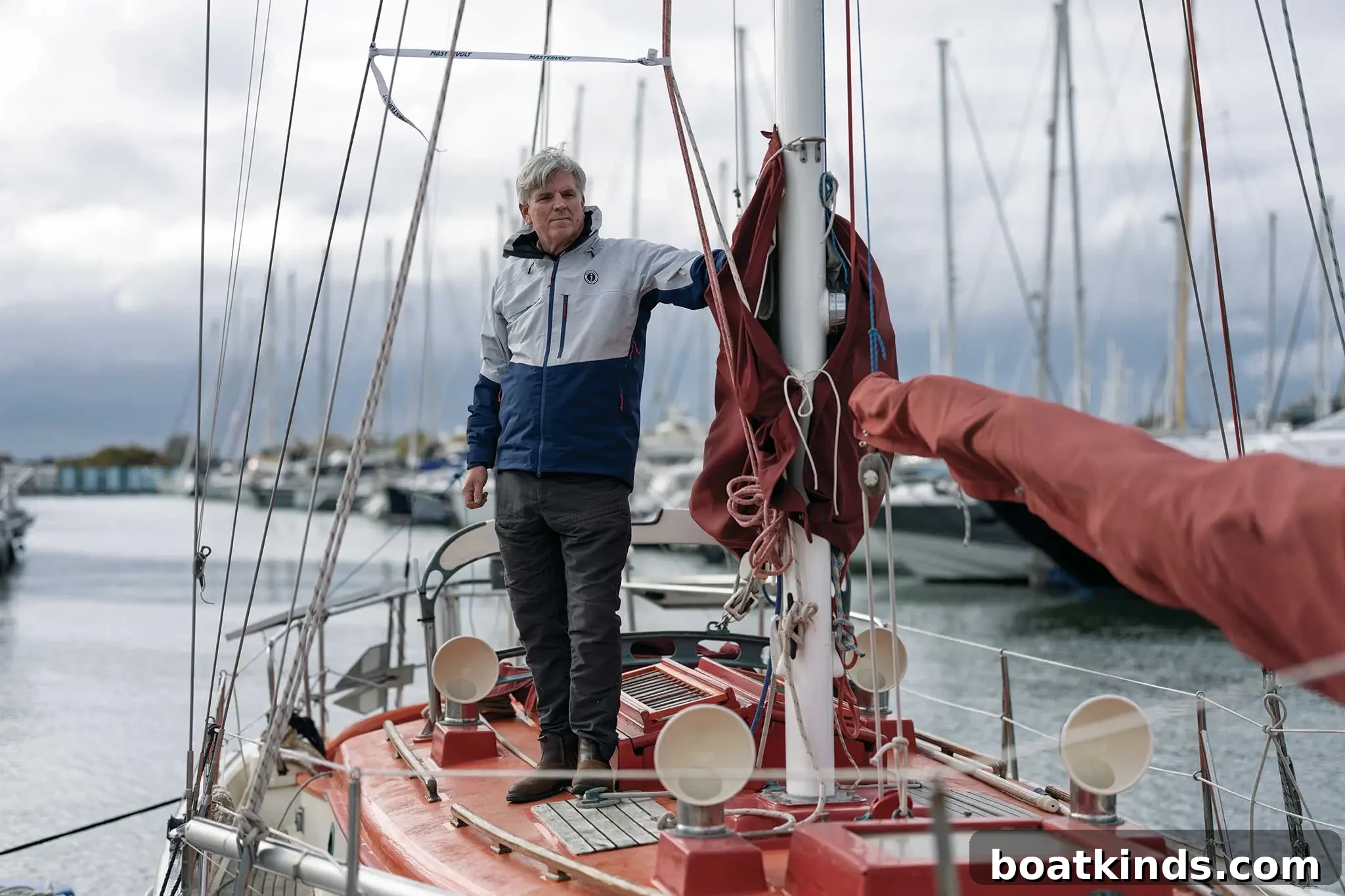
Gunnar Christensen will sail his Hans Christian 34 around the world in the Golden Globe Race, which begins Sept. 6 in France. Jason Ludlow
On a blustery, overcast late-spring day in England, I stand in the yard at Lymington Yacht Haven and look up at a boat propped on jackstands. She is an orange-and-white Hans Christian 34—a solid, full-keel double-ender built in 1978. Pompoen, nicknamed the Mighty Pumpkin, looks unmistakably seaworthy. She’d better be, because she will carry one of my favorite people around the world in the Golden Globe Race, which departs Les Sables-d’Olonne, France, on Sept. 6.
Gunnar Christensen, 60, grew up in Maine and has been on the water as long as he can remember. His professional life has taken him from yachts to research vessels, and for the past decade he has lived in the U.K., overseeing large yacht builds and refits. Those skills are now focused on preparing his boat for the 2026 edition of the Golden Globe Race (GGR).
The GGR—famously called the Voyage of Madmen—sends solo sailors on a 30,000-nautical-mile circumnavigation via the five Great Capes, in production full-keel boats of 32 to 36 feet built before 1988, and with minimal modern electronics. Modeled on the 1968 Sunday Times Golden Globe Race won by Sir Robin Knox-Johnston, the modern event preserves the spirit and hardship of the original. In an era of foiling, multimillion-dollar IMOCA yachts that can complete solo circumnavigations in weeks, the GGR remains a stark test of traditional seamanship, endurance and patience. It is slow, lonely and potentially perilous.
Gunnar’s decision to enter began with a casual conversation while racing on the Solent. A client suggested he enter the GGR—and then offered to pay the entry fee. With that prompt and the certainty that he wanted to race again, Gunnar agreed. “I thought, OK, why not? I’ll sail around the world,” he says.
He had been considering other classic cruisers like the Rustler 36 or Tradewinds 35 when I spotted the Hans Christian 34 listed for sale and sent him the link. The boat was ashore in Trinidad and Tobago after her owners’ plans changed. Gunnar flew to Port of Spain, inspected seacocks, sails and rigging, spent an hour learning the windvane, and then bought her.
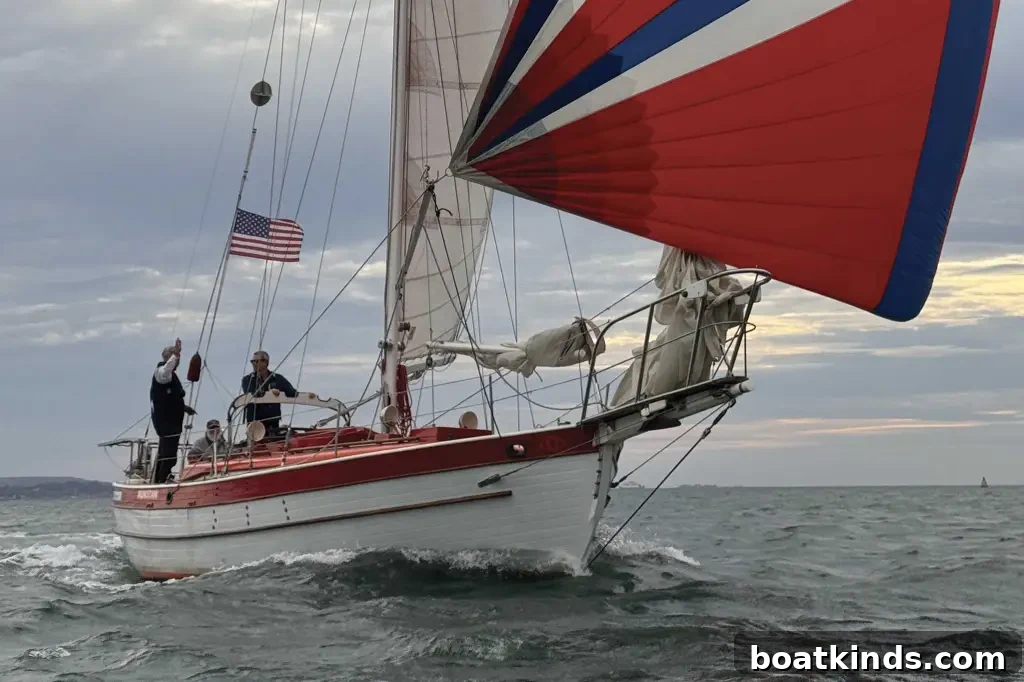
With hurricane season beginning, he watched the weather, provisioned the boat, and four days later sailed north through the Caribbean. After an eight-hour stop in Sint Maarten for stove fuel and a cheeseburger, he turned east and crossed the Atlantic. Pompoen handled beautifully; the provisioning plan was less successful. He arrived in Lymington 32 days later, looking both lean and exhilarated.
“It’s never necessarily a great call to take all your money and spend it sailing around the world,” Gunnar admits. “But moving to the south of England and racing again reminded me how much I love it. Work had crowded that out for a while. This race is a chance to do something I love, on my own terms.”
Below decks, Pompoen looks like a busy workshop: tools and parts everywhere, a recently mounted weatherfax near the chart table, a new battery bank and a full rewire underway. An SSB radio and cassette player are in place (no phones or tablets are allowed during the race). Completed upgrades include an enclosed cockpit entry, a new central water tank, AIS, a YB tracker, solar panels and controllers, Hydrovane self-steering gear, a hydrogenator, new engine controls, and a wood-burning stove intended for the Southern Ocean. Extensive sanding, varnishing and repainting have been carried out to prepare the hull and display sponsors’ names and logos.
Gunnar credits a dedicated support team: “I am so lucky. I have an amazing team of volunteers behind me. I could not do this without them.” He also has attracted multiple benefactors and a primary sponsor, the charity Seafarers Mental Health, which focuses on improving the mental health and wellbeing of seafarers worldwide and delivers mental health first-aid training in partnership with MHFA International.
“I could have funded this myself,” Gunnar says, “but the support helps me avoid wiping out my savings.” A new mast was one of those additions he might have skipped without sponsors; now Pompoen wears a mast topped with a Maine quarter design featuring the schooner Victory Chimes.
Although Gunnar has crossed the Atlantic four times, he had not sailed solo until his recent passage on Pompoen. Loneliness surprised him during that first solo leg, and he expects to face it again during more than 200 days at sea in the GGR. This time he’ll be better prepared with books and music on cassette and improved provisions. He takes comfort in the GGR community—knowing other skippers are facing similar trials provides a quiet reassurance.
One notable departure from the 1968 rules is modern safety equipment. Life rafts, EPIRBs, fleet tracking and communications are state-of-the-art; Don McIntyre, founder of the modern GGR, has prioritized safety from the start. For 2026 the race organization has invested in a bespoke black-box system that opens a one-way live window into conditions aboard seven boats. Gunnar has agreed to host one of these units. The feed transmits skipper heart rate, yacht pitch and roll, apparent wind speed and direction, speed and course over ground, plus intermittent live video. Sailors can choose to enable one of three onboard cameras; race HQ then takes over the feed. Although skippers receive no feedback from the system, the knowledge that friends and family can view the live window offers real comfort.
For the rest of us, that same system will offer a rare, vivid glimpse into what it takes to attempt one of the world’s most demanding solo sailing challenges.
RACE RESOURCES
For official details about the 2026 Golden Globe Race—entrant lists, rules and live tracking once the race begins—consult the race organizers’ published information. The modern GGR revived the original event for its 50th anniversary in 2018 and continues to run with a maximum fleet of 30 boats. To learn more about the history and personalities of the race, read Peter Nichols’ A Voyage for Madmen, which recounts the epic 1968 event. The 2022 race winner, Kirstin Neuschafer, demonstrated that the field welcomes skilled women as well as men. For information about Gunnar Christensen and his campaign, search for his official site and updates from his team.
This article was originally published in the August 2026 issue.